
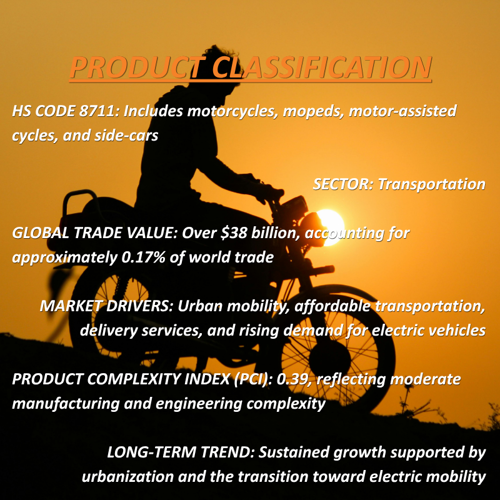
PRODUCT CLASSIFICATION
Motorcycles and cycles have become an essential part of global mobility, offering a practical, affordable, and increasingly sustainable means of transportation. From urban commuters and delivery riders to recreational enthusiasts, two-wheeled vehicles play a crucial role in both developed and emerging economies. Their versatility, fuel efficiency, and growing electrification have strengthened demand across a wide range of markets.
From a trade perspective, motorcycles and cycles belong to the Transportation sector and are classified under HS Code 8711, covering motorcycles (including mopeds), cycles fitted with auxiliary motors, and side-cars. The category includes everything from small-displacement commuter bikes to premium motorcycles and rapidly expanding electric two-wheelers.
Global trade in motorcycles and cycles is valued at approximately $38.3 billion, representing around 0.17% of total world trade. Over the last several years, the sector has recorded an average annual growth rate of approximately 6.2%, reflecting rising urbanization, increasing demand for cost-effective transportation, and the expansion of electric mobility solutions.
Among internationally traded products, motorcycles and cycles rank among the most significant transportation goods, with a Product Complexity Index (PCI) of 0.39, highlighting the combination of manufacturing expertise, engineering capabilities, and sophisticated supply chains required for production.
EXPORT
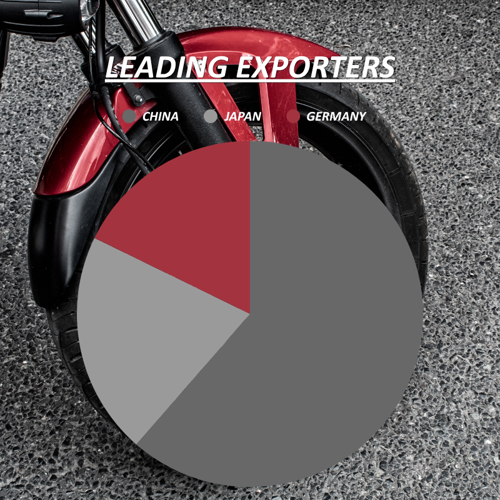
The global export market for motorcycles and cycles is dominated by a handful of major manufacturing nations with strong industrial ecosystems and internationally recognized brands.
The leading exporters are:
• China – approximately $11.2B
• Japan – approximately $3.8B
• Germany – approximately $3.24B
China is by far the world's largest exporter, accounting for roughly 29% of global motorcycle and cycle exports. Its leadership is driven by large-scale manufacturing capacity, competitive production costs, and a strong presence in both traditional and electric two-wheeler segments.
Japan remains a global powerhouse thanks to internationally renowned manufacturers, advanced engineering, and a reputation for reliability. German exports, meanwhile, are supported by premium motorcycle brands and a strong focus on high-performance and luxury segments.
Countries with the highest share of motorcycles and cycles within their overall export portfolios include:
• Togo – 1.76%
• Thailand – 0.88%
• Saint Pierre and Miquelon – 0.80%
These percentages highlight economies where the sector plays a particularly important role relative to total exports.
The largest trade surpluses are recorded by:
• China – +$10.8B
• Japan – +$3.05B
• India – +$2.81B
These surpluses reflect strong domestic manufacturing capabilities, established international brands, and competitive production costs that position these countries as global supply leaders.
IMPORT
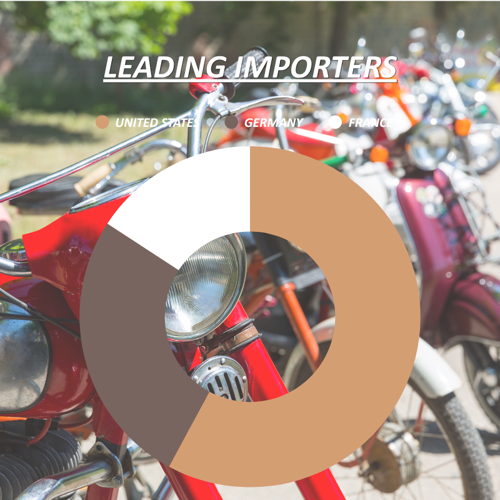
Demand for motorcycles and cycles is widespread across both developed and developing markets. Strong consumer demand, recreational use, urban mobility needs, and the growing popularity of electric vehicles continue to support import flows worldwide.
The leading importers are:
• United States – approximately $4.04B
• Germany – approximately $2.89B
• France – approximately $2.23B
The United States represents the largest importing market, driven by a combination of recreational motorcycle demand, premium vehicle purchases, and a diverse consumer base. Germany and France are major European destinations where motorcycles are used both for leisure and everyday mobility.
The largest trade deficits are registered by:
• United States ––$3.35B
• France ––$1.56B
• Philippines ––$1.27B
These deficits indicate a strong dependence on imported motorcycles and cycles to satisfy domestic demand, particularly in markets where consumption significantly exceeds local production.
MARKET INSIGHTS: THE RISE OF ELECTRIC TWO-WHEELERS
One of the most important developments in the industry is the rapid growth of electric motorcycles and scooters. Electric two-wheelers have become one of the fastest-growing segments within the broader mobility market, especially in Asia and Europe, where governments increasingly promote low-emission transportation solutions.
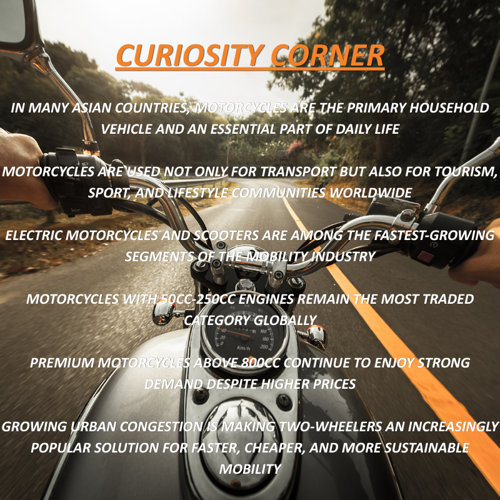
In fact, electric motorcycles represent more than $10 billion in global trade, making them one of the largest product categories within the sector. They have already become the second most traded sub-category after traditional motorcycles with engine capacities between 50cc and 250cc.
At the same time, motorcycles with engines between 50cc and 250cc account for approximately $12.4B in international trade, confirming their importance as the preferred solution for affordable daily transportation across much of the world. Premium motorcycles above 800cc generate roughly $7.24B in trade, demonstrating the continued strength of the high-end market.
CURIOSITY CORNER: THE GLOBAL CULTURE OF TWO WHEELS
Motorcycles are far more than a means of transport. In many countries, they are deeply embedded in local culture and everyday life. In Southeast Asia, motorcycles often serve as the primary household vehicle, while in Europe and North America they are frequently associated with leisure, tourism, and lifestyle communities.
The world's largest motorcycle-producing nations manufacture millions of units each year, supplying customers across every continent. Meanwhile, advances in battery technology, connectivity, and smart mobility are transforming motorcycles into increasingly sophisticated machines.
Another fascinating trend is the growing popularity of electric scooters and urban micro-mobility solutions. As cities become more congested, two-wheeled vehicles are increasingly viewed as a practical answer to traffic, parking shortages, and environmental concerns.
CONCLUSION
The global trade of motorcycles and cycles demonstrates the continuing importance of two-wheeled transportation in the modern economy. With a market valued at more than $38 billion, the sector benefits from strong international demand, advanced manufacturing capabilities, and the rapid expansion of electric mobility.
China, Japan, and Germany remain the leading exporting nations, while the United States, Germany, and France stand out as the largest import markets. Significant trade surpluses in Asia and notable deficits in major consumer economies illustrate the highly interconnected nature of global supply chains.
As urbanization, sustainability goals, and technological innovation continue to reshape transportation, motorcycles and cycles are likely to remain a key component of global mobility. From traditional combustion-engine models to next-generation electric vehicles, the sector is well positioned to play an increasingly important role in international trade and everyday transportation worldwide.