Green Trade: How ESG Policies Are Reshaping Global Trade
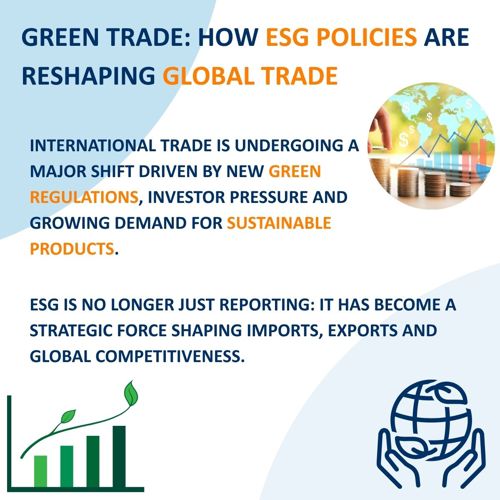
In recent years, international trade has been undergoing a profound transformation driven by three main forces:
- new green regulations,
- investor pressure,
- growing demand for sustainable products.
Environmental, Social and Governance (ESG) policies are no longer simple reporting tools, but they have become strategic levers influencing imports, exports, and the competitiveness of entire countries.
Europe as the Engine of the Green Trade Transition
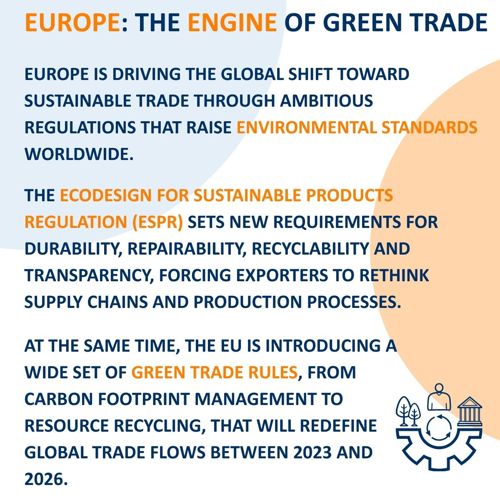
Europe has positioned itself as the driving force behind the global shift toward green trade, thanks to a comprehensive series of regulations designed to raise sustainability standards across international markets. One of the most impactful measures is the Ecodesign for Sustainable Products Regulation (ESPR), which has been in force since 2024 and requires companies to meet new criteria related to durability, repairability, recyclability, and full transparency through the Digital Product Passport. These obligations significantly affect exporters outside the EU, who must now rethink their supply chains, materials, and production processes to access the European market.
At the same time, the EU is rolling out an integrated set of green trade rules that span carbon footprint management, ecodesign requirements, resource recycling and sustainability verification. These regulations, which will be implemented progressively between 2023 and 2026, are set to profoundly reshape trade flows by demanding new environmental benchmarks from companies worldwide.
Impact on Global Supply Chains
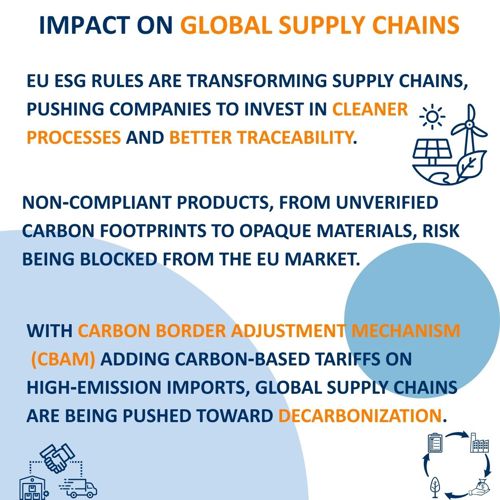
These policy developments are transforming global supply chains in ways that both challenge and stimulate companies involved in international trade. As compliance requirements become stricter, businesses must invest more heavily in lifecycle assessment tools, ESG auditing systems, and cleaner production technologies. The cost of these transformations can be substantial, yet they are increasingly unavoidable for exporters who want to maintain their presence in the EU market.
A further shift emerges from the EU’s determination to ensure environmental integrity: products failing to meet sustainability standards, whether due to unverifiable carbon footprints, opaque supply chains or non‑compliant materials, will simply be excluded from the European market. This raises the stakes for companies operating in sectors where sustainability documentation is difficult to obtain.
Equally impactful is the Carbon Border Adjustment Mechanism (CBAM), designed to prevent carbon leakage by imposing a carbon-based tariff on certain high‑emission imports. The mechanism encourages companies to upgrade their environmental performance rather than relocate production to jurisdictions with weaker environmental regulations, effectively pushing global supply chains toward decarbonization.
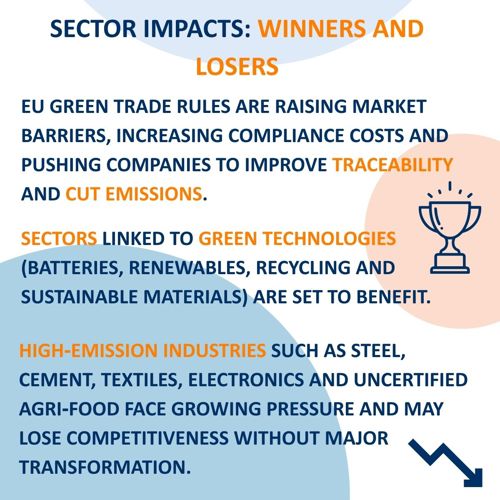
Sector Impacts: Winners and Losers
The EU’s new Green Trade Regulations will significantly affect exporters to the EU, introducing both major impacts and substantial challenges.
1. Impacts on Exporting Companies
- Higher market entry barriers:
Stricter carbon and environmental footprint standards will make it harder for non‑EU products to enter the EU market, potentially forcing some companies out. - Rising compliance costs:
Exporters will need to invest more in carbon footprint management, eco‑design, and certification, reducing overall profit margins. - More complex supply chain management:
Regulations require detailed environmental disclosure across the entire product lifecycle, increasing the need for transparency and complicating coordination among supply chain partners. - Weakened international competitiveness:
Costs linked to compliance may reduce price competitiveness and market share, reshaping global trade dynamics and weakening China’s position in the EU market.
2. Key Challenges for Companies
- Carbon footprint management:
Companies must adopt low‑carbon technologies and improve lifecycle data tracking. Many, especially SMEs, struggle with fragmented data, limited sharing mechanisms, and a technological gap compared to the EU. - Supply chain decarbonization:
Aligning upstream and downstream partners is difficult due to differing interests, uneven digital capabilities, limited data sharing, and inconsistent carbon regulations across countries. - Standards compatibility:
The EU requires assessment not only of carbon emissions but also 15 other environmental indicators. Many companies lack the tools, data, and experience needed to meet such comprehensive environmental footprint requirements.
The shift toward green trade inevitably creates winners and losers across different industries. Sectors connected to green technologies, such as battery production, renewable energy components, recycling, circular economy solutions and sustainable materials, are positioned to thrive, fueled by growing demand and regulatory alignment. This is especially evident in the electric vehicle industry, where the EU has introduced a detailed methodology for calculating and verifying the carbon footprint of EV batteries, making compliance both a challenge and an opportunity for companies able to innovate quickly.
Conversely, other sectors face increasing pressure as the EU tightens environmental requirements. Industries such as non‑decarbonized steel and cement, high‑impact textiles, electronics with insufficient supply chain transparency and uncertified wood and agricultural products are likely to struggle unless they undergo significant restructuring. Additional complexity is emerging from the EU Deforestation Regulation, whose implementation has recently been postponed but still hangs over exporters dealing in risk‑sensitive commodities.
Opportunities for Emerging Markets
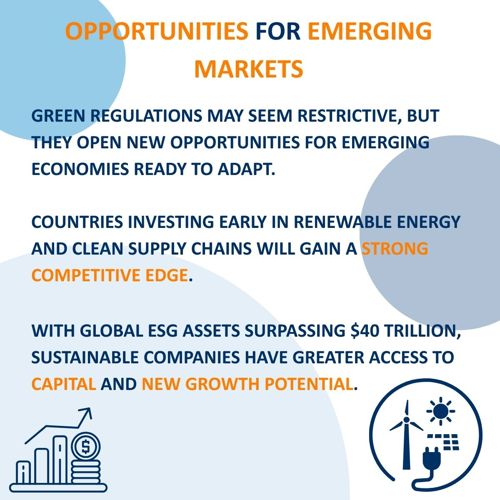
While green regulations may appear restrictive, they also represent a major opportunity for emerging economies ready to adapt.
New Competitiveness Drivers: Countries investing early in renewable energy and clean supply chains will gain significant advantages over those that lag behind.
Access to ESG Financing: Global ESG assets surpassed $40 trillion by 2025, giving sustainable companies a strong advantage in attracting capital.
What Companies Need to Do
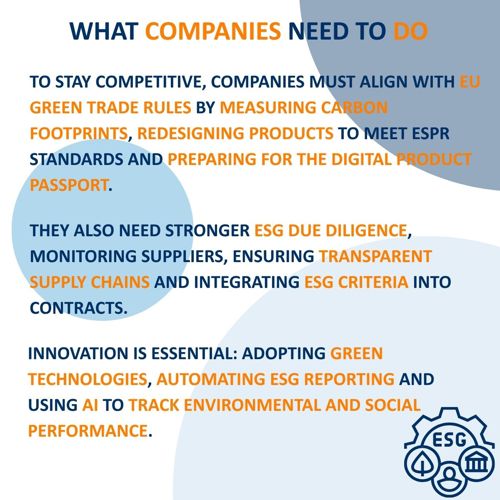
To remain competitive in this new landscape, companies should follow a three‑step strategy:
1. Regulatory Alignment
- implement carbon footprint calculation systems,
- adapt product design to ESPR requirements,
- prepare for the Digital Product Passport.
2. Strengthening ESG Due Diligence
Regulations such as CSRD, CS3D and CSDDD require businesses to:
- monitor direct and indirect suppliers,
- ensure supply chain transparency,
- integrate ESG obligations into contracts and procurement.
3. Innovation and Investment
- adopt green technologies,
- automate ESG reporting,
- use AI to monitor environmental and social indicators.
Conclusion
As global trade enters a new era shaped by sustainability, companies can no longer view ESG policies as mere regulatory hurdles but must instead recognize them as catalysts for long‑term competitiveness. The shift toward greener supply chains, transparent reporting, and lower‑impact production processes is redefining market access and reshaping the balance of power across industries. While the transition demands investment, adaptation, and strategic foresight, it also opens the door to innovation, new partnerships, and expanded opportunities, especially for businesses and emerging economies ready to align with the evolving expectations of regulators, investors, and consumers. In this landscape, embracing ESG is no longer optional: it is the foundation for resilient, future‑proof growth in the global marketplace.
Sources: External impacts of new EU sustainable product standards , EU Green Trade Regulations: Impacts and Responses – China-CEE Institute , Implications of the EU’s ESG regulatory framework - KPMG Belgium , ESG regulations and frameworks businesses need on their radar , 2025 ESG Wrap-Up and 2026 Outlook