
OVERVIEW
Brazil stands as one of the most influential economies in the Southern Hemisphere, combining vast natural resources, a large domestic market, and strong trade ties across continents. Ranked among the world’s top economies by GDP, the country plays a crucial role in global supply chains, particularly in agriculture, energy, and raw materials.
What makes Brazil especially interesting is its dual identity:
a modern emerging economy with advanced industrial sectors, yet still deeply rooted in commodity exports. This balance shapes not only its trade performance but also its resilience to global economic shifts.
From the fertile lands of Mato Grosso producing soybeans to offshore oil fields driving energy exports, Brazil’s economic engine is as diverse as its geography.
ECONOMIC PROFILE AND COMPLEXITY
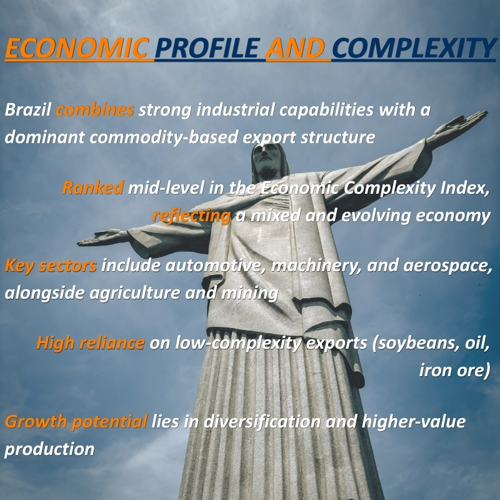
Brazil’s economic structure reflects a moderate level of diversification. According to the Economic Complexity Index (ECI), it sits roughly mid-ranking globally, highlighting an economy that combines both sophisticated and less complex exports.
On one side, Brazil has developed industrial capabilities in sectors like automotive, aerospace (notably Embraer), and machinery. On the other, a significant share of its export value still comes from primary goods, an indicator of lower complexity.
This combination creates an interesting paradox:
• Strength: High competitiveness in large-scale commodity production.
• Limitation: Exposure to global price cycles and demand fluctuations.
Despite this, Brazil’s scale and resource endowment give it a strong position in global trade networks, especially in feeding the world’s growing demand for food and energy.
EXPORTS
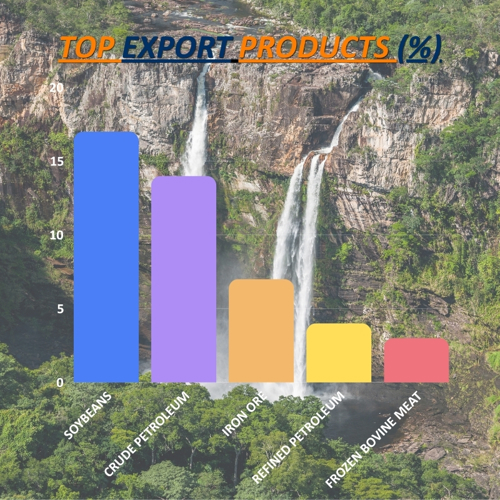
Brazil’s export basket is heavily dominated by commodities, with a few key products accounting for a large share of total value. The country exports hundreds of billions of dollars’ worth of goods annually, placing it among the world’s top exporters.
TOP EXPORT PRODUCTS
• Soybeans – the leading export item, driven by demand from Asia
• Crude Petroleum – rapidly growing thanks to offshore production
• Iron Ore – essential for global steel manufacturing
• Refined Petroleum Products
• Frozen Bovine Meat
These categories reveal a strong reliance on:
• Agriculture
• Extractive industries
• Energy
KEY EXPORT DESTINATIONS
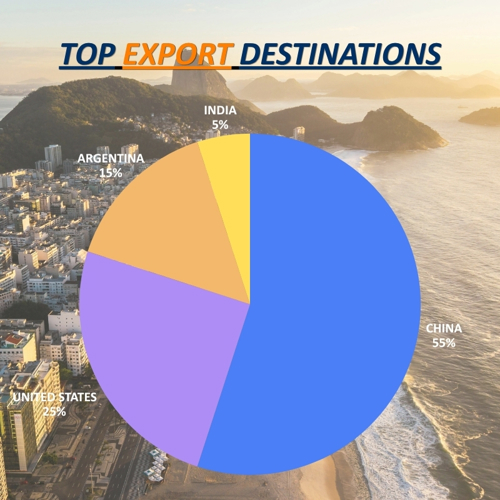
• China (by far the largest partner)
• United States
• Argentina
• India
• Netherlands
China alone absorbs a significant portion of Brazil’s exports, particularly agricultural and mineral products, making the bilateral relationship central to Brazil’s trade strategy.
IMPORTS
On the import side, Brazil tells a different story, one of industrial demand and technological dependence.
The country imports a wide range of goods, totaling hundreds of billions of dollars annually.
TOP IMPORT PRODUCTS
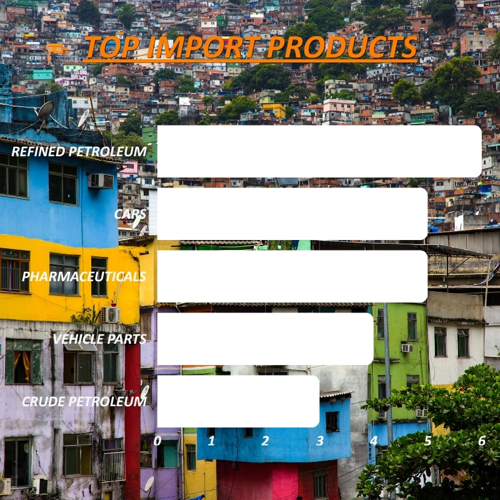
• Refined Petroleum
• Passenger Cars
• Pharmaceuticals (packaged medicaments)
• Vehicle parts and components
• Crude petroleum
These imports reveal key structural needs:
• Energy inputs (despite being an exporter)
• Advanced manufacturing components
• Healthcare-related goods
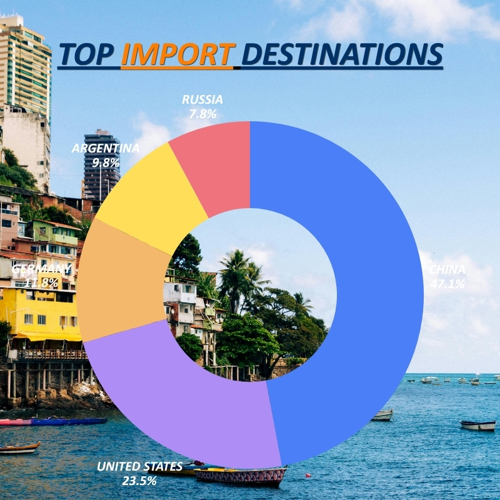
MAIN IMPORT PARTNERS
• China
• United States
• Germany
• Argentina
• Russia
China again plays a dominant role, but this time as a supplier of manufactured goods, reinforcing a complementary (yet asymmetric) trade relationship.
TRADE BALANCE
Brazil consistently maintains a positive trade balance, exporting more goods than it imports.
Recent trade data shows:
• Annual exports exceeding $300 billion
• Imports significantly lower, resulting in a strong surplus
On a monthly basis, the trend continues, with exports regularly outpacing imports and generating solid surpluses.
What Drives the Surplus?
• High global demand for commodities
• Competitive agricultural sector
• Strong energy exports
RISK FACTORS
• Commodity price volatility
• Dependence on a limited number of export categories
• Exposure to major partners like China
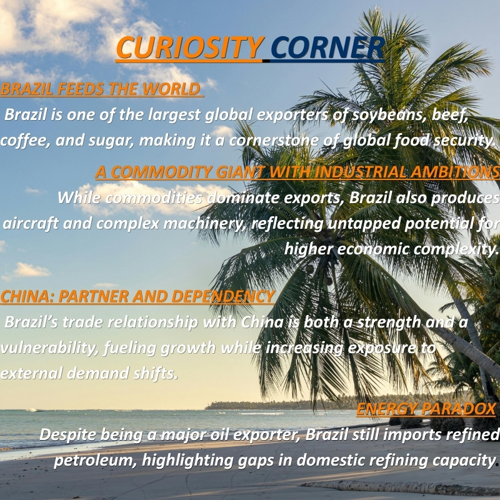
CURIOSITY CORNER
1. Brazil feeds the world
Brazil is one of the largest global exporters of soybeans, beef, coffee, and sugar, making it a cornerstone of global food security.
2. A commodity giant with industrial ambitions
While commodities dominate exports, Brazil also produces aircraft and complex machinery, reflecting untapped potential for higher economic complexity.
3. China: partner and dependency
Brazil’s trade relationship with China is both a strength and a vulnerability, fueling growth while increasing exposure to external demand shifts.
4. Energy paradox
Despite being a major oil exporter, Brazil still imports refined petroleum, highlighting gaps in domestic refining capacity.
CONCLUSION
Brazil’s trade profile is a story of scale, resources, and strategic positioning. As one of the world’s largest exporters of agricultural and natural resources, it plays a vital role in global supply chains.
However, its future growth will likely depend on:
• Increasing economic complexity
• Expanding industrial capabilities
• Reducing reliance on commodity cycles
For businesses, analysts, and policymakers, Brazil offers a compelling mix of opportunity and challenge, a market where raw potential is abundant, but transformation is still underway.