PRODUCT CLASSIFICATION
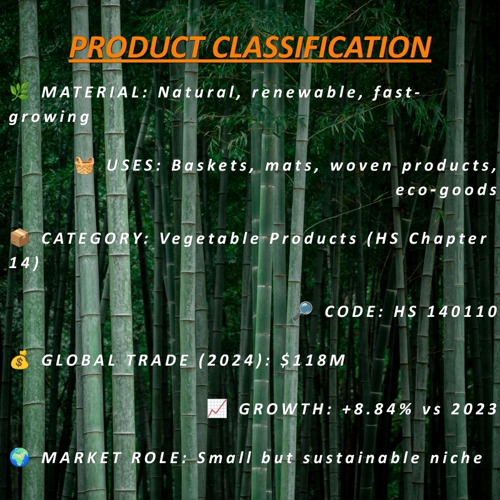
Bamboo is one of the most versatile natural materials in the world, widely appreciated for its strength, flexibility, and sustainability. Fast-growing and renewable, bamboo plays a crucial role in both traditional craftsmanship and modern eco friendly industries. When used primarily for plaiting, it becomes a key raw material for producing baskets, mats, furniture elements, and a wide range of woven products used across households and commercial sectors.
From a trade perspective, bamboos used for plaiting fall under the Vegetable Products category, specifically within HS Chapter 14: Vegetable plaiting materials, classified under HS6 code 140110. Despite being a relatively simple and low processed material, bamboo holds economic significance due to its importance in artisanal industries, sustainable manufacturing, and rural economies.
In 2024, global trade in bamboo used primarily for plaiting reached $118M, marking an 8.84% increase compared to $108M in 2023. Over the past five years, however, the sector has remained relatively stable, with a slight annual decline of –0.11%, reflecting shifting demand patterns and competition from synthetic alternatives.
Among the 5,380 products traded globally, bamboo for plaiting ranked 4,391st, accounting for less than 0.005% of total world trade, highlighting its niche but specialized role within global commerce.
EXPORT
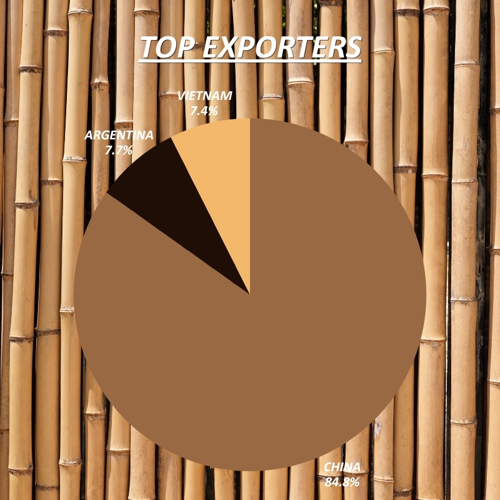
In 2024, global exports of bamboo for plaiting were dominated by a small group of countries with strong production capacity and established supply chains.
The top exporters were:
• China – $79.3M
• Argentina – $7.23M
• Vietnam – $6.93M
China overwhelmingly leads the market, thanks to its vast bamboo resources, well-developed processing industry, and long-standing tradition in bamboo craftsmanship; the country serves as a primary supplier to both developed and emerging markets. Argentina and Vietnam, although much smaller in scale, play important regional roles, supplying raw materials to nearby manufacturing hubs and export-oriented industries.
Export performance in this sector is often linked to natural resource availability rather than technological complexity. Countries rich in bamboo forests benefit from low production costs and an established base of traditional skills, allowing them to remain competitive even in a relatively small global market.
IMPORT
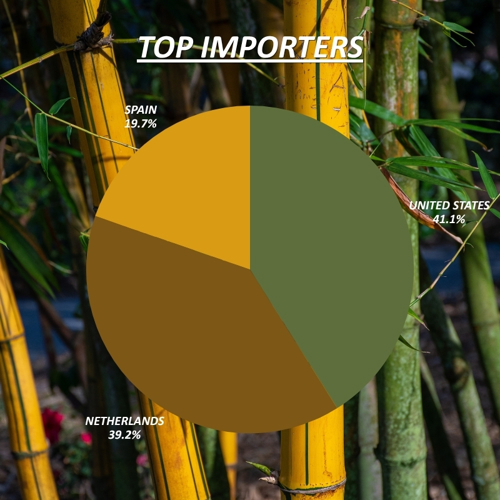
On the demand side, imports are concentrated in countries with strong manufacturing, retail, or consumption markets for woven products and eco-friendly materials.
The top importers in 2024 were:
• United States – $17.9M
• Netherlands – $17.1M
• Spain – $8.59M
The United States represents the largest consumer market, driven by demand for sustainable products, home décor, and garden materials. The Netherlands acts as a key European distribution hub, re-exporting bamboo products across the continent thanks to its advanced logistics network. Spain, meanwhile, reflects stable Mediterranean demand linked to furniture, construction, and artisanal goods.
Import patterns show how bamboo, despite being a natural raw material, is deeply integrated into global value chains, often processed in one country and consumed in another.
CURIOSITY CORNER: THE HIDDEN STORY BEHIND BAMBOO
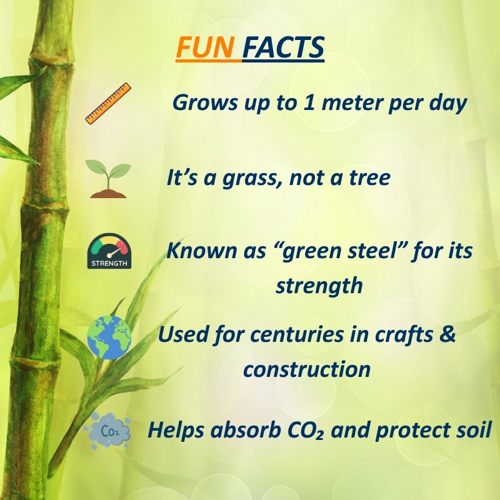
Bamboo is often called “green steel,” and for good reason. Some species grow up to one meter per day, making bamboo one of the fastest-growing plants on Earth. Its rapid regeneration makes it a symbol of sustainability and a powerful ally in reducing environmental impact.
Beyond trade, bamboo has deep cultural roots. In many Asian countries, it has been used for centuries in construction, art, music, and daily life. From traditional baskets and paper to modern textiles and even biodegradable packaging, bamboo continues to evolve with new applications.
Interestingly, bamboo is not actually a tree but a type of grass. Despite this, its strength rivals that of hardwood, and it can even be used in structural applications such as scaffolding and housing.
Another fascinating aspect is its environmental impact; bamboo forests can absorb significant amounts of carbon dioxide and help prevent soil erosion, making them essential in sustainable land management practices.
CONCLUSION
The global trade of bamboo used for plaiting in 2024 highlights the importance of niche natural materials within international markets. Although relatively small in value compared to major agricultural commodities, bamboo plays a crucial role in supporting sustainable production, traditional craftsmanship, and rural economies.
China remains the dominant exporter, while countries like the United States and the Netherlands drive demand through strong consumption and distribution networks. The sector’s modest size and low complexity do not diminish its relevance, on the contrary, bamboo represents a growing intersection between trade, sustainability, and innovation.
As global attention increasingly shifts toward environmentally friendly materials, bamboo is well positioned to expand its role in international trade. Combining ancient tradition with modern applications, it stands as a product rooted in nature yet aligned with the future of sustainable development.