
OVERVIEW
The United Kingdom, a country that bridges centuries of global influence with a highly developed modern economy, remains one of the world’s most significant financial, commercial, and technological hubs. Home to London, one of the leading centers for finance, innovation, aviation, and services, the UK combines a diversified industrial base with a strong international orientation.
A founding nation of the global trading system, the UK maintains deep connections with Europe, North America, and Asia, despite the structural shifts following Brexit. Its economy is driven by services, particularly finance, professional services, creative industries, and high‑tech manufacturing, alongside important contributions from aerospace, automotive, pharmaceuticals, and energy.
In 2024, the United Kingdom ranked:
- 6th in GDP, with $3.69T
- 14th in total exports
- 5th in total imports
- 23rd in GDP per capita (current US$)
These indicators confirm the UK’s status as a top global economy with significant trade flows, high income levels, and strong industrial capabilities.
TRADE OVERVIEW
In 2025, the United Kingdom recorded a significant trade imbalance.
In December 2025, the UK:
- Exported £30.1B
- Imported £70.8B
- resulting in a negative trade balance of £40.7B
Compared to December 2024, exports fell sharply by £6.69B (–18.2%), while imports rose by £18.9B (+36.3%), reflecting both weakening export performance and a strong increase in demand for foreign goods, especially gold and high‑value commodities.
Key export and import points included major hubs such as London Heathrow, Dover/Eurotunnel, Southampton, and Immingham, confirming the strategic role of these ports and airports in UK trade.
EXPORT
In 2024, the United Kingdom exported $417B, making it the 14th largest exporter globally.
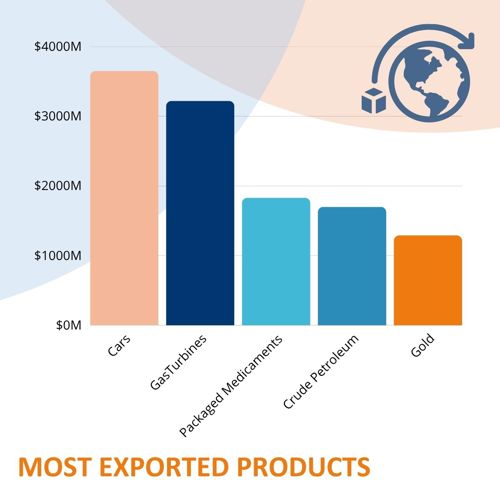
The most important export products were:
- Cars – $36.5B
- Gas Turbines – $32.2B
- Packaged Medicaments – $18.3B
- Crude Petroleum – $17B
- Gold – $12.9B
In December 2025 specifically, top export categories included:
- Gas Turbines – £3.4B
- Cars – £1.96B
- Aircraft parts – £1.04B
- Gold – £1.04B
The United Kingdom’s export structure reflects strong capability in aerospace, automotive, pharmaceuticals, and energy, supported by advanced manufacturing and research-intensive industries.
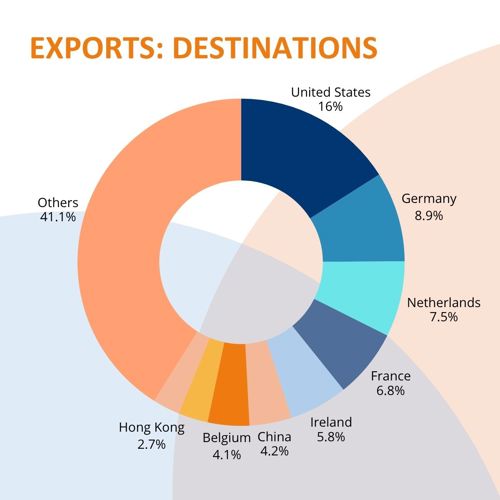
The main export destinations were:
- United States – $66.5B / £4.13B in Dec 2025
- Germany – $37.1B / £2.4B
- Netherlands – $31.2B / £2.05B
- France – $28.5B / £1.8B
- Ireland – $24.1B / £1.9B
These countries are long-standing strategic partners, reflecting deep economic ties across the Atlantic and within Europe.
The most significant declines by product were:
· Gold (-£7.55B)
· Cars (-£327M)
· Silver (-£301M)
IMPORT
In 2024, the UK imported $728B, ranking as the 5th largest importer in the world.
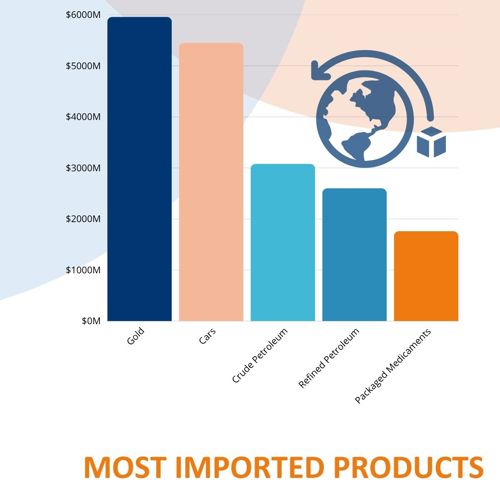
Its main imports were:
- Gold – $59.6B
- Cars – $54.5B
- Crude Petroleum – $30.8B
- Refined Petroleum – $26B
- Packaged Medicaments – $17.6B
In December 2025, top import categories mirrored broader annual trends:
- Gold – £21.1B
- Cars – £3.5B
- Gas Turbines – £2.22B
- Refined Petroleum – £1.69B
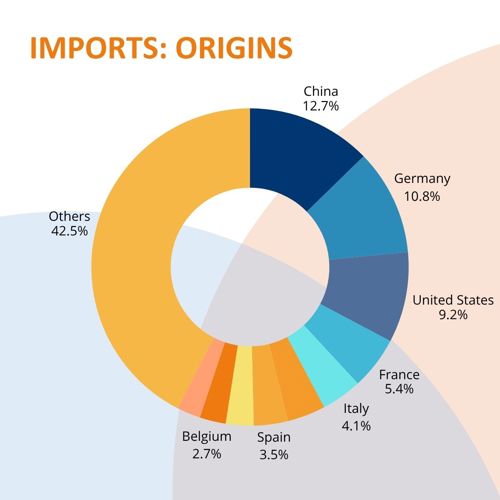
The most important import origins were:
- China – $92.3B / £5.32B in Dec 2025
- Germany – $78.5B / £5.77B
- United States – $67.1B / £6.86B
- France – $39.3B
- Norway – $30.8B
Year-on-year import growth in 2025 was driven by strong increases from:
- Switzerland (+£9.27B)
- Canada (+£2.25B)
- Hong Kong (+£1.77B)
Notable increases in imported goods included:
- Gold (+£14.9B)
- Silver (+£1.02B)
- Gas Turbines (+£787M)
CURIOSITY CORNER
One of the UK’s most unusual economic traits is its position as a global hub for gold trading. London hosts one of the world’s largest bullion markets, and as a result, UK trade flows show extremely high values of gold imports and exports, often unrelated to domestic production, but tied to financial transactions and global investment strategies.
Another interesting aspect is the UK’s leadership in creative industries, a sector valued globally for music, film, design, publishing and gaming. British cultural exports, from blockbuster films to globally recognized bands, contribute billions to the economy and strengthen the nation's soft power worldwide.
Additionally, despite its size, the UK is home to some of the most advanced aerospace engineering capabilities in the world, especially in gas turbine and aircraft component manufacturing, industries that remain powerful engines of UK export performance.

CONCLUSION
The United Kingdom remains a major global economic force, driven by advanced industries, strong international connections, and a highly diversified portfolio of goods and services. Despite recent declines in exports and a widening trade deficit, driven largely by volatility in gold markets and reduced shipments to key partners, the country maintains competitive strengths in aerospace, automotive, pharmaceuticals, and financial services.
With deep integration in global supply chains and long-standing economic ties with both European and transatlantic partners, the UK continues to play a central role in global trade, investment, and innovation. While structural imbalances persist, the UK's combination of world-class industries, innovation capacity, and strategic geographic position supports its resilience and long-term economic relevance.