PRODUCT CLASSIFICATION
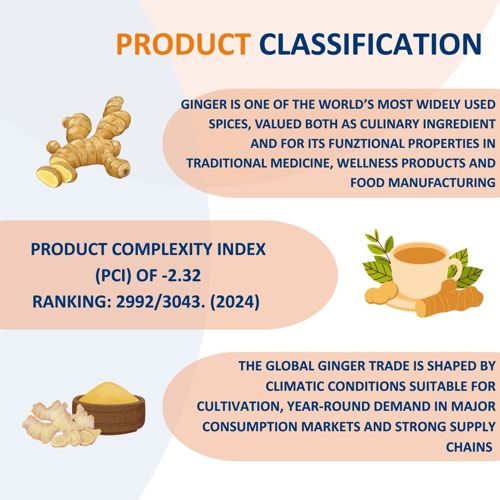
Ginger (Zingiber officinale) is one of the world’s most widely used spices, valued both as a culinary ingredient and for its functional properties in traditional medicine, wellness products, and food manufacturing. Its pungent aroma, fibrous texture, and heat-stable flavor make it essential in cuisines across Asia, Europe, Africa, and the Americas. Beyond fresh rhizomes, ginger is traded globally in dried, ground, preserved, and processed forms, each requiring specific handling to maintain volatile oils and aromatic quality.
In international trade, ginger is classified within the Vegetable Products section, specifically in HS Chapter 09: Coffee, tea, maté & spices, under the HS4 category “Spices.” This classification reflects its role as an agricultural spice crop with relatively low technological complexity but high global culinary relevance.
In 2024, global trade of ginger reached $1.51B, marking a 11.4% increase from $1.36B in 2023. Over the past five years, trade in this category expanded at an annual rate of 6.7%, demonstrating strong, consistent demand driven by health-conscious consumer trends and diversified uses in food, beverages, and natural remedies.
Among 5,024 products traded worldwide in 2024, ginger ranked 1760th, accounting for 0.0066% of global trade value. According to the Product Complexity Index (PCI), ginger ranked 2992nd out of 3043 products, with a PCI score of –2.32, positioning it among the least complex products in international trade, consistent with its role as a raw, minimally processed agricultural commodity.
The global ginger trade is shaped by climatic conditions suitable for cultivation, year-round demand in major consumption markets, and strong supply chains linking Asian producers with North American and European import hubs.
EXPORT
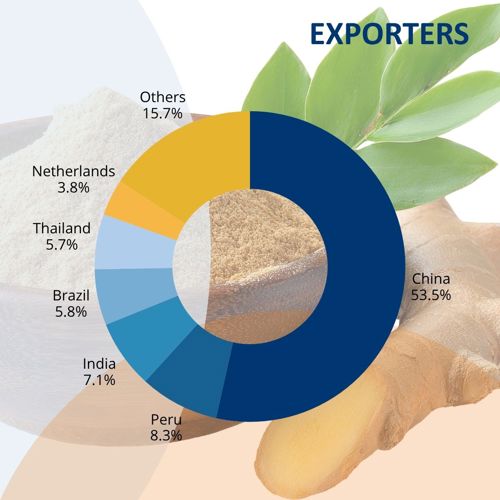
In 2024, the leading exporters of ginger were:
- China – $810M
- Peru – $125M
- India – $108M
China dominates global exports thanks to extensive cultivation in provinces like Shandong, Guangxi, and Yunnan, combined with large-scale drying, processing, and packaging capacity. Peru’s rise reflects growing international demand for high-quality organic ginger, particularly in North America and Europe. India, historically one of the largest producers, continues to expand its export presence through both fresh and processed ginger varieties.
Countries with the highest share of ginger in their export portfolios in 2024 were:
- Aruba – 0.42%
- Dominica – 0.37%
- Nepal – 0.35%
These high percentages highlight the relevance of ginger as an export specialty for some smaller economies and agricultural producers.
The largest trade surpluses in 2024 were recorded by:
- China – $807M
- Peru – $125M
- India – $93.1M
These surpluses reflect strong production capacity paired with solid international demand, particularly for dried and processed ginger.
IMPORT
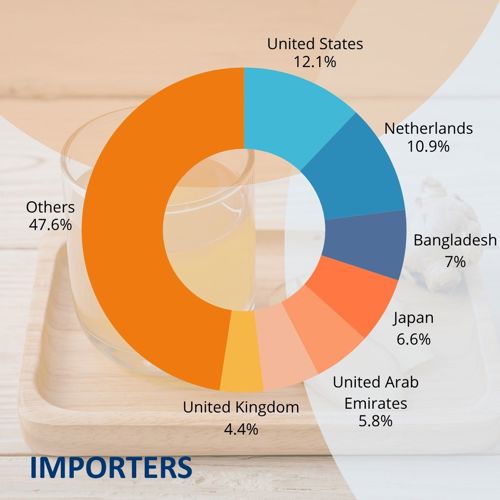
In 2024, the main importers of ginger were:
- United States – $183M
- Netherlands – $165M
- Bangladesh – $107M
The United States remains one of the largest global consumers due to widespread use in the food industry, nutraceuticals, beverages, and ethnic cuisines. The Netherlands acts as a major re-export hub within Europe, distributing imported ginger to Germany, the UK, and Scandinavia. Bangladesh’s high import volumes reflect strong domestic consumption and limited local production relative to demand.
Countries with the largest trade deficits in 2024 were:
- United States – –$178M
- Netherlands – –$108M
- Bangladesh – –$106M
These deficits are directly linked to high consumption levels, limited domestic output, and in the case of the Netherlands, a strategic role in intra-European redistribution.
CURIOSITY CORNER: THE CULTURAL AND BOTANICAL FASCINATION OF GINGER
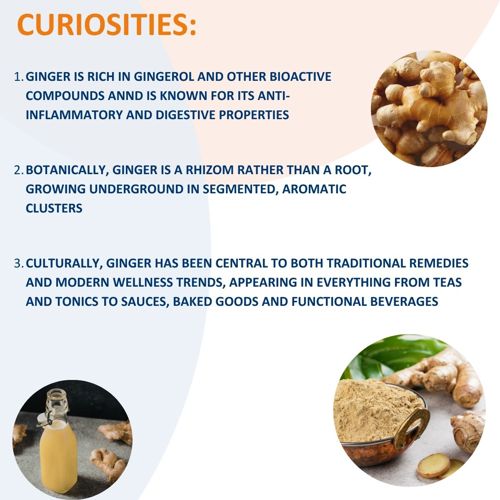
Ginger has been cultivated for over 3,000 years, with origins in Southeast Asia and a long history in Ayurvedic and Chinese medicine. Rich in gingerol and other bioactive compounds, it is known for its anti-inflammatory and digestive properties. This dual identity – culinary and medicinal – has contributed to its enduring global appeal.
Botanically, ginger is a rhizome rather than a root, growing underground in segmented, aromatic clusters. Its adaptability to tropical and subtropical climates explains why it is grown extensively across Asia and Latin America. While fresh ginger is prized for its pungency and moisture, dried ginger delivers a more concentrated flavor profile, making it ideal for industrial applications.
Culturally, ginger has been central to both traditional remedies and modern wellness trends, appearing in everything from teas and tonics to sauces, baked goods, and functional beverages. Its strong aromatic profile and versatility have made it a staple that bridges centuries-old traditions and contemporary consumer habits.
CONCLUSION
The global ginger trade in 2024 reflects the strong and growing worldwide demand for this versatile spice. With an 11.4% year-over-year increase and a solid five-year growth trajectory, ginger continues to expand its role in international markets. Major exporters like China, Peru, and India leverage their agricultural strengths, while leading importers such as the United States and the Netherlands demonstrate the spice’s widespread culinary and commercial importance.
Despite its low product complexity, ginger relies on coordinated global supply chains, specialized drying and processing infrastructure, and health-driven consumer trends. As interest in natural ingredients, wellness products, and ethnic cuisines continues to rise, ginger is poised to remain a dynamic and expanding segment of the global spice trade.