
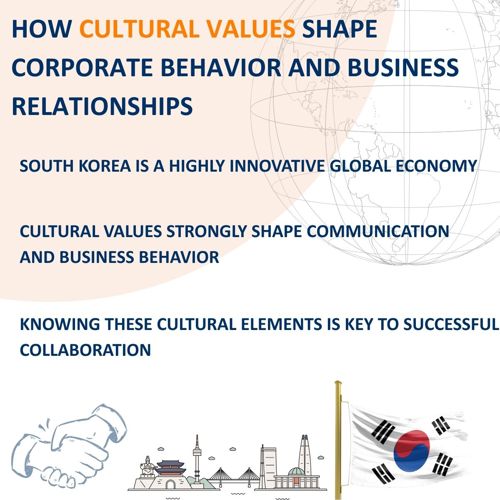
South Korea has transformed into one of the world’s most dynamic and innovative economies, home to global giants such as Samsung, Hyundai, and LG. But behind the country’s technological and industrial success lies a deeply rooted cultural framework that influences how Korean professionals communicate, negotiate, and build business relationships.
Understanding these cultural elements is essential for anyone looking to work or partner with South Korean companies and can make the difference between a smooth collaboration and a potentially challenging one.
THE INFLUENCE OF CONFUCIAN VALUES
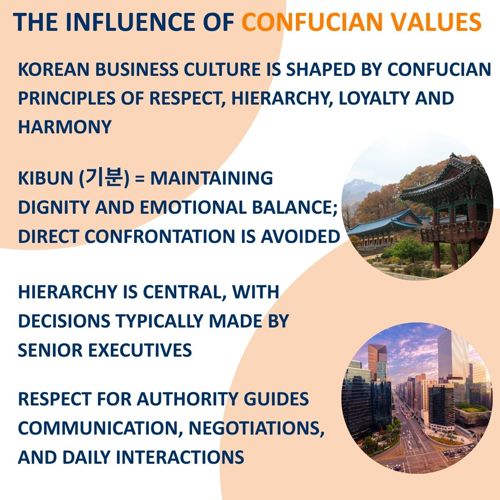
Korean business culture is strongly shaped by Confucian principles, which emphasize respect, hierarchy, loyalty, and harmony.
These values manifest in several key concepts:
Kibun (기분) Kibun refers to maintaining dignity and emotional harmony in both personal and professional relationships. In business contexts, Koreans avoid direct confrontations and negative responses to preserve kibun. They may agree to consider proposals even when unlikely to proceed, making it crucial for international professionals to recognize these communication subtleties.
Hierarchy and Authority Korean businesses operate with clear hierarchical structures where decisions are typically made at the executive level. Respect for authority is paramount, and subordinates consistently defer to senior leadership during meetings and negotiations.
FIRST IMPRESSION
BUILDING TRUST FIRST
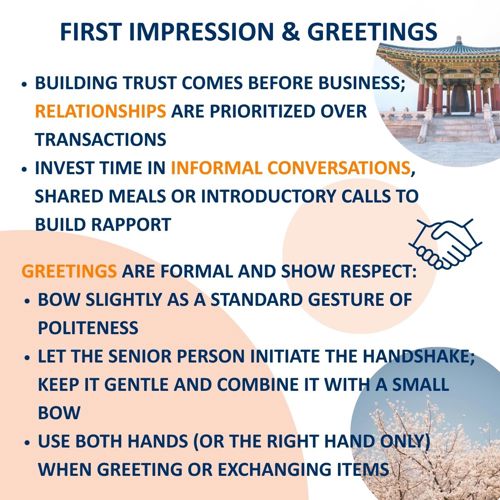
Relationships take priority over transactions. Many Korean professionals expect to know and trust their partners before moving to contractual details.
Practical takeaway: Invest time in informal discussions, shared meals, or introductory calls to establish rapport.
GREETING PROTOCOL
In Korea, the way you greet others plays an important role in establishing respectful professional interactions:
Bowing:
A small bow, hands resting at your sides or lightly held together, is the customary way to greet someone, bid farewell, or express an apology.
Handshakes:
Allow the more senior individual to offer a handshake first. A gentle handshake combined with a slight bow conveys courtesy. Keep in mind that overly firm handshakes are generally viewed as impolite or inappropriate in Korean etiquette.
Use of hands:
When greeting someone or exchanging items, use both hands or only your right hand. Relying solely on the left hand is traditionally considered unlucky and can carry negative connotations.
BUSINESS ETIQUETTE:
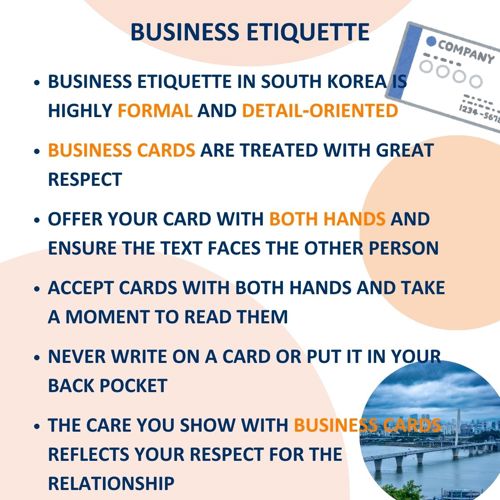
South Korean business etiquette is highly codified, and even small details can carry significant meaning.
In Korean professional settings, business cards (meishi) are treated with great respect and must be handled with care.
Presenting a Card:
- Offer your card using both hands.
- Make sure the printed side faces the other person so they can read it immediately.
- It is advisable to have one side of your card translated into Korean.
- Bring plenty of cards to every meeting.
Receiving a Card:
- Accept the card with both hands, or with your right hand if you use one.
- Take a moment to look over the card: this shows genuine interest.
- Place the card face-up on the table in front of you until everyone is seated.
- Avoid writing on the card.
- Never put it in your back pocket, as this is considered highly disrespectful.
- Keep the card in a proper card case or place it neatly on the table.
The care you show when giving or receiving a business card reflects the level of respect you intend to show in the business relationship.
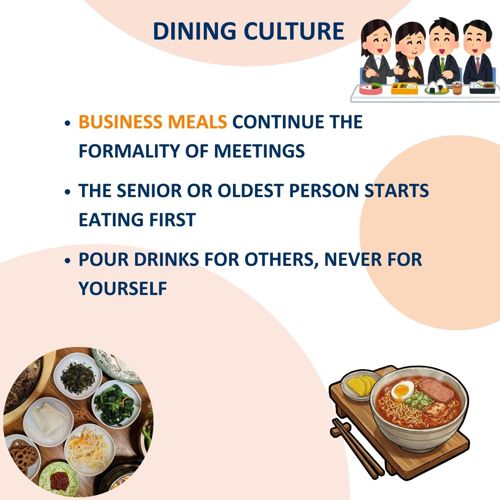
Dining Culture
Business meetings often continue over meals, where hierarchy again plays a role: the oldest or highest-ranking person begins eating first.
Drinking etiquette is also important: it is customary to pour drinks for others, not for oneself.
A Blend of Tradition and Innovation
Despite its traditional values, South Korea is also one of the world’s most digitally advanced and innovation-driven markets. Modern Korean companies increasingly integrate global practices (agile methods, flat teams, remote collaboration) while still maintaining the cultural foundations discussed above.
The result: a fascinating blend of precision, loyalty, creativity, and technological excellence.
PROFESSIONAL APPEARANCE AND PUNCTUALITY
Dress Code
Business attire in Korea tends to be traditional and formal, and projecting a polished, conservative image is important.
For Men:
- Dark-colored suits such as navy, black, or charcoal
- Subtle, classic ties
- Well-maintained dress shoes
- Overall muted tones
For Women:
- Professional, tailored business outfits
- Modest cuts for both skirts and necklines
- Conservative styling and accessories
- understated colors and designs
Bright colors, casual items, or overly fashion-forward clothing may be seen as inappropriate or disrespectful. In Seoul’s corporate culture, it is generally safer to dress more formally than less.
Punctuality
Arriving on time, ideally 10 to 15 minutes ahead of schedule, is considered essential. Being punctual is a sign of respect and professionalism. Even minor delays can be viewed as a lack of seriousness or dedication. Make sure to plan accordingly and allow time for unforeseen inconveniences.

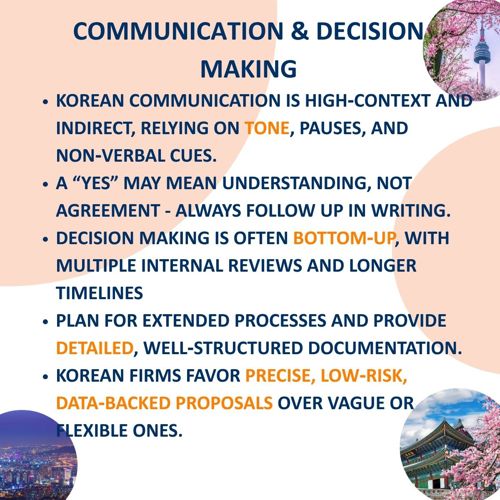
COMMUNICATION STYLE: HIGH‑CONTEXT AND INDIRECT
Korea is a high‑context culture, meaning communication relies heavily on implicit messages, non‑verbal cues, and the overall atmosphere rather than direct words.
Indirect Expressions
A “yes” does not always mean full agreement; sometimes it simply means “I understand” or “I will consider it.”
Practical takeaway: Pay attention to tone, pauses, and body language. Follow up in writing to confirm mutual understanding.
Decision‑Making: Consensus, Patience, and Precision
Korean companies often adopt a bottom‑up decision-making process, where teams analyse details thoroughly before escalating decisions to upper management.
Longer Timelines
The process can require several internal reviews, which may extend negotiation periods.
Practical takeaway: Plan longer lead times and provide detailed documentation to facilitate internal discussions.
Risk Aversion and Thorough Preparation
Korean firms prefer well-structured proposals with clear risk assessment, quality guarantees, and long-term perspectives.
Practical takeaway: Present data-backed solutions and avoid overly flexible or vague proposals.
NEGOTIATIONS
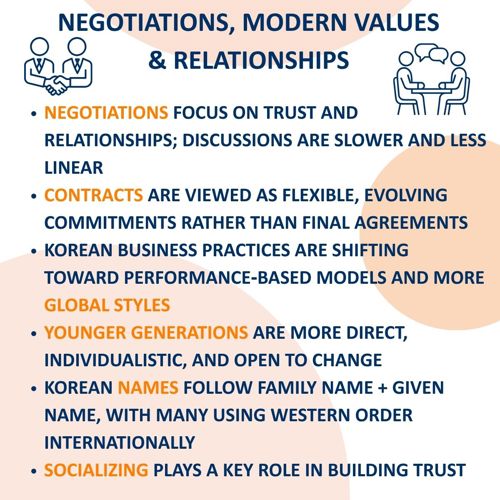
Building strong personal relationships is a key step before entering negotiations in South Korea. Discussions tend to be slower, less linear, and not as strictly agenda‑based as in many Western countries. Agreements often require close follow‑up, as contracts are viewed more as evolving commitments within the relationship rather than rigid, final documents.
South Korea’s business landscape is also changing rapidly. Traditional systems, such as seniority‑based pay or paternalistic management, are gradually giving way to performance‑based models and a more individualistic approach. Practices like entertainment during negotiations are becoming less common.
As Korean companies globalize, many negotiators are increasingly familiar with Western styles, partly because a growing number have studied abroad. Still, you should research your counterpart in advance and avoid relying on outdated cultural stereotypes, the range of negotiation styles is wider today than ever.
MODERN VALUES
While Confucian principles still influence society, their impact has weakened, especially among younger generations who tend to be more individualistic, direct, and equality‑focused. Many reject traditional gender roles and are comfortable with more open communication.
Korean society remains more reserved than most Western cultures, and academic achievement continues to be highly valued. A strong emphasis on hard work persists, though companies and employees are increasingly prioritizing a better work–life balance.
NAMING CONVENTIONS
Korean names follow the order family name + given name (e.g., KIM Min Su). Romanization varies greatly, so the same Korean name may appear with multiple spellings.
Many Koreans switch to Western name order in international contexts or adopt an English name altogether (e.g., LEE Hyori becoming "Michelle"). The most common family names include Kim, Park, Lee, Choi, and Chung.
RELATIONSHIPS
Because the Korean business environment is highly competitive, relationships built on trust are essential. Introductions through mutual contact are particularly effective. Koreans often seek detailed personal information to better understand their partners; patience and openness help strengthen rapport.
Business ties frequently extend into social life. Meals and drinking are common ways to bond, and sharing drinks after work is often seen as a sign of camaraderie. You are not expected to match your counterpart’s alcohol consumption; in fact, staying sober can be advantageous as important information is frequently shared informally. If you avoid drinking, cite medical or religious reasons, but be aware that opting out may slow relationship‑building.
THE IMPORTANCE OF “JEONG” AND LOYALTY IN BUSINESS RELATIONSHIPS
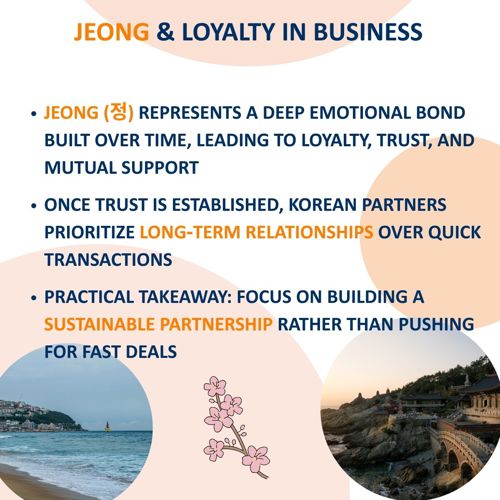
A unique Korean concept, Jeong (정), refers to a deep emotional bond formed through long-term interactions. In business, it translates into loyalty, trust, and mutual support.
Partnerships Over Transactions
Once trust is established, Korean partners tend to maintain strong relationships and expect the same commitment in return.
Practical takeaway: Focus on building a sustainable partnership rather than pushing for quick deals.
Conclusion
Entering the South Korean market or partnering with Korean companies requires more than understanding the business landscape: it requires understanding the culture that shapes it.
Respect for hierarchy, indirect communication, the importance of relationships, and strong attention to detail all influence how agreements are made and how collaboration unfolds.
By appreciating these cultural dynamics, international partners can build more effective, respectful, and lasting business relationships with South Korean counterparts.
Source: Korean Business Etiquette for International Professionals: Essential Guide to Success - Korea On Screen , Business Culture in South Korea | Global Business Culture