WHAT IS SOCIAL JUSTICE?
Social justice refers to the principle that all individuals deserve equal rights, opportunities, and access to resources regardless of gender, ethnicity, socioeconomic background or place of birth. It is rooted in the idea that societies function best when fairness, dignity, and inclusion are guaranteed for everyone. Today, social justice encompasses a wide range of global priorities, from reducing poverty and eliminating discrimination to ensuring decent work, protecting human rights, and promoting social protection systems that leave no one behind.
HISTORICAL BACKGROUND: HOW THE WORLD DAY OF SOCIAL JUSTICE CAME TO LIFE
The creation of the World Day of Social Justice is the result of decades of international efforts aimed at promoting fairness, equality, and human dignity. The roots of this observance can be traced back to the post‑war period, when the global community began to articulate a shared vision for human rights and social development.
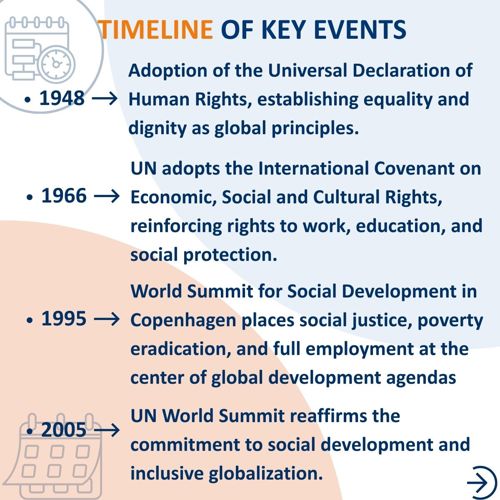
A major turning point came in 1948, with the adoption of the Universal Declaration of Human Rights. For the first time, nations collectively affirmed that every person is entitled to equal rights and opportunities, regardless of background or circumstance. This foundational document laid the groundwork for later initiatives focused on social protection, decent work, and the fight against discrimination.
In the decades that followed, the United Nations continued to strengthen this vision. The International Covenant on Economic, Social and Cultural Rights, adopted in 1966, expanded the global commitment to ensuring access to education, healthcare, fair working conditions, and social security. These principles became essential pillars of what we now call social justice.
The conversation gained new momentum in 1995, during the World Summit for Social Development in Copenhagen. Governments from around the world agreed that poverty eradication, full employment, and social integration should be central objectives of global development. This summit marked a shift from abstract principles to concrete policy commitments.
By the early 2000s, the need for a dedicated global day became increasingly clear. Globalization was accelerating, bringing opportunities but also widening inequalities. In 2005, the UN World Summit reaffirmed the importance of inclusive development and the need to ensure that economic progress benefits everyone.
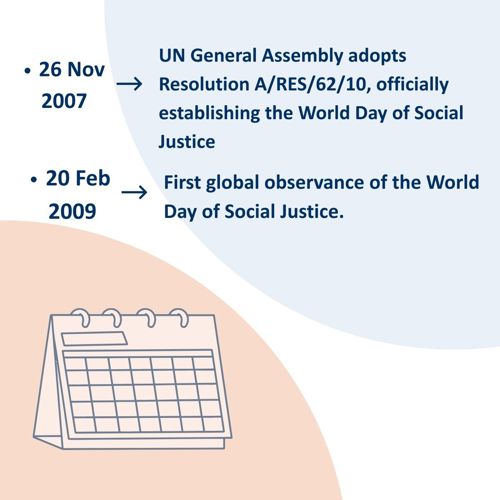
Finally, in 2007, the UN General Assembly adopted a resolution establishing 20 February as the World Day of Social Justice. The first observance took place in 2009, creating an annual moment for reflection, advocacy, and action. Since then, the day has served as a reminder that social justice is not merely an aspiration but a continuous effort requiring collaboration between governments, institutions, businesses, and civil society.
WHY THE WORLD DAY OF SOCIAL JUSTICE IS IMPORTANT
The World Day of Social Justice serves as a global reminder that fairness and equality are not abstract ideals but essential conditions for sustainable development and peaceful societies. Its importance lies in several dimensions:
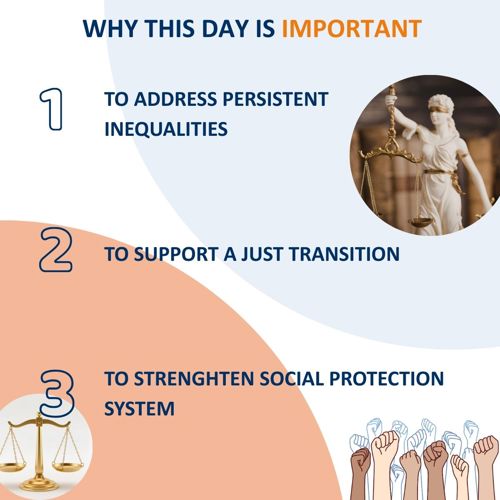
1. Addressing Persistent Inequalities
Despite global progress, millions still face barriers due to poverty, gender inequality, discrimination, or lack of access to education and employment. This day highlights the urgency of tackling these systemic issues and promoting inclusive growth.
2. Supporting a Just Transition
As the world moves toward low‑carbon and digital economies, the UN emphasizes the need for a just transition, ensuring that workers, vulnerable communities, and marginalized groups are not left behind in the process of economic transformation.
3. Strengthening Social Protection Systems
Social justice requires robust safety nets: fair wages, access to healthcare, unemployment support, and protections for informal workers. The day encourages governments and organizations to reinforce these systems.
WHAT HAPPENS ON THIS DAY
Organizations worldwide, including the UN, the International Labour Organization, NGOs, and academic institutions, use this day to:
- Publish reports and policy recommendations on poverty reduction, employment, and social inclusion
- Host conferences, webinars, and roundtables on human rights and fair economic development
- Launch awareness campaigns on discrimination, gender equality, and workers’ rights
- Promote initiatives supporting migrants, youth, and marginalized communities
For companies and institutions, it’s also an opportunity to reaffirm commitments to ESG principles, diversity and inclusion, and ethical business practices.
GOALS AND CHALLENGES AHEAD
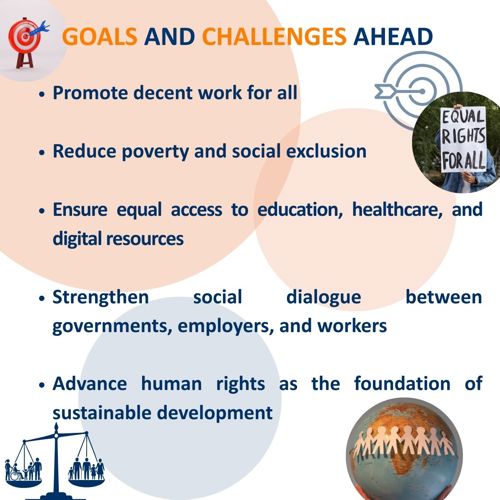
The World Day of Social Justice is built around a set of ambitious yet essential goals that reflect the international community’s commitment to creating fairer and more inclusive societies. One of the central objectives is to promote decent work for all, ensuring that every individual, regardless of gender, age, or background, has access to safe working conditions, fair wages, and opportunities for professional growth. This goal is closely tied to the broader vision of reducing poverty and enabling people to build stable, dignified lives.
Another fundamental aim is to strengthen social protection systems. From healthcare to unemployment support, from pensions to child benefits, these systems form the backbone of resilient societies. The World Day of Social Justice encourages governments and institutions to invest in policies that protect the most vulnerable and prevent individuals from falling into cycles of deprivation.
A further priority is to ensure equal access to essential services, including education, healthcare, and digital resources. In a world where opportunities increasingly depend on connectivity and knowledge, guaranteeing universal access is crucial for reducing inequalities and empowering communities.
The day also emphasizes the importance of social dialogue, that is the ongoing conversation between governments, employers, workers, and civil society. Effective dialogue helps shape policies that are fair, inclusive, and responsive to real needs. It is a reminder that social justice is not achieved through top‑down decisions alone, but through collaboration and shared responsibility.
Finally, the overarching goal is to advance human rights as the foundation of sustainable development. Social justice is inseparable from the protection of fundamental freedoms, the fight against discrimination, and the promotion of dignity for all. By reaffirming these principles each year, the World Day of Social Justice reinforces the idea that progress must be measured not only in economic terms but also in the well‑being and inclusion of people.
MAJOR CHALLENGES
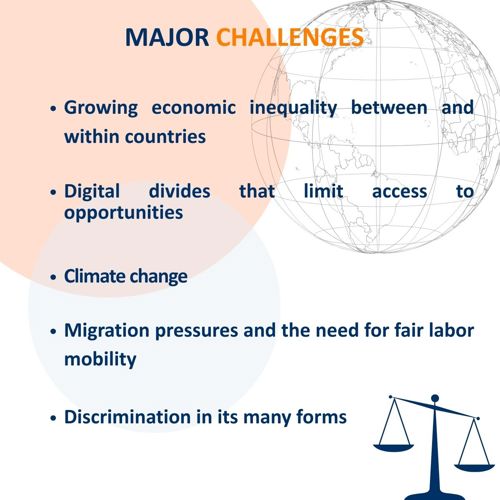
Despite the global commitment to social justice, the path toward a fairer and more inclusive world remains complex. One of the most pressing challenges is the widening gap between those who have access to opportunities and those who are systematically excluded. Economic inequality continues to grow both within and between countries, creating societies where access to education, healthcare, and decent work is still determined largely by socioeconomic background. This imbalance not only undermines individual potential but also weakens social cohesion and long‑term development.
Another significant challenge is the digital divide. As economies and public services become increasingly digital, millions of people risk being left behind simply because they lack internet access, digital skills, or the technological infrastructure needed to participate fully in modern life. This challenge limits the ability of communities to benefit from innovation and economic transformation.
Climate change adds an additional layer of complexity. Its impacts, from extreme weather events to resource scarcity, disproportionately affect vulnerable populations, including low‑income communities, migrants, and workers in sectors exposed to environmental risks. Ensuring a just transition toward greener economies means protecting these groups, offering reskilling opportunities, and designing policies that balance environmental goals with social protection.
Migration and labor mobility also present ongoing challenges. While migration can be a powerful driver of development, many migrants still face exploitation, unsafe working conditions, and limited access to rights and services. Creating fair and transparent labor systems is essential to ensure that mobility becomes an opportunity rather than a source of vulnerability.
Finally, discrimination in its many forms, whether based on gender, ethnicity, disability, or other factors, continues to limit the participation of millions of people in economic and social life. Overcoming these barriers requires not only strong legal frameworks but also cultural change, inclusive institutions, and sustained advocacy.
These challenges make the World Day of Social Justice not just symbolic, but essential for shaping a fairer global future.
CONCLUSION
The World Day of Social Justice serves as a powerful reminder that fairness, inclusion, and equal opportunity are not abstract ideals but essential conditions for sustainable global development. While significant progress has been made, the challenges ahead require continuous commitment, collaboration, and innovation. By reflecting on these issues each year, institutions, businesses, and individuals can renew their dedication to building societies where everyone has the chance to thrive.
Source: World Day of Social Justice | United Nations, World Day of Social Justice 2026