World Arabic Language Day
Every year, since 2012, on December 18th, the world celebrates World Arabic Language Day, honoring one of the most influential and widely spoken languages across continents. Arabic is not only a means of communication for hundreds of millions of people, but also a bridge between cultures, histories, and economies. Its legacy spans centuries, shaping literature, science, philosophy, and trade, while continuing to play a vital role in global dialogue today. For SkyMinder, this day is an opportunity to reflect on how language fosters understanding, strengthens international connections, and supports the exchange of knowledge and commerce in an increasingly interconnected world.
In its many forms, whether classical or dialectal, spoken or expressed through poetic calligraphy, the Arabic language has shaped a captivating aesthetic that permeates architecture, poetry, philosophy, and music. It opens the door to a remarkable spectrum of identities and beliefs, while its history highlights the depth of its connections with other tongues. Arabic has served as a driving force in the advancement of knowledge, carrying Greek and Roman sciences and philosophies into Renaissance Europe. It also fostered cultural exchange along the Silk Roads, stretching from the shores of India to the Horn of Africa.
On World Arabic Language Day, UNESCO is encouraging everyone to celebrate not only a language, but also a culture and, more broadly, emphasizing how much we need diverse perspectives.
HISTORICAL BACKGROUND
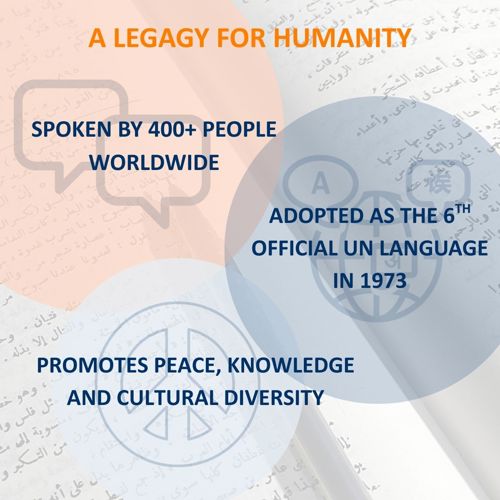
The Arabic language stands as a cornerstone of humanity’s cultural diversity and is among the most widely spoken languages in the world, with more than 400 million people using it daily. Since 2012, World Arabic Language Day has been celebrated every year on December 18, a date chosen to mark the adoption of Arabic as the sixth official language of the United Nations in 1973. Beyond its linguistic significance, Arabic has played a vital role in fostering social cohesion, advancing knowledge, and spreading values of peace and mutual understanding. Its contribution transcends borders and peoples, representing a shared legacy of civilization for the entire world. In recognition of multilingualism and multiculturalism, the United Nations Department of Global Communications established dedicated observances for each of the six official UN languages, with December 18 reserved for Arabic following General Assembly resolution 3190 (XXVIII).
INNOVATION, INCLUSION AND DIGITAL PRESENCE
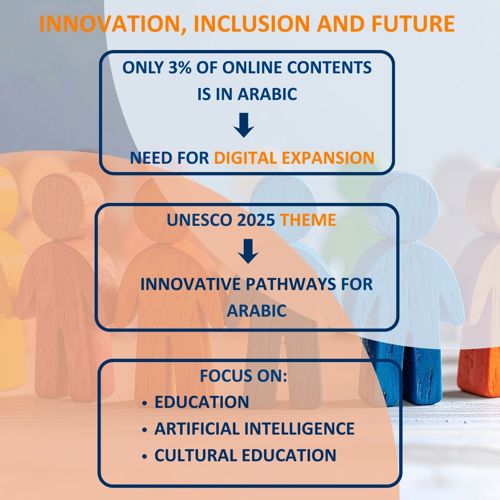
The 2025 celebration of World Arabic Language Day highlights how innovation and inclusion are shaping the future of Arabic in an era of rapid digital transformation. With more than 450 million speakers and official status in nearly 25 countries, Arabic remains a global language of immense importance. Yet, despite its reach, only about 3% of online content is available in Arabic, underscoring the need to bridge the digital gap. By integrating technology into education systems, digital platforms, and public discourse, and by adopting inclusive policies, Arabic is becoming more accessible to multilingual and under-resourced communities. Recent observances have focused on themes such as artificial intelligence and innovation, exploring how these tools can preserve cultural heritage while empowering Arabic speakers worldwide. Expanding its digital presence ensures that Arabic continues to thrive as a living language, adapting to modern challenges while safeguarding its rich traditions and intellectual legacy.
EDUCATION AND KNOWLEDGE EXCHANGE
Arabic remains central to education and knowledge production, not only within the Arab world but also internationally. UNESCO and the UN emphasize the importance of inclusive policies that integrate Arabic into curricula, teacher training, and digital learning platforms. These efforts ensure that younger generations engage with Arabic in ways that are relevant to their lives today, while also strengthening intercultural dialogue. By promoting Arabic alongside other global languages, these initiatives support multilingualism and help bridge divides between communities.
A BRIDGE ACROSS CULTURES AND FUTURES - 2025 THEME
Arabic has always been a language of connection, linking civilizations along trade routes and fostering intellectual exchange across continents. Today, its role as a bridge between cultures is reinforced by policies that encourage multilingualism and cultural diversity, reaffirming its importance as a tool for peace, mutual understanding, and sustainable development. In 2025, this vision is captured under the theme “Innovative Pathways for Arabic: Policies and Practices for a More Inclusive Linguistic Future.” The celebration, organized by UNESCO and held at its headquarters in Paris on December 18, 2025, highlights how education, technology, media, and public policy can expand the presence and accessibility of Arabic, particularly for multilingual and resource-constrained communities. In line with UNESCO’s Management of Social Transformations (MOST) Programme, the event provides a platform for cultural dialogue and reflects a strong commitment to linguistic diversity. Supported by the Sultan Bin Abdulaziz Al Saud Foundation and its pioneering Arabic Language Support Programme, these initiatives empower communities, enhance Arabic knowledge production, and strengthen the language’s global standing. Together, they underscore that Arabic is not only a legacy of the past but also a vital resource for shaping a more inclusive and interconnected future.
CONCLUSION
As the world marks World Arabic Language Day, we are reminded that Arabic is far more than a language: it is a living testament to humanity’s shared heritage and a vital bridge to our collective future. Its influence spans centuries, shaping art, science, philosophy, and trade, while today it continues to foster dialogue, innovation, and inclusion across cultures. The 2025 theme, “Innovative Pathways for Arabic: Policies and Practices for a More Inclusive Linguistic Future,” underscores the importance of embracing technology, education, and policy to ensure Arabic remains accessible and relevant in a rapidly changing world. By celebrating Arabic, we celebrate diversity, mutual understanding, and the enduring power of language to connect people across borders and generations.
Source: List of International Days and Weeks | United Nations