
The Origins of Holi: Myths, Symbols and Meanings
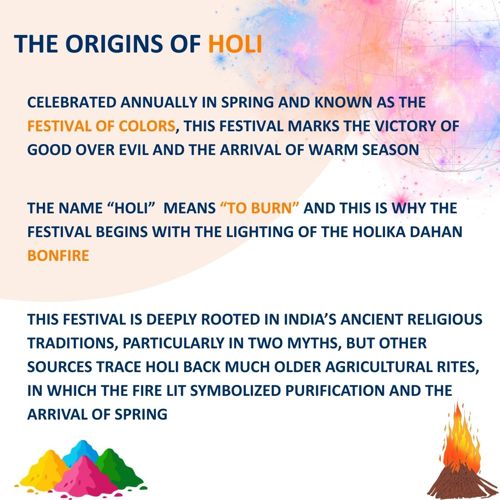
Celebrated annually in spring, in 2026 Holi begins on March 3rd, with the traditional Holika Dahan bonfire, and reaches its joyful peak on March 4th, with the vibrant celebration of colors. Known as the Festival of Colors, one of India’s most joyful and iconic celebrations, Holi marks the victory of good over evil and the arrival of the warm season, and it is deeply rooted in India’s ancient religious traditions, particularly in two myths.
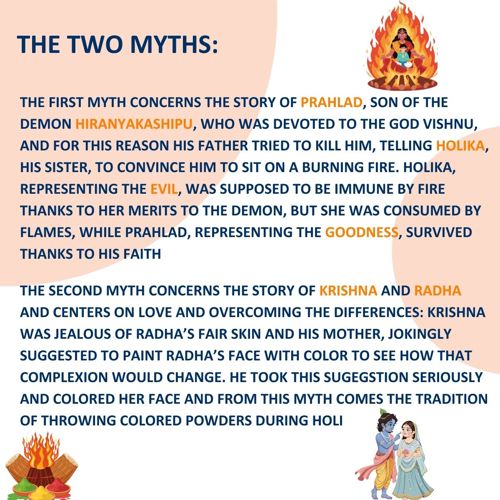
The first myth concerns the story of Prahlad, Holika and the demon Hiranyakashipu and talks about the triumph of good over evil. Prahlad, son of the demon Hiranyakashipu, was devoted to the god Vishnu, but his father, feeling his power and authority diminished by such devotion, attempted various ways to kill him. One day, he ordered his sister Holika to sit with Prahlada on a burning pyre. Prahlada accepted his father’s challenge and immediately began to pray to Lord Vishnu for protection. Holika was supposed to be immune to fire thanks to her merits, but she was consumed by the flames because of her evil intentions, while Prahlada survived thanks to his faith.
From this myth comes the tradition of lighting a bonfire during Holi to burn away evil, represented by Holika. In fact, the word “Holi” literally means “to burn,” which is why the festival begins with the lighting of the Holika Dahan bonfire. This story appears in ancient Sanskrit texts such as the Bhāgavata Purāṇa, although not all scholars agree on how faithfully these stories were preserved over the centuries or how much they may have been reshaped.
Other sources trace Holi back to much older agricultural rites in which the fire lit on the eve of the festival symbolized purification and the arrival of spring. The rural element here is essential: it was not only about honoring deities but also about ensuring good harvests and renewing community ties.
The second myth concerns Krishna and Radha and centers on love and the breaking down of differences. It tells the story of the love between the god Krishna and Radha, symbolizing union and devotion. According to tradition, Krishna, known for his dark complexion, as a child felt jealous of Radha’s fair skin. One day, he confided this insecurity to his mother, who jokingly suggested to paint Radha’s face with colors to see how his complexion would change. The young and curious Krishna took his mother’s words seriously and colored Radha’s face. In honor of this myth, the tradition of throwing colors, powders, and colored water during Holi became established.
Although the name “Holi” immediately recalls the figure of Holika, in some regions the festival is known by different names, such as Phagwah, a term that carries echoes of seasonal cycles and fertility. The wide range of names has long been studied by Indian and Western linguists: some argue that “Holi” was originally a local expression that later became widespread thanks to the popularity of its legends. Others believe that the use of “Phagwah” reflects the desire of agricultural communities to preserve a reference to nature beyond mythological narratives.
A Festival Between Spirituality and Rural Traditions
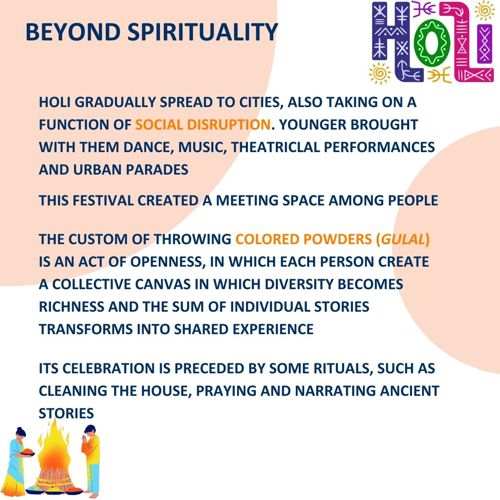
Originally confined to small villages, Holi gradually spread to cities, also taking on a function of social disruption. Younger generations brought with them dance, music, theatrical performances and, in recent times, even urban parades with almost carnival-like tones.
One of the most striking aspects of Holi, whether observed in cities or in the countryside, is its ability to create a real meeting space among people. The custom of throwing colored powders (gulal) is not merely a game: it is an act of openness, a way of setting aside differences and resentments, at least for one day. Holi’s colors are like brushstrokes on a collective canvas: each person, with their gesture, contributes to a larger picture where diversity becomes richness, and the sum of individual stories transforms into shared experience.
From a spiritual perspective, Holi remains deeply anchored in Hindu values. The Holika Dahan fire, lit on the evening before the festival, is the moment of greatest religious participation: prayers are recited, songs are sung, and the year’s accumulated negativity is symbolically entrusted to the flames. During the main day, the figure of Krishna is celebrated in stories, dances, and devotional songs. The playful throwing of colors, however seemingly secular, reflects the theme of divine love expressed through spontaneity, joy, and human connection.
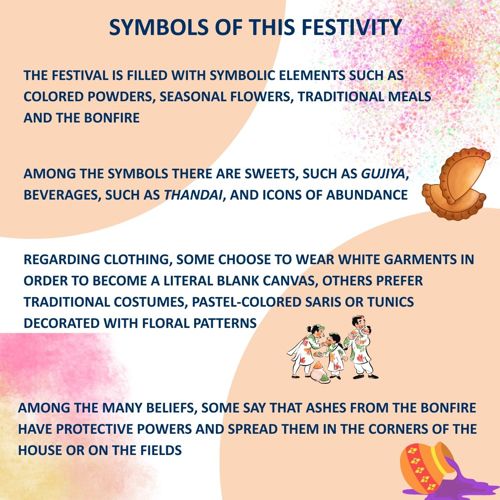
As for visual symbols and sacred objects, the festival is filled with symbolic elements such as colored powders, seasonal flowers, traditional sweets like Gujiya, and, of course, the bonfire. Each color represents something: red symbolizes vital energy, yellow prosperity, blue the protection of Krishna, though meanings vary among communities.
To light the fire, aromatic woods and herbs are mainly used, which not only give off a particular scent but are also believed to bring well-being. In some rural areas, votive objects are thrown into the flames as a sign of gratitude or a request for protection.
The Festival of Colors: Unity, Joy and Transformation
Holi follows the Hindu lunar calendar and falls on the first full moon of March, during the month of Phalgun, a period that corresponds with nature awakening and fields beginning to bloom with colorful flowers. Another tradition involves cleaning the house on the evening before the festival, a gesture meant to leave behind winter and everything one wishes to forget. The festival is celebrated over two days: the first is dedicated to the lighting of the bonfire with collective prayers and songs; the second, the most well-known, is when people pour into the streets to play with colors (Rangwali Holi). Despite the scale of the celebration, participation varies: some families prefer to observe the festival at home in a more intimate way.
The days leading up to the festival form a ritual of their own, with women preparing colored powders, often using natural ingredients such as turmeric, rose petals or neem leaves. Recently, however, industrially produced powders have become more common, something that older generations frown upon, insisting that natural colors are more fragrant and bring good fortune.
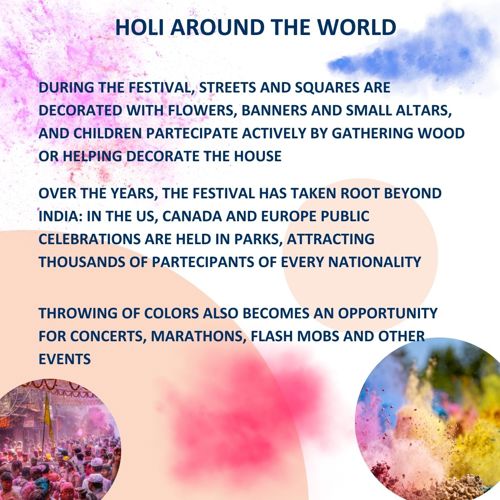
During the festival, streets and squares are decorated with flowers, banners and small altars, and children participate actively by gathering wood or helping decorate the house.
Holi Rituals, Preparations and Traditional Attire
Regarding clothing, some choose to wear white garments to become a literal blank canvas, while others prefer traditional costumes with vibrant embroidery, pastel-colored saris, or tunics decorated with floral patterns. In many families, grandparents bless children’s clothes, wishing them health and happiness for the year ahead. At the end of the day, gifts are exchanged as a sign of affection and prosperity, symbolizing the renewal of bonds.
Among the festival’s many symbols are sweets, beverages, and icons of abundance. A typical sweet is Gujiya, a fried pastry shaped like a half-moon symbolizing the cyclical nature of time, filled with milk and dried fruit. As for beverages, there is Thandai, made with milk, almonds and spices, sometimes enriched with a hint of bhang (a cannabis-based preparation). Each family contributes to a sort of communal feast where flavors, stories and memories mingle. Among the many beliefs, some say that ashes from the bonfire have protective powers and should be spread in the corners of the house or on the fields. In some villages, it is said that the color left on one’s clothes brings luck for the entire year.
Holi Around the World: A Celebration Beyond India
Over the years, the festival has taken root beyond India as well: in the United States, Canada, and Europe, public celebrations are held in parks, attracting thousands of participants of every nationality. Often, the throwing of colors becomes an opportunity for concerts, marathons, and flash mobs.
Conclusion
Holi, with its blend of ancient myths, agricultural rites, family gestures and moments of collective joy, remains one of India’s most vibrant and deeply shared celebrations. It is a festival that goes far beyond the throwing of colors, carrying a universal message: leaving behind what weighs us down, welcoming the light of a new season, and recognizing ourselves in others beyond every difference. Every bonfire lit, every handful of color, every homemade sweet becomes a bridge between past and present, between spirituality and daily life, between tradition and renewal. And perhaps it is precisely this ability to unite what seems distant that makes Holi a boundless festival, capable of resonating just as strongly in Indian villages as in the great cities of the world.