Inside the Chinese Calendar: Traditions, History and the New Year of the Horse
An ancient system that still shapes modern life
Today, 17 February 2026, marks the beginning of the Year of the Horse, which will continue until 5 February 2027. This transition offers a timely opportunity to look more closely at the system that defines these cycles: the Chinese calendar, one of the world’s oldest timekeeping traditions still in use.
The Chinese calendar is one of the world’s oldest timekeeping systems still in use. Unlike the Gregorian calendar, it is lunisolar, meaning it aligns both lunar cycles and the solar year. Each month begins with the new moon, and an extra month is added approximately every three years to keep the seasons aligned.
Its origins go back thousands of years: legend attributes its creation to the Yellow Emperor (2637 BCE), but historical evidence shows that it developed gradually through astronomical observation. As early as the Shang dynasty (14th century BCE), astronomers had already calculated the length of the year (about 365 days) and the lunar month (about 29.5 days) with remarkable accuracy, values very close to modern measurements.
During the Han dynasty, the calendar became a mature and complex system. In 104 BCE, Emperor Wu introduced the Taichu Calendar, which established key elements: a year of 12 months with intercalary months to stay aligned with the solar cycle, and the 24 solar terms, used to mark seasonal transitions.
Over the centuries, imperial astronomers continually refined the calendar to improve its precision. It was more than a practical tool: it represented cosmic order and the legitimacy of the ruler. Maintaining an accurate calendar was considered a sacred duty of the emperor, essential for agriculture and for interpreting omens. For this reason, issuing a calendar outside the imperial court was a serious offense.
While China uses the Gregorian calendar for civil purposes, the traditional calendar remains essential for cultural events, agricultural planning, and major celebrations such as the Lunar New Year, the Lantern Festival, and the Mid-Autumn Festival. In 2016, UNESCO recognized the Twenty‑Four Solar Terms as Intangible Cultural Heritage of Humanity, highlighting their importance as a ‘system of knowledge and social practices’ developed through the observation of the sun’s annual movement. This recognition emphasizes that the calendar is not merely an ancient scientific artifact; it is a living cultural treasure.
The 12‑animal cycle: symbolism, identity and storytelling
At the heart of the Chinese calendar is a repeating 12‑year cycle, each year represented by an animal: Rat, Ox, Tiger, Rabbit, Dragon, Snake, Horse, Goat, Monkey, Rooster, Dog and Pig. These are combined with the Five Elements (Wood, Fire, Earth, Metal, Water), creating a 60‑year cycle that shapes cultural identity and personal symbolism. This sexagenary cycle (Ganzhi) has been in use for about 2,000 years and reflects a philosophical view of the world: the Heavenly Stems and Earthly Branches were linked to yin and yang and to the Five Elements. In traditional thought, time itself was cyclical and infused with cosmic qualities, so a given year, month, or day possessed characteristics defined by these celestial patterns. Among these combinations, one of the most discussed and fascinating is of course the Year of the Fire Horse, in Chinese 火马年 (huǒ mǎ nián), which begins today.
The Horse in the Chinese Zodiac
The Horse (马 mǎ) symbolizes energy and vitality, movement and change, independence and a free spirit. In Chinese tradition, the horse is associated with success achieved through personal effort, quick action, and the ability to seize opportunities. It’s no coincidence that in the past, owning good horses was a sign of power and prestige.
The Fire Element and the Combination 火马
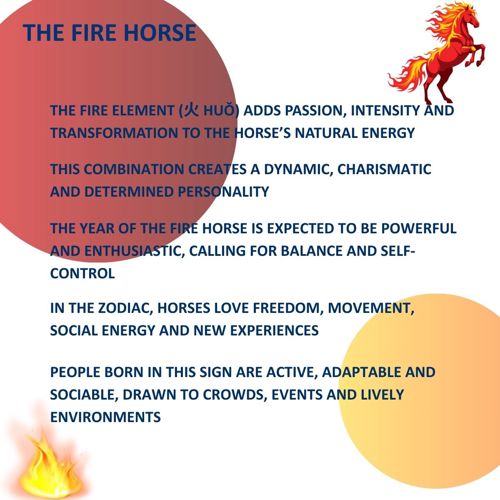
The Fire element (火 huǒ) represents passion, enthusiasm, impulsiveness, and transformation. When fire combines with the horse, an extremely dynamic, charismatic, and determined figure emerges. The Fire Horse sign is associated with brilliant, enterprising individuals who are hard to stop, though sometimes marked by impatience or a rebellious streak. In essence, the Year of the Fire Horse is expected to be a powerful and “fiery” one, though it also calls for balance and self‑control.
According to the Chinese horoscope, the Year of the Horse should be full of enthusiasm, just like a spirited Thoroughbred, and any excuse is a good one to spur business toward success, leaping over any obstacles that dare to appear in our path while always following the fastest trajectory. It will be a year in which we can gallop freely far and wide, guided by our strength and willpower. In the Chinese zodiac, the Horse represents freedom, and those born under this sign love company, are instinctive, lively, fond of novelty, and highly adaptable. People born in the Year of the Horse are extremely active and energetic, always ready to respond to new stimuli. Horses love being around others and typically enjoy crowds, concerts, theater, sports and social events, and especially parties.
With a strong sense of humor, Horses are great speakers, especially when it comes to quick back‑and‑forth exchanges. They love being the center of attention and engaging an audience in any situation.
Sometimes Horses can be a bit self‑centered, but that doesn’t mean they’re uninterested in other people’s problems. Horses are more cunning than they are intellectual, and this may be why they can sometimes feel a bit insecure.
The symbol of the horse is still very prominent in modern Chinese, especially in chengyu (成语) and auspicious slogans. This shows how traditional Chinese culture continually renews itself, keeping ancient symbols alive while adapting them to the present. The horse appears frequently in New Year greetings because it is associated with rapid success and progress. Here are some common expressions:
- 马到成功 (Mǎ dào chéng gōng) – “May success arrive as swiftly as a galloping horse.” It means achieving immediate success and is one of the most common and versatile wishes.
- 一马当先 (Yī mǎ dāng xiān) – “A horse leading the way.” A wish for taking the lead or being a pioneer.
- 龙马精神 (Lóng mǎ jīng shén) – “The vigorous spirit of the dragon and the horse.” A blessing for vitality, strength, and energy, often addressed even to older people.
- 马年大吉 (Mǎ nián dà jí) – “Great fortune in the Year of the Horse.”
- 事业一马平川 (Shìyè yī mǎ píng chuān) – “May your career flow smoothly like a horse riding across a flat plain,” meaning a career without obstacles.
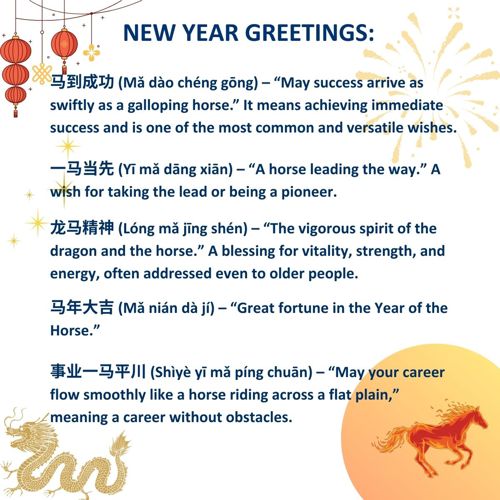
During the Years of the Horse, it is common to see these phrases displayed on decorations, greeting cards and even in workplaces, as a wish for growth and swift results.
Chinese New Year: rituals that connect past and present
Chinese New Year, also known as the Spring Festival, is the most important celebration in the traditional calendar. The festivities last 15 days and include rituals meant to bring good fortune and drive away negative energies:
- cleaning the home, to sweep away the misfortune of the previous year
- red decorations, the color of prosperity
- red envelopes (hongbao) containing money, symbolizing good luck
- fireworks and firecrackers, used to scare off evil spirits
- the reunion dinner, a moment of strong family togetherness
The use of fireworks originates from the legend of Nian, a mythical creature said to emerge once a year to frighten villagers. According to folklore, Nian feared the color red and loud noises, hence the tradition of red decorations and firecrackers.
Shedding the old, embracing the new
The transition from the past Year of the Snake to the Year of the Horse carries a powerful symbolic meaning: just as the snake sheds its skin, we too are invited to let go of what no longer serves us. It is a moment of transformation and renewal, an opportunity to release the weight of the past and step into the new year with a renewed spirit, more authentic, energized and ready to move forward toward new possibilities.
As the Year of the Horse begins, the Chinese calendar reminds us that time is not only a sequence of days but a cultural compass, shaped by stories, symbols and centuries of observation. Its traditions continue to resonate because they speak to universal human experiences: renewal, aspiration, and the desire to move forward with purpose. Whether interpreted through mythology, seasonal rhythms or zodiac symbolism, the Horse invites us to embrace momentum and possibility. In a world that changes rapidly, this ancient system offers a moment to pause, realign with our intentions, and step into the new year with clarity, confidence and a renewed sense of direction.
And so, as we cross this threshold, 马到成功 (Mǎ dào chéng gōng) may success arrive as swiftly as a galloping horse, and may the year ahead unfold with grace, vitality and bright new beginnings.