
PRODUCT CLASSIFICATION
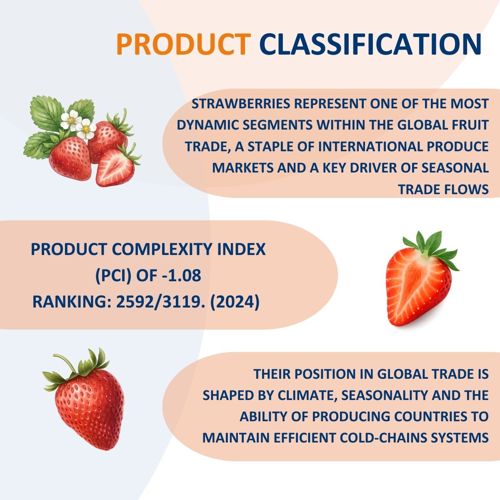
Fresh strawberries represent one of the most dynamic segments within the global fruit trade. Known for their bright color, delicate texture, and short shelf life, they combine agricultural simplicity with significant logistical sophistication. Their appeal spans continents and cultures, making them a staple of international produce markets and a key driver of seasonal trade flows.
In trade terms, fresh strawberries fall under the HS Code 081010, within the broader category of Edible Fruits, Nuts & Fruit Peels (HS Chapter 08). Despite being a relatively low‑complexity agricultural product, they play a notable role in global commerce. In 2024, driven by rising consumer demand, advances in cultivation technology, and increasingly efficient cold‑chain logistics, strawberries have become a strategic product in international trade reaching $4.34 billion, a 7.2% increase compared to 2023, accounting for 0.019% of global trade. According to the Product Complexity Index (PCI), strawberries have a score of –1.08, ranking 2592nd out of 3119 products, a reflection of their straightforward biological nature paired with the demanding logistics required to maintain freshness and quality.
Their position in global trade is shaped by climate, seasonality, and the ability of producing countries to maintain efficient cold‑chain systems. As a result, strawberries offer a compelling example of how even simple agricultural goods can depend on advanced supply chain coordination and international market integration.
Among the 5,380 products traded worldwide in 2024, fresh strawberries ranked 860th in total trade value, representing 0.019% of global trade.
EXPORT
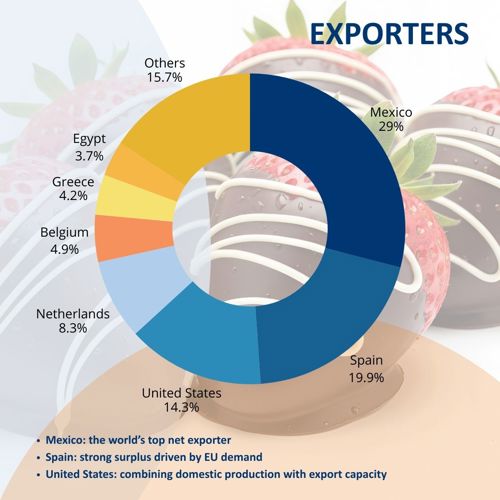
In 2024, the leading exporters of fresh strawberries were:
- Mexico – $1.26B
- Spain – $863M
- United States – $623M
Countries with the highest share of strawberries in their export portfolios were:
- Mexico – 29% of global exports
- Spain – 19.9%
- United States – 14.3%
The largest trade surpluses were recorded by:
- Mexico – the world’s top net exporter
- Spain – strong surplus driven by EU demand
- United States – combining domestic production with export capacity
IMPORT
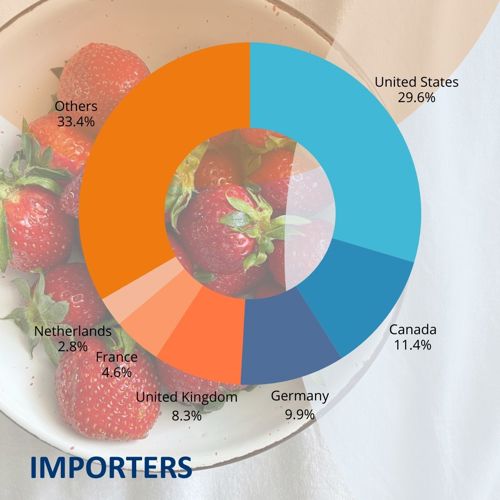
In 2024, the main importers of fresh strawberries were:
- United States – $1.17B
- Canada – $496M
- Germany – $430M
Countries with the highest share of strawberries in their import portfolios were:
- United States – 26.9% of global imports
- Canada – 11.4%
- Germany – 9.89%
The largest trade deficits were recorded by:
- United States – the world’s largest net importer
- Canada – strong seasonal dependence on foreign supply
- Germany – high consumption and limited domestic production
CURIOSITY CORNER: STRAWBERRIES, BETWEEN MYTH, BOTANY AND GLOBAL SURPRISES
Strawberries are among the world’s most beloved fruits, but behind their bright color and sweet flavor lies a universe of surprising facts. To begin with, they are the only fruit that carries its seeds on the outside: on average, each strawberry has around 200 of them, which explains why it’s almost impossible not to get a few stuck between your teeth. And here’s the twist: those tiny yellow dots aren’t decorative at all. They are the real fruits, called achenes, while the juicy red part we eat is technically a “false fruit.”
Botanically speaking, strawberries aren’t even berries. Unlike grapes or blueberries, they are classified as aggregate fruits, formed by the cluster of many individual achenes. And if that’s surprising, it’s even more fascinating to learn that strawberries belong to the rose family. If you get close to a strawberry plant in bloom, you’ll notice a delicate fragrance that unmistakably recalls rose blossoms.
The strawberry plant is also perennial: it blooms every year and, once fully established, can continue producing fruit for about five years. This resilience has helped strawberries spread across the globe, along with their culinary versatility and their high vitamin C content, which makes them not only delicious but also nutritionally valuable.
Strawberries have captivated people since ancient times. The Romans considered them a delicacy, while Greek mythology tells a more romantic story: according to legend, strawberries were born from the tears of Aphrodite as she mourned the death of Adonis, tears that fell to the ground and turned into small red hearts. No wonder this fruit is often associated with love.
And for those who think the fascination with strawberries is a modern trend, a visit to the Musée de la Fraise in Wépion, Belgium, proves otherwise. This museum is entirely dedicated to the fruit’s history and offers everything from homemade jams to strawberry‑shaped kitchen tools, and even strawberry‑flavored beer.
Beyond their cultural charm, strawberries are also valued for their antioxidant and anti‑inflammatory properties, making them a small natural ally for everyday wellness.
Extra curiosity: the global trade paradox
Despite being perceived as a “local” and seasonal fruit, strawberries are actually one of the most globalized products in the entire fresh‑produce sector. The real paradox is that some countries are simultaneously major producers, exporters, and importers. The United States, for example, exports hundreds of millions of dollars’ worth of strawberries, yet still imports over $1.17 billion to meet off‑season demand. The same happens in Europe, where countries with strong domestic production, such as Germany or France, still rely heavily on imports to guarantee year‑round availability.
A fruit we associate with springtime in our own region is, in reality, a perfect symbol of the circularity of global trade: simple on the surface, yet supported by a sophisticated international supply chain working in harmony to bring it to our tables at any time of the year.

CONCLUSION
In summary, fresh strawberries occupy a unique position in global trade: a biologically simple fruit supported by a highly sophisticated international supply chain. Their 2024 performance, marked by growing trade volumes, strong export leadership from Mexico and Spain, and significant import demand from the United States, Canada, and Germany, highlights how deeply interconnected the market has become. Despite their seasonality and perishability, strawberries circulate across continents thanks to advanced logistics, coordinated production cycles, and robust commercial networks. Whether viewed through trade data, supply chain dynamics, or cultural significance, strawberries demonstrate how even the most familiar products reflect the complexity and reach of today’s global economy.