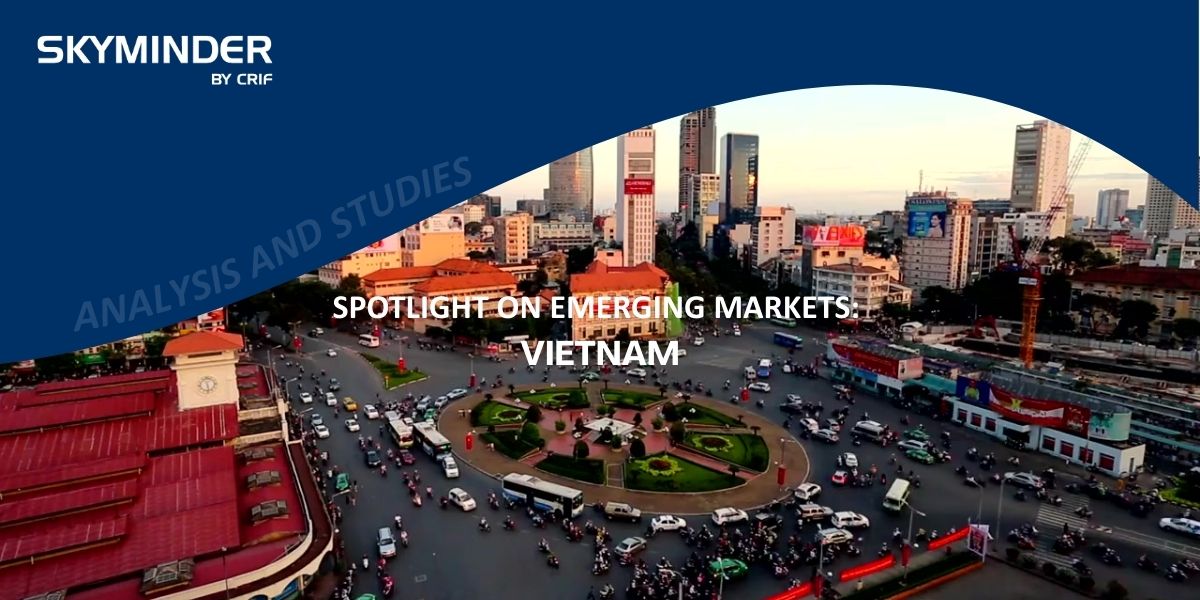
Vietnam’s Economic Momentum: Structural Strength, Rising Opportunities, and the Outlook for 2025
Vietnam has rapidly evolved into one of Asia’s most dynamic emerging markets. Over the past decade, the country has transformed from a low‑cost manufacturing base into a diversified, increasingly sophisticated economy. Supported by strong macroeconomic fundamentals, a competitive manufacturing base, and a clear commitment to global integration, the country is positioning itself as a strategic destination for international investors. Vietnam’s economic momentum remains a crucial factor when assessing opportunities across its equity and capital markets.
As Vietnam continues to modernize its industrial landscape and strengthen its financial system, the long‑term outlook remains compelling for businesses and investors seeking exposure to high‑growth emerging markets.
Structural Drivers Behind Vietnam’s Expansion
Vietnam’s economic momentum is supported by a combination of strong domestic demand, industrial upgrading, and deepening global integration. A rapidly expanding middle class, rising household incomes, and ongoing urbanization are fueling consumption across retail, services, healthcare, and digital sectors. At the same time, the country has strengthened its role as a competitive manufacturing hub, evolving from low‑cost production toward higher‑value industries such as semiconductors, renewable‑energy components, and electric‑vehicle parts.
Trade integration plays a central role in this transformation. Participation in major agreements like CPTPP (Comprehensive and Progressive Agreement for Trans-Pacific Partnership), EVFTA (EU-Vietnam Free Trade Agreement), and RCEP (Regional Comprehensive Economic Partnership) has diversified export markets and reinforced Vietnam’s position within global supply chains, making it an attractive destination for companies seeking to rebalance production across Asia. Foreign direct investment continues to accelerate this shift, supporting capital formation, technology transfer, and industrial modernization, particularly in high‑tech manufacturing, logistics, renewable energy, and digital infrastructure.
These developments are underpinned by a maturing financial system. Enhanced regulatory oversight, expanding credit penetration, and ongoing capital‑market development are improving financial stability and enabling more efficient allocation of resources, strengthening the foundations for Vietnam’s long‑term growth.
Vietnam Economic Outlook 2025-2026
Growth in 2025-2026 is projected between 6.5% and 7%, supported by stable macroeconomic fundamentals, reforms in key industries, major infrastructure investments, and resilient domestic demand. The government is prioritizing not only the pace of growth but also its quality and sustainability, with a strategic focus on digital transformation, green transition, and industrial upgrading.
Key Opportunities for the Next Decade
Vietnam’s long‑term growth trajectory is supported by a combination of industrial upgrading, digital transformation, sustainability initiatives, and rising consumer demand. The country is strengthening its position as a strategic hub for high‑tech manufacturing and global supply‑chain diversification, with expanding opportunities in semiconductors, electronics, electric‑vehicle components, and advanced industrial production. At the same time, Vietnam’s fast‑growing digital economy – driven by fintech, e‑commerce, cloud services, and cybersecurity – is reshaping business models and accelerating innovation across sectors.
The green transition represents another major opportunity: Vietnam’s commitment to net‑zero emissions by 2050 is attracting investment in offshore wind, solar power, green finance, and sustainable transport infrastructure.
Large‑scale connectivity projects, including expressways, airport expansions, and port modernization, are further enhancing the country’s competitiveness and logistics efficiency.
Finally, domestic consumption remains a powerful engine of growth. A young, urbanizing population with rising incomes is fueling demand in retail, healthcare, pharmaceuticals, education, and tourism. Digital platforms are amplifying this shift, making Vietnam one of Southeast Asia’s most dynamic consumer markets.
Business Risks: Key Considerations for Companies and Investors
While Vietnam offers a compelling long‑term growth story, the country still exhibits several characteristics typical of emerging markets. These factors require disciplined risk management for companies and investors operating in or engaging with the Vietnamese market.
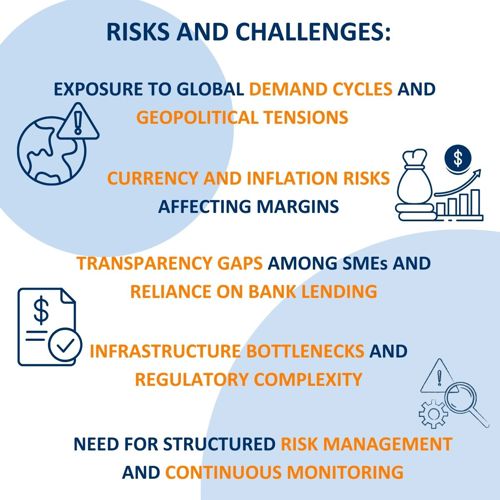
Its open, export‑driven economy remains sensitive to global demand cycles, geopolitical tensions, and financial‑market volatility: exposure amplified by Vietnam’s deep integration into global supply chains.
Currency and inflation risks are also relevant, as exchange‑rate fluctuations and cost pressures can affect margins and financial planning. While the financial system is maturing, vulnerabilities persist: uneven transparency among SMEs, reliance on bank lending, and the need for continued regulatory strengthening. These factors make thorough due diligence and ongoing credit monitoring particularly important.
Operationally, companies may face infrastructure gaps, administrative inefficiencies, and dependence on imported inputs for high‑tech manufacturing, all of which can impact logistics and production continuity.
Governance and policy shifts add another layer of complexity, as reforms, though generally positive, can progress unevenly and introduce rapid regulatory changes in strategic sectors.
In this context, an active and structured approach to risk management is crucial. Monitoring macroeconomic indicators, diversifying exposures, assessing partner reliability, and integrating scenario analysis into strategic planning help businesses navigate Vietnam’s opportunities while mitigating its inherent risks.
Investment Perspective: Why Vietnam Matters
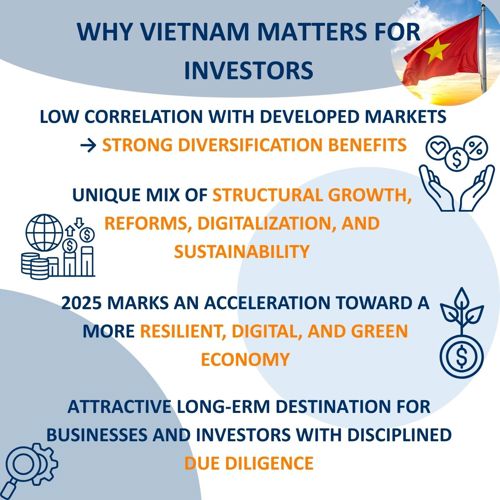
Vietnam offers diversification benefits due to its relatively low correlation with developed markets. Exposure to Vietnam can complement broader emerging‑market or Asian allocations, improving long‑term risk‑adjusted returns.
For investors and businesses, Vietnam represents a rare combination of structural growth, reform momentum, expanding consumer demand, rising technological sophistication, and increasing sustainability commitments. 2025 stood out as a pivotal year, marking the acceleration of Vietnam’s transition toward a more resilient, digital, and sustainable economy.
Conclusions
Vietnam is entering a decisive phase in its development. Structural reforms, a growing consumer base, and deeper integration into global supply chains continue to strengthen its long‑term growth outlook. At the same time, rising investment in high‑tech manufacturing, digital innovation, and the green transition is reshaping the country’s competitive position.
However, Vietnam still carries the typical risks of an emerging market. Exposure to global cycles, financial‑system vulnerabilities, and operational challenges require a disciplined and proactive approach to risk management. Organizations that combine strategic ambition with rigorous due diligence will be best positioned to capture opportunities while navigating uncertainty.
Looking ahead, Vietnam’s shift toward a more resilient, digital, and sustainable economy reinforces its status as one of Asia’s most promising emerging markets, a compelling destination for businesses and investors prepared to engage with both its potential and its complexity.