
PRODUCT CLASSIFICATION
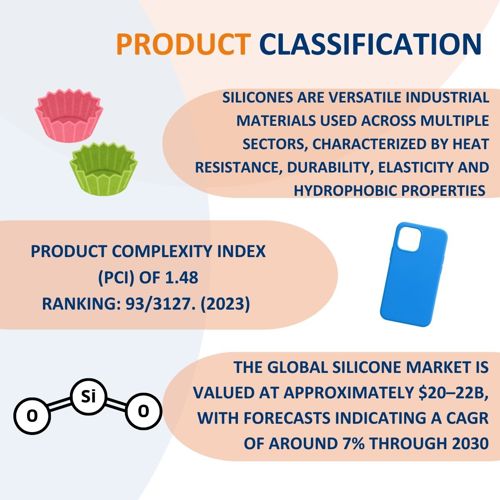
Silicones in primary forms are versatile industrial materials used across multiple sectors, including electronics, automotive, construction, medical devices, cosmetics, and renewable energy technologies. Thanks to their unique chemical structure, combining organic flexibility with inorganic stability, silicones offer exceptional heat resistance, durability, elasticity, and hydrophobic properties, making them essential in thousands of applications worldwide. Beyond their role as raw materials, silicones serve as key components in sealants, adhesives, lubricants, coatings, encapsulants, and high‑performance polymers, positioning them as a foundational ingredient in advanced manufacturing and technological innovation.
From a trade perspective, silicones fall under HS Code 391000, within the broader category of primary-form polymers and chemical intermediates. This classification reflects their importance as a high‑value industrial input with strong global demand across both mature and emerging markets.
The global silicone market is valued at approximately $20–22 billion, with forecasts indicating a CAGR of around 7% through 2030, driven by expanding use in electronics, electric vehicles, medical technologies, and sustainable construction materials.
However, the industry faces challenges linked to energy-intensive production processes and the availability of key raw materials such as metallic silicon, which ties silicone pricing to fluctuations in the semiconductor and solar industries. Environmental regulations and rising energy costs in Europe and Asia also influence production capacity and supply chain stability. Regionally, Asia-Pacific leads consumption, supported by China’s dominant manufacturing base, while North America and Europe remain major producers and importers due to strong demand in automotive, aerospace, and high-tech sectors.
Silicones in primary forms have a Product Complexity Index (PCI) of -1.03, ranking 2,478th out of 2,930 products, highlighting their status as a relatively low-complexity material despite their high strategic importance in global industry.
EXPORT
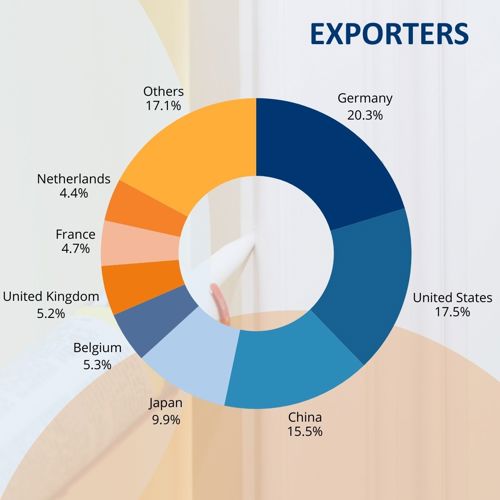
In 2023 it was estimated that the principal countries exporting silicones in primary forms were:
- Germany – $1.68B;
- United States – $1.45B;
- China – $1.2B;
- Japan – $821M;
- Belgium – $437M.
It was revealed that, in the latest year, silicones in primary forms ranked among the top chemical intermediates traded globally, with total exports increasing steadily over the last decade due to rising demand in electronics, automotive, construction, and medical manufacturing.
IMPORT
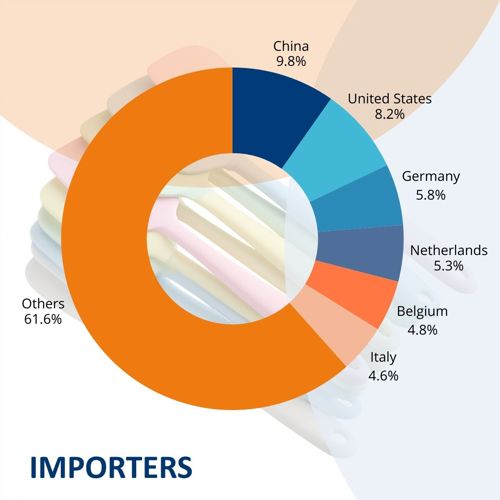
In 2023 it was estimated that the principal countries importing silicones in primary forms were:
- China – $808M;
- United States – $675M;
- Germany – $480M;
- The Netherlands – $440M
- South Korea – $413M
On the other hand, the commonest origins of global silicone imports were:
- China – leading supplier globally;
- United States – major exporter of high‑grade formulations;
- Germany – strong in specialty silicones;
- Japan – advanced polymer technologies;
- France – established chemical production base.
Lastly, it was revealed that, in the latest year, silicones in primary forms continued to show strong import growth, driven by expanding industrial applications and increasing reliance on silicone‑based materials across high‑tech and manufacturing sectors.
CURIOSITY CORNER: THE SURPRISING WORLD OF SILICONES
While silicones are often seen simply as industrial materials, their story is far more fascinating than most people realize. Born in the 1940s from pioneering research into heat‑resistant polymers, silicones quickly became indispensable in fields ranging from aerospace engineering to everyday household products. What makes them truly unique is their unusual chemical backbone: unlike most plastics, which are carbon‑based, silicones are built on a chain of silicon and oxygen atoms, a structure more similar to minerals than to organic polymers. This hybrid identity gives them their extraordinary flexibility, stability, and resilience, qualities that no other synthetic material can replicate in quite the same way.
One of the most intriguing aspects of silicone production is its deep connection to quartz, one of the most abundant minerals on Earth. To create silicone, quartz is transformed into metallic silicon through high‑temperature processes, linking the silicone industry directly to the worlds of metallurgy, solar energy, and even semiconductor manufacturing. This means that fluctuations in the tech sector, from smartphone demand to solar panel production, can unexpectedly influence the price and availability of silicones.
Silicones have also found a place in cultural and scientific milestones. They were used in early space missions for their ability to withstand extreme temperatures, and today they are essential in medical implants, wearable devices, and renewable energy technologies. Their presence is so widespread that they quietly shape modern life: from the sealants in skyscrapers to the coatings on baking molds, from cosmetic formulations to the insulation protecting electric vehicles.
In short, silicones are far more than a chemical commodity. They are a bridge between geology and technology, a material born from sand yet essential to the most advanced innovations of our time, a reminder that even the most ordinary‑looking substances can have extraordinary stories behind them.
CONCLUSIONS
Silicones stand at the crossroads of chemistry, technology, and modern industry. Although their Product Complexity Index places them among lower‑complexity materials, their strategic importance is undeniable: they enable innovation in sectors as diverse as electronics, renewable energy, automotive engineering, construction, healthcare, and consumer goods. Global demand continues to rise as industries shift toward lighter, more durable, and more energy‑efficient materials, reinforcing silicones’ role as an essential industrial input. At the same time, the sector faces challenges linked to energy costs, environmental regulations, and the volatility of raw materials such as metallic silicon, factors that are reshaping production strategies and encouraging investment in cleaner, more efficient technologies. Silicones in primary forms illustrate how a material born from one of Earth’s simplest minerals can become a cornerstone of advanced manufacturing, driving progress across global value chains and supporting the transition toward more sustainable and technologically sophisticated economies.