OVERVIEW
Paraguay, a landlocked nation in the heart of South America, is a country defined by fertile plains, the Paraguay River, and a cultural blend of Guaraní and Spanish traditions. Its economy relies heavily on agriculture, livestock, and hydroelectric power, thanks to the Itaipú and Yacyretá dams, two of the largest in the world. Despite its geographic isolation from the sea, Paraguay has built strong trade connections with its neighbors and maintains a competitive export sector.
In 2023, Paraguay ranked 98th in global GDP ($43B) and 111th in GDP per capita, reflecting a developing but steadily growing economy. Trade plays a central role in its economic structure, with soybeans, electricity, and meat forming the backbone of its export portfolio.
In 2023 Paraguay ranked:
- 98th in GDP ($43B)
- 94th in total exports
- 111th in GDP per capita
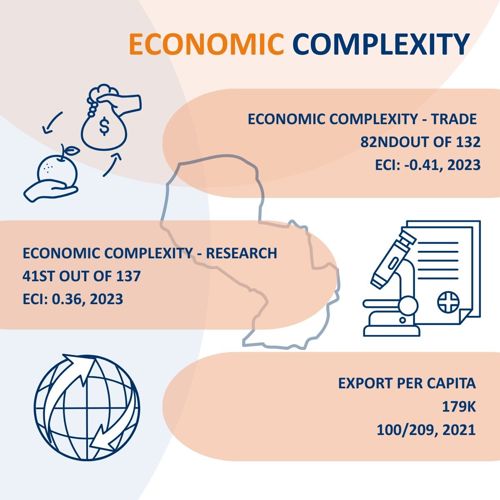
- 82nd in Economic Complexity Index (Trade)
- 41st in Economic Complexity Index (Research)
ECONOMIC COMPLEXITY RATE
Paraguay shows a moderate level of economic complexity, ranking 82nd in trade complexity and a notably strong 41st in research complexity. This reflects a productive structure that, while still centered on primary goods, is supported by growing research capacity and improvements in agricultural technology, livestock genetics, and energy management.
The country’s reliance on soy, meat, and electricity exports highlights a resource-driven economy, but its rising research complexity suggests potential for future diversification.
EXPORT
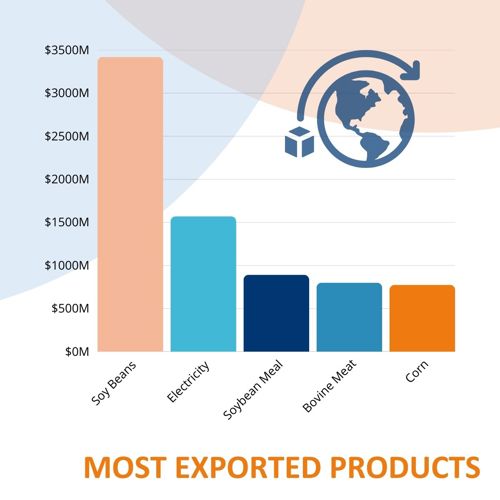
In 2023, Paraguay exported $12.3B, making it the 94th largest exporter globally. Its export basket is dominated by agricultural and energy products:
- Soybeans – $3.42B
- Electricity – $1.57B
- Soybean Meal – $892M
- Bovine Meat – $800M
- Corn – $775M
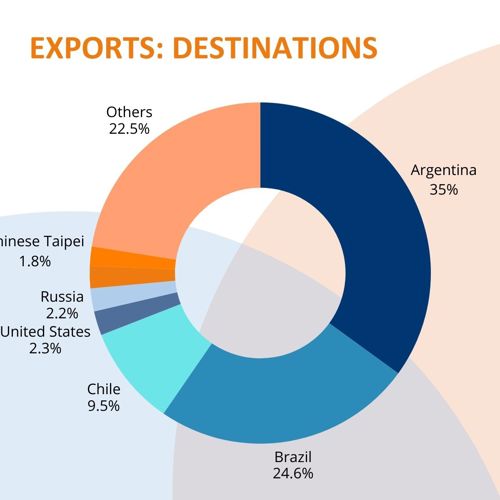
Top destinations for Paraguayan exports were:
- Argentina – $4.29B
- Brazil – $3.01B
- Chile – $1.16B
- United States – $282M
- Russia – $267M
Over the last five years, exports increased from $9.29B in 2018 to $12.3B in 2023, a rise of $2.97B. This growth reflects strong agricultural output and Paraguay’s role as a major regional supplier of soy and meat.
IMPORT
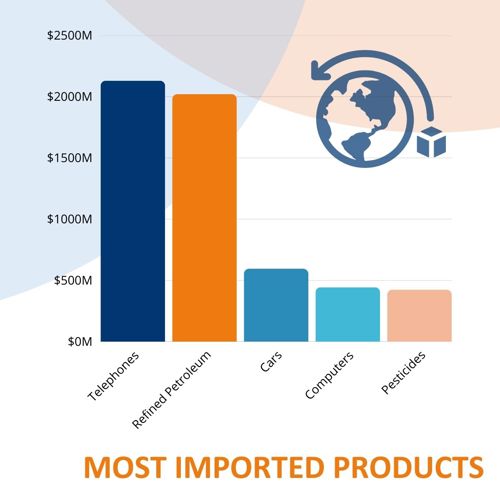
In 2023, Paraguay imported $16.4B, ranking as the 97th largest importer in the world. Imports reflect the country’s dependence on external markets for technology, fuel, and industrial inputs.
Main imports included:
- Telephones – $2.13B
- Refined Petroleum – $2.02B
- Cars – $595M
- Computers – $444M
- Pesticides – $424M
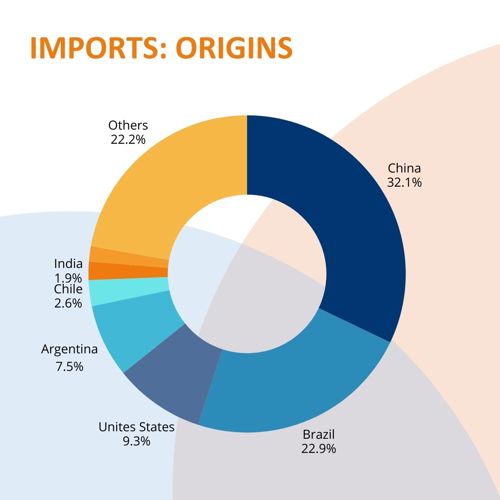
Top origins of imports were:
- China – $5.25B
- Brazil – $3.74B
- United States – $1.51B
- Argentina – $1.22B
- Chile – $431M
Imports have grown from $13.7B in 2018 to $16.4B in 2023, an increase of $2.65B, driven by rising demand for electronics, vehicles, and agricultural inputs.
CURIOSITY CORNER
Paraguay is one of the world’s largest exporters of hydroelectricity, thanks to the Itaipú Dam, which it co‑owns with Brazil. Culturally, Paraguay stands out for its Guaraní heritage, which remains deeply embedded in daily life: Guaraní is spoken by the majority of the population and is one of the country’s official languages.
Another distinctive feature is tereré, a cold herbal infusion that is both a national drink and a symbol of social identity.
CONCLUSIONS
In 2023, Paraguay emerged as a resilient South American economy with strong agricultural and energy sectors. Its trade profile reflects both its strengths (soybeans, electricity, meat) and its challenges, including reliance on imported technology and fuel.
Long‑term opportunities lie in agro‑industrial development, renewable energy expansion, and improved logistics to enhance competitiveness. Culturally and economically, Paraguay continues to balance tradition and modernity, leveraging its natural resources and regional partnerships to shape its role in the global market.