OVERVIEW
The Netherlands stands as one of the world’s most dynamic and globally connected economies. Located in the heart of Western Europe, the country leverages world‑class logistics infrastructure, a diversified industrial base, and a strong innovation ecosystem to position itself as a major hub within global value chains.
With a GDP of $1.21 trillion in 2024, the Netherlands ranks as the 19th largest economy worldwide and 14th in GDP per capita, reflecting its high productivity and strong living standards. The economy’s outward orientation is evident in its trade performance: in 2024, the country was the 9th largest exporter in the world.
The economic landscape is strongly shaped by the Port of Rotterdam, one of the largest globally, and Amsterdam’s Schiphol Airport. Together, they create a powerful logistical network that supports industries ranging from petrochemicals and advanced manufacturing to pharmaceuticals, electronics, and high‑tech agriculture.
In November 2025, Dutch trade flows remained robust:
- Exports: €64.2B
- Imports: €53.9B
- Positive trade balance: €10.3B
Although exports and imports declined slightly compared with the previous year, the Netherlands maintains a structurally strong and resilient trade position.
ECONOMIC PROFILE AND COMPLEXITY
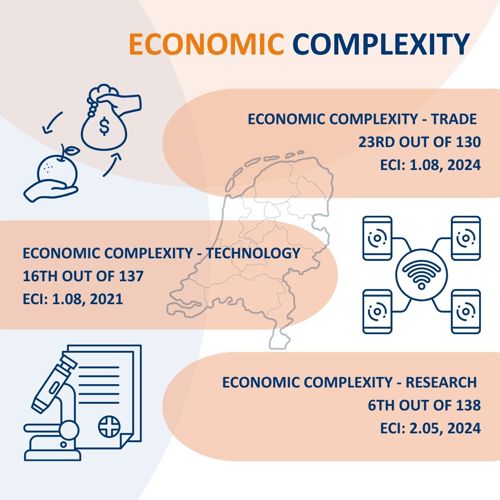
The Dutch economy is one of Europe’s most diversified and technologically advanced. Its global competitiveness stems from a unique combination of:
- sophisticated logistics and trade infrastructure
- highly skilled workforce
- innovation‑driven industries
- strategic geographical position
The Netherlands excels in high‑value sectors such as semiconductors, petrochemicals, biotechnology, electronics, agritech, and digital technologies. This complexity allows the country to act not only as a major producer but also as an indispensable gateway for goods entering and leaving Europe.
EXPORTS
In 2024, the Netherlands exported $572B, consolidating its position as the 9th largest exporter globally. Over the last five years, exports rose by $61.1B from 2019 levels.
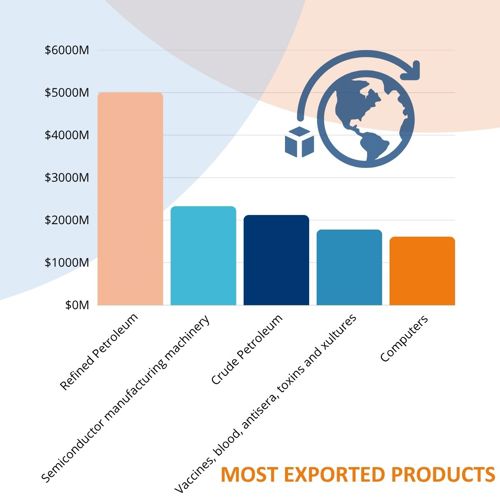
Top Export Products (2024)
- Refined Petroleum – $50.1B
- Semiconductor manufacturing machinery – $23.3B
- Crude Petroleum – $21.2B
- Vaccines, blood, antisera, toxins and cultures – $17.8B
- Computers – $16.1B
These categories underscore a combination of energy‑related industries and world‑leading technological manufacturing, driven by strong innovation capabilities.
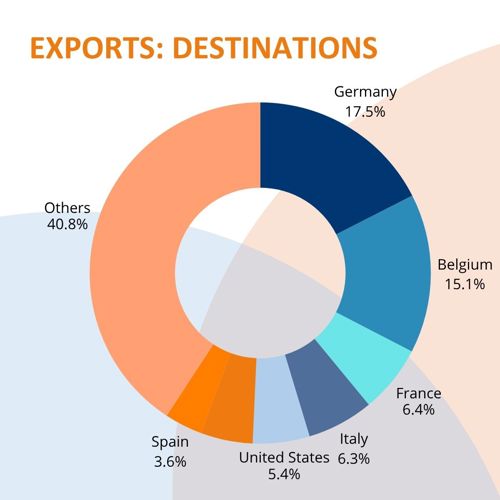
Top Export Destinations
- Germany – $100B
- Belgium – $86.5B
- France – $36.7B
- Italy – $36.1B
- United States – $30.8B
Europe remains the dominant market, highlighting the Netherlands’ central role in the EU’s trade and logistics network.
IMPORTS
In 2024, Dutch imports reached $693B, making the Netherlands the 7th largest importer worldwide. Over five years, imports rose by $108B.
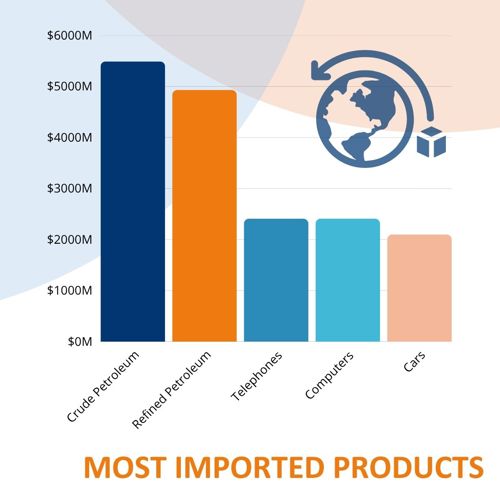
Top Import Products (2024)
- Crude Petroleum – $54.9B
- Refined Petroleum – $49.3B
- Telephones – $24.4B
- Computers – $24.1B
- Cars – $21B
The data shows strong demand for energy‑related inputs and high‑tech consumer goods, consistent with the country’s production profile and its role as a European trading hub.
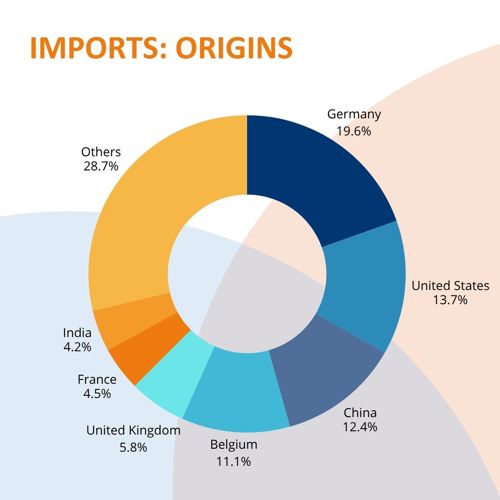
Top Import Origins
- Germany – $105B
- United States – $73.7B
- China – $66.2B
- Belgium – $59.3B
- United Kingdom – $31.2B
The relationship with Germany remains strategically central, while China and the U.S. account for most high‑tech and industrial imports.
TRADE BALANCE
In 2024, the Netherlands recorded large trade surpluses with several EU partners:
- Belgium – +$27.2B
- Italy – +$17.5B
- France – +$12.6B
- Sweden – +$8.7B
- Spain – +$8.37B
Significant trade deficits were instead registered with:
- China – –$45.8B
- United States – –$42.9B
- India – –$20.2B
- Norway – –$11.6B
- Brazil – –$9.1B
These imbalances reflect the Netherlands’ dependence on imported energy, technology, and intermediate goods.
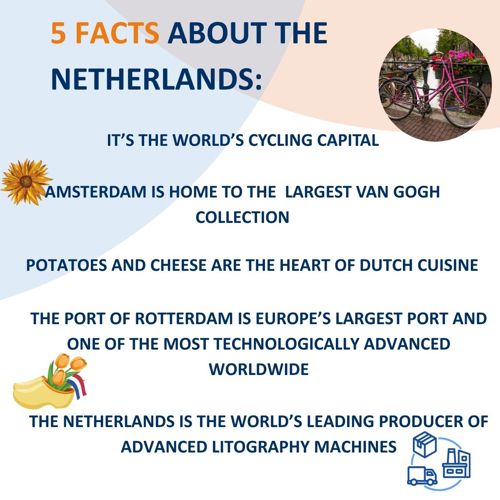
CURIOSITY CORNER: INSIDE THE DUTCH WAY OF LIFE AND INNOVATION
Beyond its powerful trade engine and advanced industrial ecosystem, the Netherlands is shaped by cultural aspects and lifestyle elements that deeply influence mobility, creativity, and even agriculture. Here are some standout traits that make the country unique:
1. The World’s Cycling Capital
The Netherlands is famously home to over 16 million bicycles, almost one for every resident. Cycling is not just a mode of transport but a national identity and an economic asset: it reduces congestion, lowers emissions, and integrates perfectly with the country’s compact urban layout.
For businesses and logistics, this culture of soft mobility has accelerated investments in sustainable transport, bike‑friendly infrastructure, and last‑mile green delivery systems.
2. Home to the Largest Van Gogh Collection
Amsterdam hosts the Van Gogh Museum, which houses the world’s most extensive collection of artworks by Vincent van Gogh. This cultural heritage fuels a thriving tourism sector and creative economy, contributing significantly to services exports and the country’s global image as a cultural hub.
The museum attracts millions of visitors every year, reinforcing the Netherlands’ status as a center for art, design, and cultural innovation.
3. Agriculture Meets Tradition: Potatoes and Cheese at the Heart of Dutch Cuisine
Although the Netherlands is renowned for high‑tech agriculture and innovative greenhouses, its cuisine remains rooted in simplicity. Potatoes and cheese, two national staples, form the base of many traditional dishes.
This culinary identity reflects a much larger story: the country is one of the world’s most efficient agricultural exporters, leveraging both traditional crops and cutting‑edge technology to serve global markets.
4. Rotterdam: Gateway to Europe’s Supply Chains
The Port of Rotterdam remains Europe’s largest port and one of the most technologically advanced worldwide. Its role in handling petroleum, chemicals, and container flows makes it a key driver of the Dutch export machine and a central node in EU logistics.
5. A Global Titan in Semiconductor Machinery
The Netherlands hosts ASML, the world’s leading producer of advanced lithography machines necessary for semiconductor manufacturing. This positions the country at the very core of global supply chains, from consumer electronics to AI infrastructure.
CONCLUSION
The Netherlands stands as a global economic and commercial powerhouse, combining strategic location, advanced logistics, and a highly diversified industrial base. Its leadership in fields such as semiconductor machinery, pharmaceuticals, petrochemicals, and high‑tech agriculture underscores its economic complexity and global relevance.
While the country relies heavily on imported energy and high‑tech goods, its strong export performance and role as a European distribution hub ensure long‑term economic resilience.
With continued investment in innovation, sustainability, and advanced manufacturing, the Netherlands remains a key example of how strategic specialization, infrastructure excellence, and global integration can shape a highly competitive and future‑proof economy.