OVERVIEW
Valued for their culinary versatility, nutritional profile, and role in both traditional and modern gastronomy, fresh and chilled mushrooms represent a dynamic segment of the global food market. From specialty varieties used in high-end cuisine to mass-market products destined for retail chains, mushrooms occupy a steady and growing space in international trade.
From a trade classification standpoint, Mushrooms (Fresh/Chilled) fall under the broader category of Vegetable Products, specifically within the HS section dedicated to edible vegetables, roots, and tubers. This positioning reflects their nature as a staple agricultural product with strong consumer demand across regions.
In 2024, global trade in fresh and chilled mushrooms reached $1.47 billion, marking a 4.73% increase from the $1.41 billion recorded in 2023. Over the past five years, this market has grown at an annualized rate of 3.67%, highlighting steady expansion driven by rising consumption and evolving food trends.
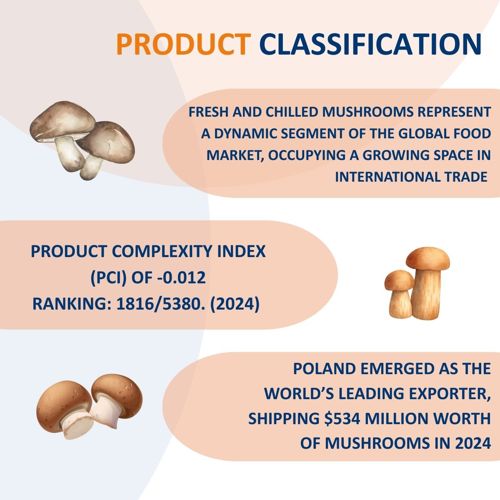
Poland emerged as the world’s leading exporter, shipping $534 million worth of mushrooms in 2024. This places the country ahead of Canada and Ireland, reinforcing its strategic role in European and global agricultural supply chains. Despite their widespread use, mushrooms remain a relatively niche item in global trade, ranking 1,816th out of 5,380 products traded worldwide in 2024 and accounting for 0.0064% of total trade value. Their Product Complexity Index (PCI) score of 0.012, ranking 1,752nd out of 3,119, reflects their status as a low-complexity agricultural product.
EXPORTS AND IMPORTS
In 2024, Poland exported $534 million in fresh and chilled mushrooms, securing its position as the top exporter globally. The country benefits from favorable growing conditions, strong agricultural specialization, and well-established relationships with key European markets.
In the same year, the main exporters of mushrooms were:
- Poland – $534M
- Canada – $347M
- Ireland – $142M
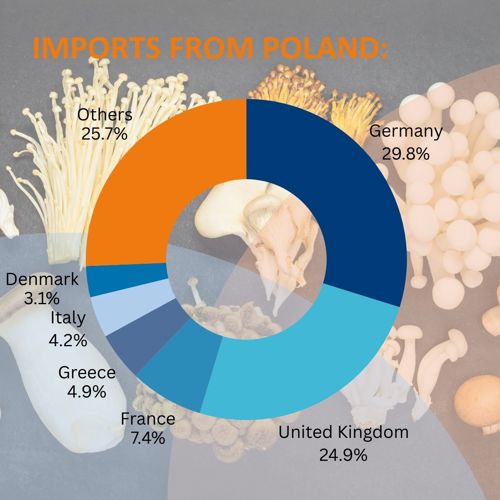
The main imports of mushrooms worldwide from Poland were especially towards:
- Germany – $159M
- United Kingdom – $133M
- France – $39.7M
Poland recorded the largest trade surplus in mushrooms in 2024, amounting to $529 million, far exceeding other major exporters such as Canada ($336M) and Ireland ($131M). This surplus underscores the country's strong production capacity and export orientation.
In terms of export portfolio relevance, mushrooms accounted for 0.15% of Poland’s total exports, the highest share globally. This highlights their importance within the nation’s agricultural and food manufacturing sectors.
The main importers of mushrooms worldwide, reflecting the demand Poland is positioned to serve, were:
- United States – $378M
- United Kingdom – $279M
- Germany – $219M
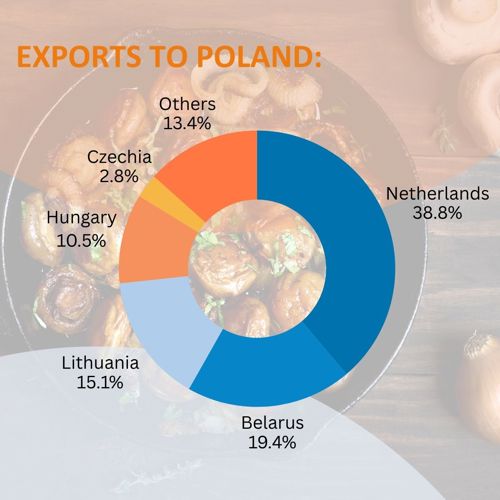
Exports to Poland came mainly by:
- The Netherlands – $1.87M
- Belarus - $934K
- Lithuania - $ 727K
TRADE OVERVIEW
Within the global landscape, mushrooms are still a relatively small commodity by value, but one with steady growth and resilience. The rise in trade volumes between 2023 and 2024 reflects broader consumer preferences for fresh, plant-based, and nutritious foods.
Poland’s leadership in this category stems from:
- Robust agricultural production
- Strong export infrastructure
- Proximity to major European consumer markets
- Competitive pricing and high product quality
With increasing global awareness around healthy eating and sustainable food systems, mushrooms are likely to maintain their positive trade trajectory.
CURIOSITY CORNER: FUN FACTS ABOUT MUSHROOMS
1. Mushrooms aren’t plants… but they’re not animals either
Although commonly treated as vegetables in the culinary world, mushrooms belong to their own biological kingdom: the Fungi Kingdom. Genetically, they are surprisingly closer to animals than to plants.
2. The largest living organism on Earth is a mushroom
In Oregon (USA), a specimen of Armillaria ostoyae spans roughly 9 square kilometers, covering an area equivalent to more than 1,600 football fields. It is considered the largest and one of the oldest organisms on the planet.
3. Mushrooms “breathe” like humans
They consume oxygen and release carbon dioxide, just like animals. This biological feature influences optimal storage and transportation conditions in international trade.
4. Some mushrooms glow in the dark
There are more than 70 species of bioluminescent fungi. This natural light, called foxfire, was historically used by soldiers in World War I to illuminate trenches.
5. They are sustainability champions
Mushrooms require very little water, minimal land, and are often grown using agricultural by‑products as a substrate. Their cultivation is one of the most circular and eco‑friendly production systems in the food industry.
CONCLUSIONS
Poland remains the world’s leading exporter of fresh and chilled mushrooms, supported by strong production capacity, efficient supply chains, and high demand from major consumer markets. Although mushrooms are considered a low‑complexity product, global trade continues to expand steadily as consumers embrace fresh, plant‑based, and sustainable foods.
The unique natural features of mushrooms add another layer of interest to a product that is both economically relevant and biologically remarkable. Looking ahead, Poland’s continued leadership will depend on maintaining competitive production while adapting to evolving sustainability standards and market preferences.