PRODUCT CLASSIFICATION
Mangoes, often celebrated as the “king of tropical fruits,” are among the most widely consumed and culturally significant fruits across Asia, Latin America, and Africa. Their vibrant color, creamy texture, and intensely aromatic flavor make them a global favorite, whether eaten fresh, dried, or used in juices, desserts, and culinary preparations. Despite their natural simplicity, mangoes require careful post‑harvest handling and robust cold chain infrastructure, especially for export‑grade varieties with delicate ripening profiles.
In international trade, mangoes fall under the broader category Guavas, Mangoes & Mangosteens (Fresh/Dried), classified within HS Chapter 08: Edible Fruits, Nuts & Fruit Peels, specifically under HS4 Tropical Fruits. Though biologically straightforward, mangoes demand well‑coordinated supply chains to preserve firmness, flavor, and shelf life during transport.
In 2024, global trade of mangoes (within this combined category) reached $4.15B, marking a 5.26% increase from the $3.95B recorded in 2023. Over the past five years, trade has grown at an annualized rate of 1.79%, reflecting rising global demand, improvements in tropical fruit logistics, and the growing popularity of mango‑based products in major consumer markets.
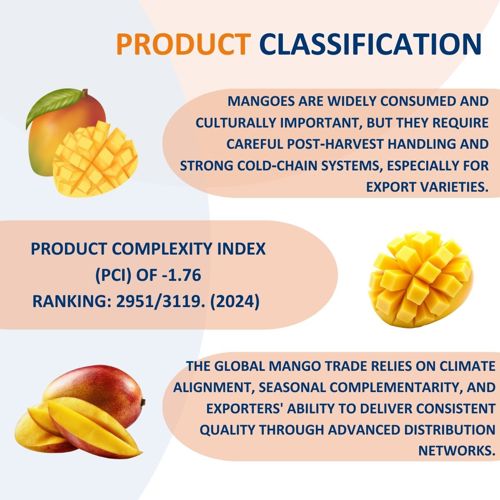
Among the 5,380 products traded worldwide in 2024, mangoes ranked 895th, accounting for 0.018% of global trade. According to the Product Complexity Index (PCI), mangoes scored –1.76, placing them 2951st out of 3119 products. This low complexity ranking aligns with their agricultural nature: simple to grow in tropical climates yet logistically demanding due to perishability and quality control requirements.
The global mango trade is driven by climate suitability, seasonal complementarity between producing regions, and the capacity of exporters to deliver consistent quality. This makes mangoes a clear example of how even tropical fruits with relatively low technological complexity rely on increasingly sophisticated international distribution networks.
EXPORT
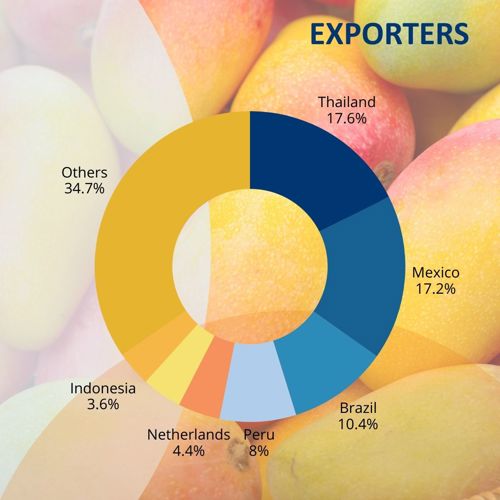
In 2024, the leading exporters of mangoes (grouped under Guavas, Mangoes & Mangosteens) were:
- Thailand – $733M
- Mexico – $715M
- Brazil – $433M
These countries dominate thanks to large-scale tropical cultivation, established global distribution networks, and varietal expertise, from Thailand’s aromatic Nam Dok Mai, to Mexico’s widely exported Ataulfo and Tommy Atkins varieties.
Countries with the highest share of mangoes in their export portfolio in 2024 were:
- Yemen – 4.25%
- Mali – 0.89%
- Dominica – 0.89%
The largest trade surpluses were recorded by:
- Thailand – $711M
- Mexico – $708M
- Brazil – $433M
These surpluses highlight the strong export orientation of mango-producing economies, particularly those with climates suited to year-round or extended-season harvests.
IMPORT
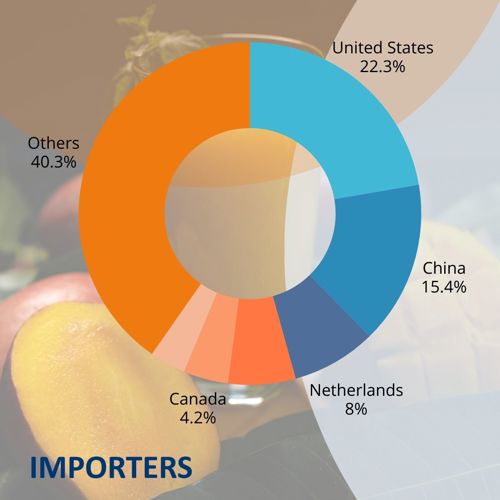
In 2024, the main importers of mangoes were:
- United States – $928M
- China – $638M
- Netherlands – $332M
These markets reflect both consumption and re‑export capacity. The Netherlands, for instance, plays a central role as a distribution hub for Europe, routing mangoes to Germany, France, and other EU countries.
Countries with the largest trade deficits in 2024 were:
- United States – –$897M
- China – –$534M
- United Kingdom – –$259M
These deficits are directly linked to high domestic demand paired with very limited domestic production capacity due to climate constraints.
CURIOSITY CORNER: THE CULTURAL AND BOTANICAL FASCINATION OF MANGOES
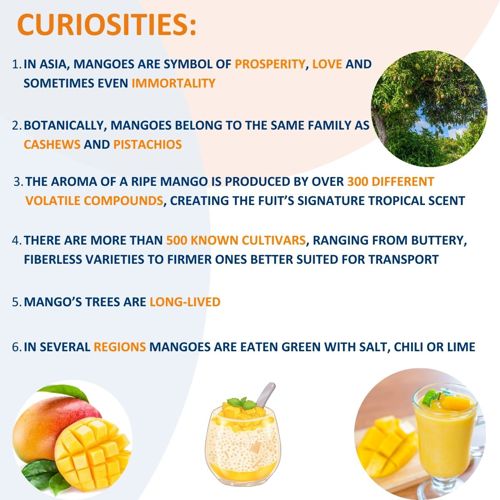
Mangoes have been cultivated for over 4,000 years and hold a special cultural status across Asia, where they are symbols of prosperity, love, and sometimes even immortality. Botanically, mangoes belong to the same family as cashews and pistachios, something few consumers suspect while enjoying the fruit’s rich sweetness.
One intriguing feature is that the aroma of a ripe mango is produced by over 300 different volatile compounds, creating the fruit’s signature tropical scent. Despite their soft texture, mangoes are surprisingly varied: there are more than 500 known cultivars, ranging from buttery, fiberless varieties to firmer ones better suited for transport.
Mango trees are also exceptionally long-lived; some in India are believed to be several centuries old and still bear fruit. And while many associate mangoes with desserts or smoothies, in several regions they are eaten green with salt, chili, or lime: a tangy snack balancing acidity and crunch.
Their global journey, from ancient orchards in South Asia to supermarket shelves worldwide, reflects not only cultural heritage but also the evolution of global supply chains able to transport one of the most beloved tropical fruits across continents while preserving its flavor and freshness.
CONCLUSION
The global mango trade highlights how a traditional tropical fruit can play a strategic role in modern international commerce. In 2024, steady growth in both imports and exports reflected rising global demand and the increasing efficiency of supply chains capable of transporting delicate fresh produce across continents. Major exporters such as Thailand, Mexico, and Brazil continue to capitalize on their climatic advantages, while high‑consumption markets like the United States, China, and the Netherlands showcase the worldwide appeal of mangoes.
Despite their low product complexity, mangoes depend on coordinated logistics, seasonal complementarities, and strong distribution hubs. As consumers around the world embrace tropical flavors and healthier food choices, mangoes are set to remain a dynamic and expanding segment within the global fruit market, bridging traditional cultivation with the evolving patterns of global trade.