
OVERVIEW
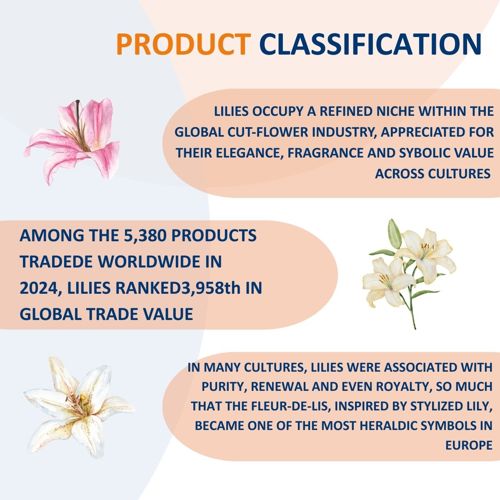
Lilies occupy a refined niche within the global cut‑flower industry, appreciated for their elegance, fragrance, and symbolic value across cultures. Although the market is smaller compared to roses or chrysanthemums, lilies remain a staple of the international floriculture trade, supported by specialized growers and efficient cold‑chain logistics.
In 2024, global trade of Lilies reached $213M, marking a 9.26% decrease from 2023, when trade totaled $235M. Despite this modest decline, the category has experienced a growth over the past five years, with an annualized rate of 0.9%.
Among the 5,380 products traded worldwide in 2024, lilies ranked 3,958th in global trade value, accounting for less than 0.005% of world trade. Lilies fall under the Vegetable Products section, specifically within HS2 Live trees, plants, bulbs, cut flowers & ornamental foliage, under the HS4 Cut Flowers classification.
EXPORT
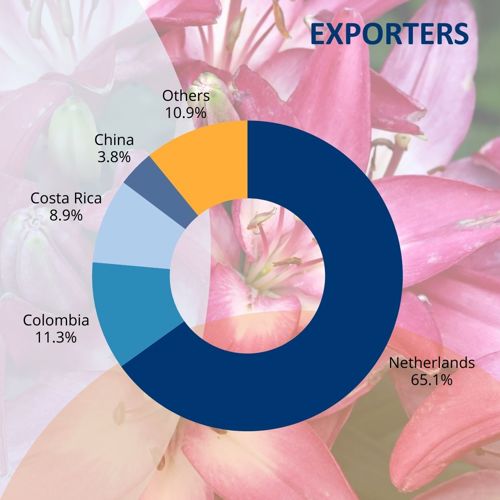
In 2023, the leading exporters of lilies were:
- Netherlands – $139M
- Colombia – $24.1M
- Costa Rica – $18.9M
The Netherlands dominates global lily exports thanks to its advanced greenhouse technology, large‑scale bulb production, and the central role of the Aalsmeer flower auction. Colombia and Costa Rica, both major players in the global floriculture sector, leverage high‑altitude climates and established logistics networks to supply premium stems to North America and Europe.
IMPORT
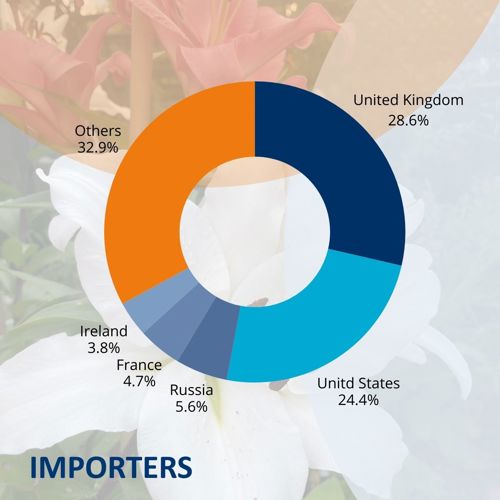
In the same year, the main importers of lilies were:
- United Kingdom – $76M
- United States – $51.9M
- Germany – $12.6M
The United Kingdom remains the largest importer, driven by strong demand from supermarkets, florists, and event‑driven consumption. The United States shows similarly high import levels, reflecting its reliance on foreign floriculture due to limited domestic production. Germany, with a mature floral market, rounds out the top three.
TRADE BALANCE
In 2023, the countries with the largest trade surpluses in lilies were:
- Netherlands – $136M
- Colombia – $24M
- Costa Rica – $18.9M
These surpluses highlight the strength of specialized floriculture industries and export‑oriented production systems.
Conversely, the largest trade deficits were recorded by:
- United Kingdom – –$60.5M
- United States – –$51.8M
- Russia – –$11.9M
These deficits reflect high domestic demand paired with limited local cultivation capacity.
CURIOSITY CORNER: Lilies
Lilies have one of the most ancient and symbolic histories in the world of ornamental plants. Traces of lily cultivation date back over 4,000 years, appearing in Minoan frescoes, Egyptian temples, and early Chinese gardens. In many cultures, lilies were associated with purity, renewal, and even royalty, so much so that the fleur‑de‑lis, inspired by a stylized lily, became one of Europe’s most iconic heraldic symbols.
What makes lilies particularly fascinating in modern trade is the role of bulb production. Unlike many cut flowers grown exclusively for stems, lilies rely on a global network of bulb growers – especially in the Netherlands – who supply farms worldwide. A single bulb can produce multiple flowering stems, making it a miniature biological factory that travels across continents before blooming in a florist’s shop.
Another curiosity: lilies are among the few cut flowers that continue to change dramatically after purchase. Their buds open progressively, revealing new blooms over several days, which is one reason they remain popular in supermarkets and floral arrangements.
Lilies may represent a small slice of global trade, but their journey, from bulb fields to bouquets, is a remarkable intersection of horticulture, logistics, and centuries‑old symbolism.
CONCLUSIONS
Lilies may represent a small share of global floriculture trade, but their market reflects a well‑defined structure shaped by specialized production and strong international demand. The Netherlands continues to dominate exports thanks to its advanced greenhouse systems and leadership in bulb cultivation, while countries like Colombia and Costa Rica supply high‑quality stems to major consumer markets.
On the import side, the United Kingdom and the United States rely heavily on foreign producers, highlighting the importance of global supply chains in meeting year‑round demand. Trade surpluses and deficits clearly mirror these structural roles.
Despite modest long‑term decline, lilies remain a stable and culturally significant product, supported by consistent retail demand and the enduring appeal of premium cut flowers.