OVERVIEW
Honduras, located in the heart of Central America and bordered by both the Caribbean Sea and the Pacific Ocean, is a country rich in natural resources, cultural heritage, and agricultural tradition. From the ancient Maya ruins of Copán to the lush rainforests and coffee‑growing highlands, Honduras blends biodiversity with a vibrant social fabric shaped by Indigenous, African, and Spanish influences.
Economically, Honduras is a developing nation with a strong agricultural base, a growing manufacturing sector, and increasing integration into regional and global trade networks. In 2023, the country ranked 104th in the world in GDP ($34.4B) and 141st in GDP per capita, reflecting both economic potential and structural challenges. Trade plays a central role in its development, with the United States serving as its primary commercial partner.
In 2023 Honduras ranked:
- 104th in GDP ($34.4B)
- 97th in total exports
- 141st in GDP per capita
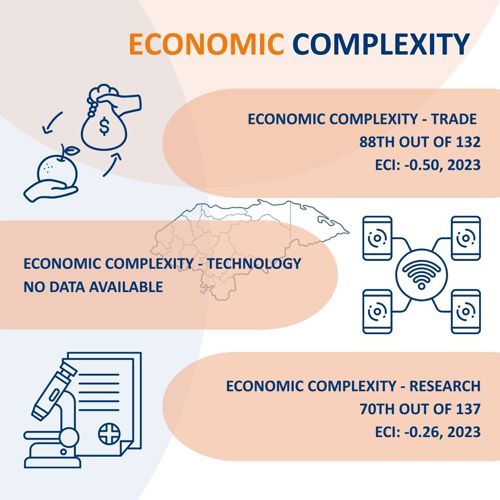
- 88th in Economic Complexity Index (Trade)
- 70th in Economic Complexity Index (Research)
ECONOMIC COMPLEXITY RATE
Honduras shows a moderate level of economic complexity, ranking 88th in trade complexity and 70th in research complexity. These rankings reflect a productive structure that combines traditional agricultural exports, such as coffee and palm oil, with more technologically intensive goods like insulated wire and textile manufacturing. The country’s growing maquila sector (apparel and electronics assembly) contributes to its upward trajectory in complexity.
EXPORT
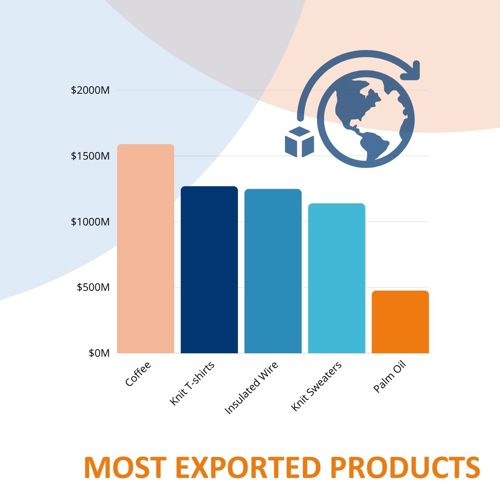
In 2023, Honduras exported $11.4B, positioning it as the 97th largest exporter globally. Its export basket is a mix of agricultural staples and manufactured goods:
- Coffee – $1.59B
- Knit T-shirts – $1.27B
- Insulated Wire – $1.25B
- Knit Sweaters – $1.14B
- Palm Oil – $477M
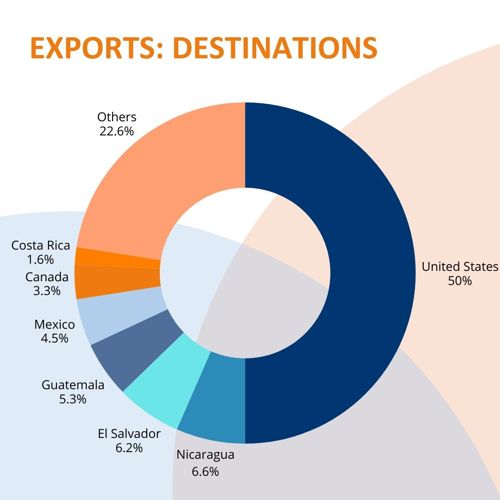
Top destinations for Honduran exports were:
- United States – $5.72B
- Nicaragua – $749M
- El Salvador – $709M
- Guatemala – $608M
- Mexico – $512M
Over the last five years, exports increased significantly from $7.76B in 2018 to $11.4B in 2023, a rise of $3.68B. This growth highlights the resilience of Honduras’s agricultural sector and the expansion of its textile and manufacturing industries.
IMPORT
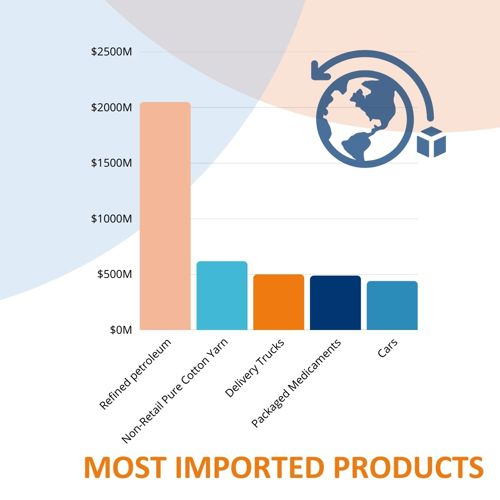
In 2023, Honduras imported $17B, making it the 94th largest importer in the world. Imports reflect the country’s reliance on external markets for energy, machinery, and industrial inputs.
Main imports included:
- Refined Petroleum – $2.05B
- Non-Retail Pure Cotton Yarn – $619M
- Delivery Trucks – $501M
- Packaged Medicaments – $490M
- Cars – $441M
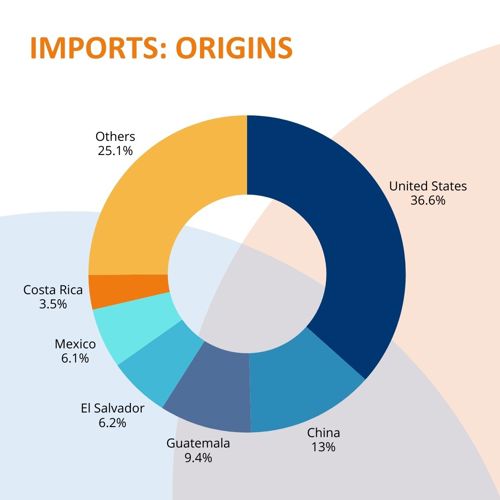
Top origins of imports were:
- United States – $6.23B
- China – $2.21B
- Guatemala – $1.6B
- El Salvador – $1.06B
- Mexico – $1.04B
Imports have grown from $12B in 2018 to $17B in 2023, an increase of $5.06B, reflecting rising domestic demand and industrial expansion.
YEARLY TRADE
The last five years show a clear upward trend in both exports and imports. Exports grew by $3.68B, while imports rose by $5.06B, indicating increasing economic activity but also a widening trade deficit. Manufactured goods – especially textiles and insulated wire – have become increasingly important, complementing Honduras’s traditional agricultural strengths.
CURIOSITY CORNER
Honduras is globally recognized for its high‑quality Arabica coffee, grown in mountainous regions such as Copán, Santa Bárbara, and La Paz. Coffee is not only the country’s top export but also a cultural symbol deeply embedded in rural life.
Another distinctive feature of the Honduran economy is its maquila industry, which produces knitwear, T‑shirts, and sweaters for major global brands. This sector has become a major employer and a driver of export diversification.
CONCLUSIONS
In 2023, Honduras stood out as a dynamic Central American economy balancing traditional agricultural exports with a growing manufacturing base. Its trade profile reflects both its strengths (coffee, textiles, insulated wire) and its challenges, including dependence on imported fuel and industrial inputs.
Opportunities for long‑term growth lie in expanding value‑added agriculture, strengthening manufacturing capabilities, and improving infrastructure and logistics. Culturally and economically, Honduras continues to project its identity through its coffee, textiles, and rich heritage, demonstrating how tradition and industrial development can coexist in a rapidly evolving economy.