
PRODUCT CLASSIFICATION
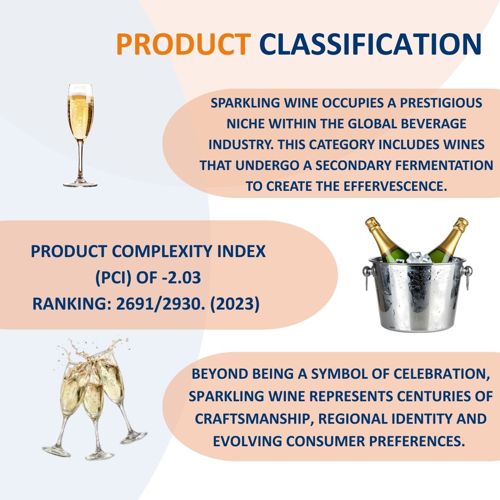
Sparkling wine occupies a prestigious niche within the global beverage industry. From Champagne to Prosecco, Cava, and Crémant, this category includes wines that undergo a secondary fermentation to create their signature effervescence. Beyond being a symbol of celebration, sparkling wine represents centuries of craftsmanship, regional identity and evolving consumer preferences.
Classified under HS Code 220410, sparkling wine reached a global trade value of $10.8B in 2022, representing 0.046% of world trade. Its Product Complexity Index (PCI) is -2.03, ranking 2,691st out of 2,930 products, indicating a low-complexity agricultural product. This reflects the traditional nature of winemaking, even though branding, terroir, and regulation make sparkling wine a highly competitive and value-driven segment.
EXPORT
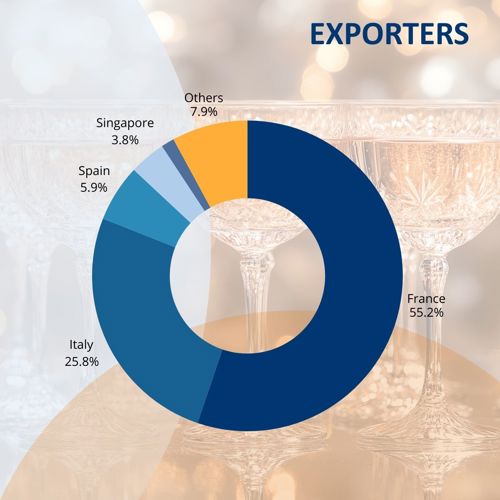
In 2022, the top exporters of sparkling wine were:
- France – $5.52B
- Italy – $2.76B
- Spain – $1.02B
- Singapore – $189M
- Germany – $165M
France leads overwhelmingly thanks to Champagne, which remains the world’s most iconic and premium sparkling wine. Italy’s growth is driven by Prosecco, which has become a global phenomenon due to its accessibility and versatility. Spain’s Cava completes the trio of global leaders.
Countries where sparkling wine represents the highest share of exports include:
- France – 0.39%
- Italy – 0.28%
- Spain – 0.16%
The largest trade surpluses were recorded by:
- France – $5.36B
- Italy – $2.70B
- Spain – $1.00B
IMPORT
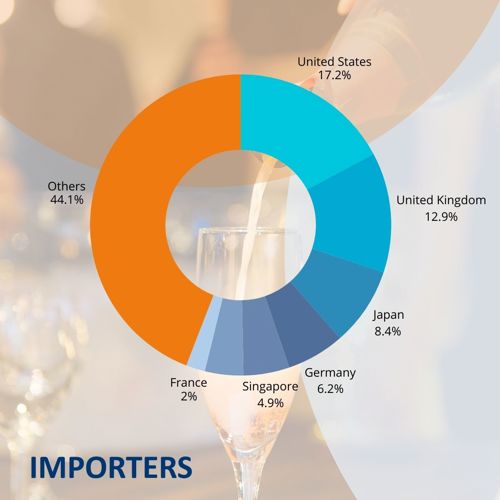
The main importers in 2022 were:
- United States – $1.62B
- United Kingdom – $1.22B
- Japan – $657M
- Germany – $531M
- Belgium – $392M
The U.S. and U.K. are the world’s largest consumption markets for sparkling wine, driven by strong demand for both premium Champagne and more affordable Prosecco. Japan stands out as a high-value market with a strong preference for quality and brand prestige.
Countries with the highest share of sparkling wine in their import mix include:
- Japan – 0.16%
- United Kingdom – 0.15%
- United States – 0.14%
The largest trade deficits were recorded by:
- United States – -$1.60B
- United Kingdom – -$1.19B
- Japan – -$650M
CURIOSITY CORNER: SPARKLING WINE
Sparkling wine has a fascinating history. Although Champagne is the most famous example, the technique of producing effervescence was once considered a flaw: bottles would explode in the cellar due to uncontrolled fermentation. Over time, winemakers mastered the process, transforming an accident into luxury.
Today, sparkling wine is one of the most brand-driven and regionally protected products in the world. Champagne, Prosecco, and Cava each follow strict production rules, and their names are protected by international agreements. Interestingly, Prosecco has been the fastest-growing sparkling wine globally, reshaping consumption habits and making bubbles more accessible to younger consumers.
Sustainability is also shaping the sector: lighter bottles, organic vineyards, and reduced emissions in production are becoming key selling points, especially in Northern Europe.
CONCLUSION
Sparkling wine is a compelling example of how tradition, branding, and global trade intersect. While the product itself is relatively simple from a complexity standpoint, its market is shaped by heritage, regulation, and consumer perception. France, Italy, and Spain dominate exports, while the United States, United Kingdom, and Japan lead imports, illustrating a clear divide between production regions and consumption markets.
As global demand continues to grow, driven by lifestyle trends, premiumization, and the rise of Prosecco, sparkling wine is poised to remain one of the most dynamic and culturally significant segments of the beverage industry. Its story shows how a centuries-old craft can evolve while preserving its identity, proving that bubbles never go out of style.