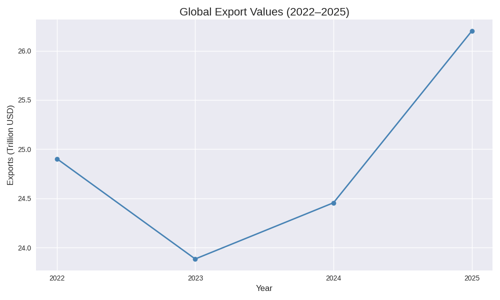
Global trade in 2025 is showing signs of recovery, but the landscape remains uneven and heavily influenced by geopolitical and economic uncertainty. According to recent analyses by UNCTAD, merchandise exports grew again in 2024 after the contraction seen in 2023, reaching $24.5 trillion. Although still below the 2022 peak, global exports are projected to hit a record $26.2 trillion in 2025, signaling cautious optimism for the year ahead.
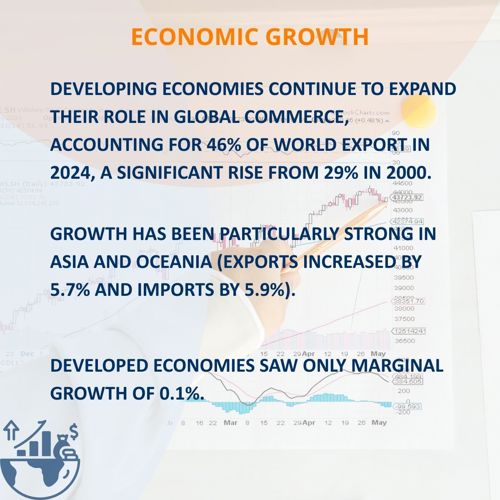
Developing economies continue to expand their role in global commerce, accounting for 46% of world exports in 2024, a significant rise from 29% in 2000. Growth has been particularly strong in Asia and Oceania, where exports increased by 5.7% and imports by 5.9%. Meanwhile, developed economies saw only marginal growth of 0.1%, reflecting a more subdued performance.
On the import side, advanced economies remained flat, while developing countries recorded a trade surplus of $778 billion, slightly higher than the previous year but still below the $819 billion reached in 2022. Developed economies maintained a stable trade deficit of around $1.1 trillion (UNCTAD Data Hub, Data Insights, UN Trade & Development, https://unctadstat.unctad.org/insights/theme/94).
Against this backdrop, sector performance varies widely, with some industries accelerating and others facing structural challenges.
This report provides an overview of which sectors are growing, which are slowing down, and how geopolitical dynamics are reshaping global trade.
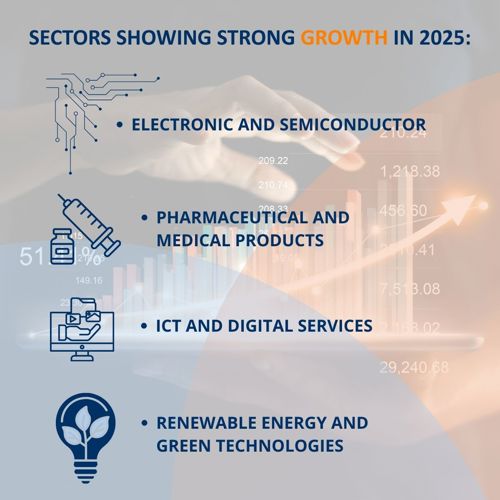
Sectors Showing Strong Growth in 2025:
· Electronics and Semiconductors
Electronics remain one of the strongest contributors to global trade growth. UNCTAD highlights that developed economies saw robust export performance in early 2025, driven in part by strong demand for electronic goods.
· Pharmaceuticals and Medical Products
Pharmaceutical exports continue to expand, supported by strong European performance and ongoing global demand for medical technologies.
· ICT and Digital Services
Digital services are among the fastest‑growing components of global trade. The OECD notes that technological change and digitalization are key forces shaping trade patterns in 2025.
· Renewable Energy and Green Technologies
The shift toward sustainability, accelerated by geopolitical and energy‑related shocks, is driving investment and trade in clean technologies.
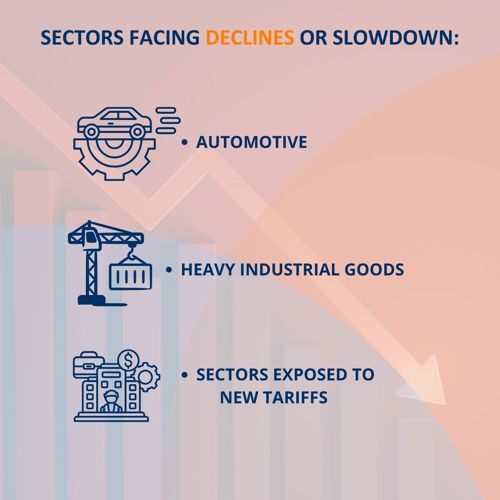
Sectors Facing Decline or Slowdown:
· Automotive
The automotive sector is experiencing slower growth due to supply chain adjustments, energy costs, and shifting trade policies. ExportPlanning’s analysis of global demand shows uneven performance across industrial sectors in early 2025.
· Heavy Industrial Goods
Industrial machinery and heavy equipment face pressure from rising energy prices and global uncertainty, as reflected in broader OECD commentary on structural changes in global trade.
· Sectors Exposed to New Tariffs
Sectors affected by new tariff regimes, particularly those linked to U.S. trade policy, are seeing reduced competitiveness and disrupted supply chains.
Key Global Trends Shaping Trade in 2025
Across global markets, several transformative forces are reshaping how countries trade, invest, and compete.
1. Major Realignments in Global Influence and Trade Flows
Power balances and economic hubs are shifting. New trade partnerships and investment corridors are emerging, challenging long‑established centers of economic gravity. The United States continues to introduce new tariffs, prompting countermeasures from trading partners, while alternative economic clusters are forming in regions that historically played a secondary role in global commerce.
2. Increasingly Fragmented Regulatory and Tax Frameworks
The global regulatory landscape is becoming more uneven. Countries are adopting new tax rules at different speeds, creating inconsistencies across markets. While many economies are implementing global minimum tax standards, others are withdrawing from multilateral tax policy.
3. A Rapidly Evolving and Politically Charged Technology Environment
Technology is advancing faster than regulatory systems can adapt. National security concerns are reshaping alliances, and divergent regulatory approaches are adding complexity for global businesses. The rise of new generative AI competitors is challenging the traditional dominance of U.S. tech firms. Geopolitical competition in AI and other technologies (i.e. quantum computing) is creating technological blocs around the US and China, thus jeopardizing international cooperation and access.
4. Growing Vulnerabilities Across Supply Chains and Critical Infrastructure
Trade barriers, geopolitical tensions, resource competition, cyber threats, and climate‑related disruptions are straining internationally exposed industries. Conflicts and regional instability are increasing risks along major maritime routes, while governments are adopting more protectionist strategies to secure essential supply chains, from energy and food to rare minerals.
5. Workforce Challenges Driven by Demographic and Technological Shifts
Labor markets are undergoing profound change. Aging populations, mass retirement, falling birth rates (in developed markets), changing worker preferences, culture wars, AI integration and reskilling bring major workforce challenges. At the same time, evolving worker expectations, cultural polarization, and the rapid integration of AI are forcing companies to rethink skills, training, and organizational models. Reskilling and adaptation are becoming essential for long‑term competitiveness (KPMG, Top Geopolitical Risks 2025, March 31 2025, https://kpmg.com/xx/en/our-insights/risk-and-regulation/top-risks-forecast-2025.html?utm_source=copilot.com ).
Conclusion
The global trade environment in 2025 is shaped by a combination of sector‑specific dynamics and deep structural forces. While industries such as electronics, pharmaceuticals, ICT, and green technologies continue to expand, others – including automotive and heavy manufacturing – face persistent challenges.
At the same time, geopolitical tensions, regulatory fragmentation, technological rivalry, supply chain vulnerabilities, and demographic pressures are redefining how countries and companies operate in the global marketplace.
For businesses engaged in international trade, understanding these shifts is essential to:
- anticipate risks
- identify emerging opportunities
- adapt supply chains
- remain competitive in a rapidly evolving global economy