PRODUCT CLASSIFICATION
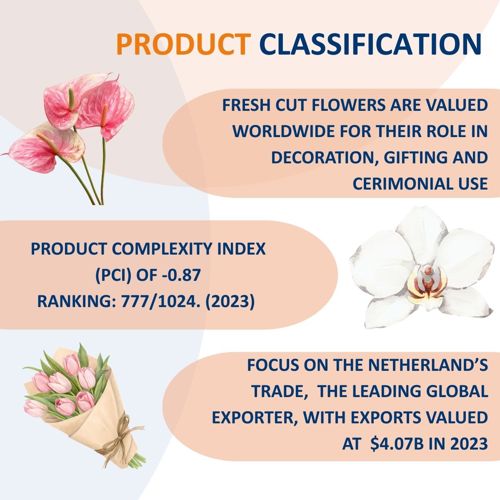
Fresh cut flowers and flower buds for bouquets are horticultural products harvested and sold in their natural form, valued worldwide for their role in decoration, gifting, and ceremonial use. They embody cultural symbolism, aesthetic appeal, and economic importance, serving both consumer and institutional markets.
These products belong to the category Live trees, plants, bulbs, roots, cut flowers, and ornamental foliage within the broader Vegetable Product section. The classification includes roses, tulips, chrysanthemums, carnations, and other ornamental flowers, reflecting the diversity of species cultivated and traded globally.
Fresh cut flowers have a Product Complexity Index (PCI) of -0.87, ranking 777 out of 1,024 products in 2023, which highlights their relatively low complexity compared to industrial goods but immense importance in terms of trade volume and cultural value.
This post will not consider the global flower trade in general, but will be focused on the Netherlands, the world’s largest exporter of fresh cut flowers.
FLOWER TRADE IN THE NETHERLANDS
The Netherlands is the leading global exporter of fresh cut flowers, with exports valued at $4.07 billion in 2023, representing 49.8% of the world’s total exports of this product. Flowers are a cornerstone of the Dutch economy, supported by advanced greenhouse technology, logistics infrastructure, and the world-famous flower auctions in Aalsmeer.
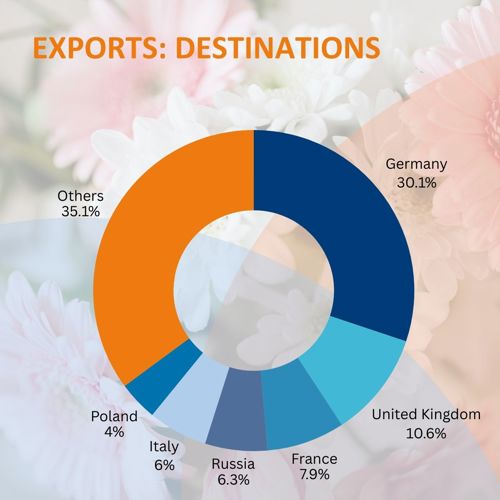
Main destinations for Dutch flower exports:
- Germany ($1.43B)
- United Kingdom ($482M)
- France ($472M)
- Italy ($284M)
- Belgium ($266M)
These figures highlight the dominance of European markets in absorbing Dutch flower supply, with Germany alone accounting for more than a third of total exports.
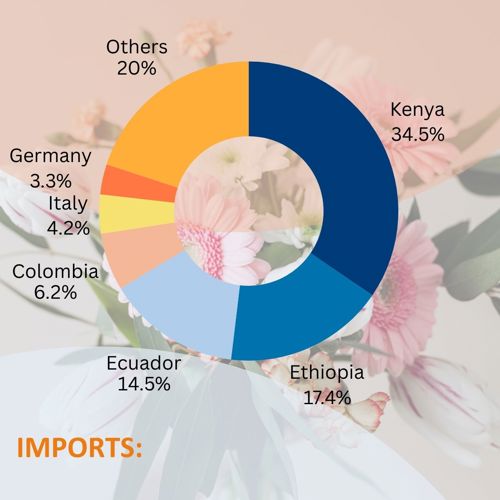
On the import side, the Netherlands sources fresh cut flowers primarily from:
- Kenya ($1.02B)
- Ethiopia ($236M)
- Colombia ($94.8M)
- South Africa ($41.7M)
- Ecuador ($40.4M)
Imports are significant, as the Netherlands acts as a global hub: flowers are imported, processed, and re-exported across Europe and beyond.
EXPORT
In 2023, the Netherlands shipped out $4.07 billion worth of fresh cut flowers, securing its position as the world’s leading supplier among 122 exporting nations. Within the country’s export portfolio, fresh cut flowers ranked as the 12th most significant product out of 1,024, underscoring their central role in the national economy.
The largest buyers of Dutch flowers during that year were:
- Germany ($1.43B)
- United Kingdom ($482M)
- France ($472M)
- Italy ($284M)
- Belgium ($266M)
Between 2022 and 2023, the most dynamic growth in demand came from:
- Germany (up $39.7M)
- Poland (up $17.3M)
- Czechia (up $12.4M)
This reflects shifting trade flows and expanding consumption in Central and Eastern Europe.
IMPORT
In 2023, the Netherlands imported $1.61 billion worth of fresh cut flowers, making it the largest importer worldwide. Within the Netherlands’ overall import basket, fresh cut flowers ranked as the 26th most imported product out of 1,024.
The largest suppliers were:
- Kenya ($1.02B)
- Ethiopia ($236M)
- Colombia ($94.8M)
- South Africa ($41.7M)
- Ecuador ($40.4M)
This highlights the Netherlands’ dual role as both a producer and a global distribution hub for flowers.
CURIOSITY CORNER
The Dutch flower world hides some pretty amazing quirks. For example, every morning at the Aalsmeer auction, buyers basically race each other using giant clocks to snag the best flowers at the perfect second. It’s like a high‑stakes game show, except the prize is a truckload of roses.
And speaking of speed: a flower in the Netherlands lives life in the fast lane. A rose cut in Kenya can land in Amsterdam, get auctioned at dawn, and end up in a Paris boutique before most people have even checked their emails. If productivity had a mascot, it would definitely be a Dutch flower.
Tulips may be the national icon, but fun fact, they once caused an economic bubble so wild that some bulbs were worth more than a house. Today you can buy a bouquet without selling your furniture, which is reassuring.
Meanwhile, Dutch greenhouses look like something out of a sci‑fi movie. Robots, climate‑controlled glass walls, LED lights that make the plants look like they’re at a rave… If flowers could party, the Netherlands would be their favorite nightclub.
CONCLUSIONS
In 2023, the Netherlands reinforced its position as the world’s leading supplier of fresh cut flowers, leveraging its advanced horticultural sector and strategic role as Europe’s floral hub. With strong demand from neighboring countries and efficient re-export systems, Dutch flowers continue to dominate international markets.
This achievement reflects the Netherlands’ ability to connect global demand with both local production and imports from Africa and Latin America, strengthening its role in the global flower market. Such dominance not only highlights the country’s current success but also provides a foundation for future growth, particularly if more value is captured through innovation, sustainability, and diversification in the floral industry.