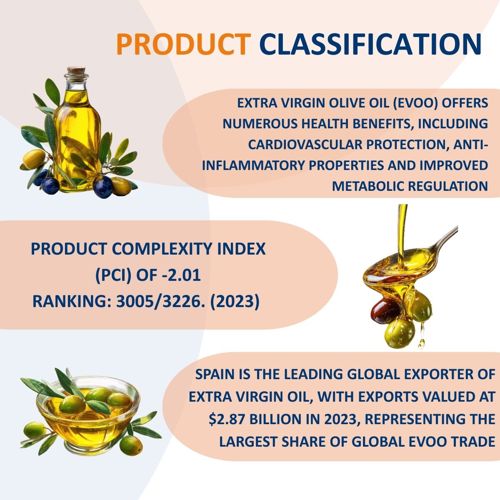
Rich in monounsaturated fats, polyphenols, and antioxidants, extra virgin olive oil (EVOO) offers numerous health benefits, including cardiovascular protection, anti-inflammatory properties, and improved metabolic regulation. Beyond its traditional role in Mediterranean cuisine, EVOO is widely incorporated into bakery products, gourmet sauces, dairy innovations, cosmetics, and nutraceuticals, making it a versatile ingredient across multiple industries.
From a trade perspective, EVOO falls under HS Code 150920, within the category of olive oil and its fractions. Its classification highlights EVOO’s role as a globally traded commodity with both cultural and economic significance.
The global olive oil market was valued at several billions of dollars in 2023, though Spain experienced a 40% decline in domestic sales due to soaring retail prices. Despite this contraction in local consumption, Spain remains the world’s leading exporter, supported by strong demand from North America, Europe, and Asia.
Production faces challenges such as climate variability, prolonged droughts, and olive tree diseases, particularly in Andalusia, the country’s main olive-growing region. Advances in sustainable farming, irrigation technologies, and certification schemes (PDO, PGI, organic) are helping to mitigate these risks and ensure consistent supply.
Regionally, Spain dominates global production, accounting for nearly half of worldwide exports, while Italy and Greece remain important competitors. Consumption is expanding in the United States and Asia-Pacific, where EVOO is increasingly perceived as a premium lifestyle product.
EVOO has a Product Complexity Index (PCI) of -2.01, ranking 3,005th out of 3,226 products in 2023, underscoring its relatively low technological complexity but high cultural and commercial value.
OLIVE OIL TRADE IN SPAIN
Spain is the leading global exporter of extra virgin olive oil, with exports valued at $2.87 billion in 2023, representing the largest share of global EVOO trade. Olive oil is a key agricultural product for Spain, underscoring its central role in the Mediterranean food economy.
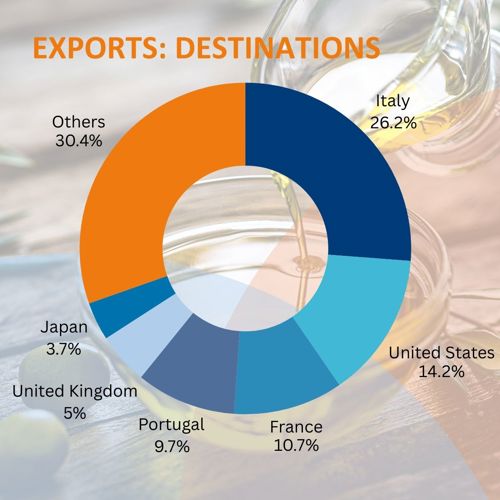
The main destinations for Spanish EVOO are:
- United States – $1.64B
- Italy – $1.01B (often re-imported for blending and bottling)
- France – $497M
- Germany – $428M
- China – $314M
These figures highlight the dominance of North American and European markets in absorbing Spain’s olive oil supply.
On the import side, Spain sources relatively small volumes of olive oil compared to its exports, mainly from Portugal and Tunisia, used for blending and stabilizing domestic supply.
EXPORT
In 2023, Spain shipped out $2.87B worth of EVOO, securing its position as the world’s leading supplier among olive oil-producing nations. Within Spain’s export portfolio, EVOO ranked as one of the most significant agricultural products, reinforcing its strategic role in the national economy.
The largest buyers of Spanish EVOO during that year were:
- United States ($1.64B)
- Italy ($1.01B)
- France ($497M)
- Germany ($428M)
- China ($314M)
Between 2022 and 2023, the most dynamic growth in demand came from China and Brazil, reflecting shifting trade flows and expanding consumption in new regions.
IMPORT
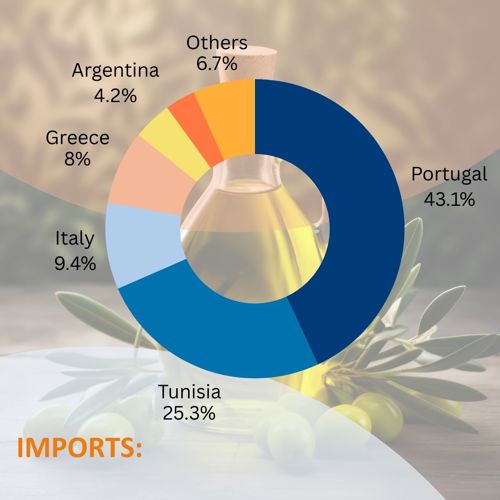
In 2023, Spain imported a limited volume of olive oil, valued at approximately $200M, placing the country far below its export levels. Within Spain’s overall import basket, olive oil ranked as a minor product, highlighting its limited role as an import.
Imports were sourced mainly from:
- Portugal
- Tunisia
- Greece
These imports are primarily used for blending and stabilizing supply during years of poor harvests.
CURIOSITY CORNER
Andalusia, in southern Spain, is considered the cradle of extra virgin olive oil. With vast olive groves stretching as far as the eye can see, this region produces around 70% of Spain’s olive oil and more than one-third of the world’s supply. The provinces of Jaén and Córdoba are especially renowned for both the quality and the scale of production, earning Jaén the title of “world capital of olive oil.”
What makes Andalusian olive oil unique is its deep connection to the land: the Mediterranean climate, limestone-rich soils, and native varieties such as Picual, known for its intense and slightly bitter flavor, give the oil a distinctive aromatic profile. Jaén’s olive oil, in particular, is recognized with PDO and PGI certifications that guarantee authenticity and quality.
Every year, the city of Jaén hosts the Feria Internacional del Aceite de Oliva e Industrias Afines (Expoliva), one of the most important olive oil fairs in the world. The event celebrates not only the product itself but also technological innovation, sustainability, and the culture surrounding this Mediterranean symbol.
Over time, Andalusian extra virgin olive oil has become a luxury ingredient in international cuisine, appreciated by chefs and consumers alike for its intensity and versatility. For Spaniards, however, it remains above all an identity symbol, a bridge between agricultural tradition and modernity, telling the story of a territory through taste.
CONCLUSIONS
In 2023, Spain’s olive oil trade reinforced the country’s position as the world’s leading supplier of extra virgin olive oil. With favorable growing conditions, centuries of tradition, and advanced processing infrastructure, EVOO has become a defining feature of Spain’s agricultural exports and international trade profile.
This achievement reflects Spain’s ability to connect global demand with local resources, strengthening its role in the global food market. Such dominance not only highlights the country’s current success but also provides a foundation for future growth, particularly if more value is captured through premium branding, local processing, and diversification into non-food sectors such as cosmetics and nutraceuticals.