India’s Economic Upswing in 2026: Strengthened Fundamentals, Strategic Reforms, and a New Trade Orientation
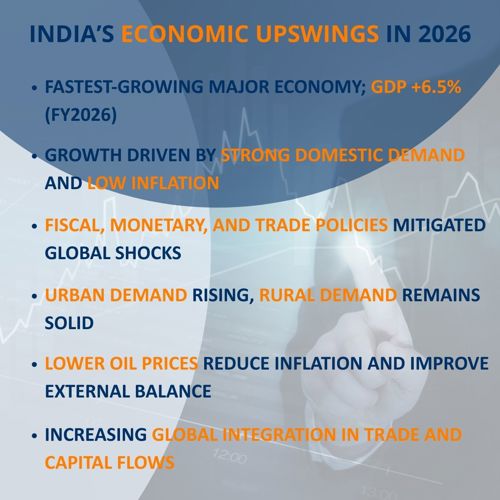
India is the world’s fastest-growing major economy, with GDP forecast to grow 6.5% in fiscal 2026. In 2025 it faced external shocks and acute effects from global policy changes, including tariff escalations and volatile capital flows.
Despite several challenges, resilience in demand, a shift in trade and investment expectations, and ongoing policy reforms were notable. India placed strong emphasis on its key advantage – domestic demand – to sustain robust growth, while inflation remained low, averaging 1.8% throughout the fiscal year. With global demand weakening, trade tensions increasing, and domestic consumption facing pressures, India implemented a carefully phased mix of fiscal, monetary, and trade measures. These actions not only helped protect the economy from external shocks but also established a solid groundwork for future expansion. As inflation continues to ease, urban consumption is expected to pick up, since city‑level spending has not yet shown a strong rebound. Rural demand remains solid, while the new income tax cuts should help strengthen urban purchasing power. The planned GST rationalization and a further decline in food inflation would especially support lower‑income households, freeing up more room for discretionary spending.
Basic necessities like food and fuel weigh more heavily on poorer families. According to Crisil (June 2025), the bottom 20% of earners face lower inflation than the top 20%. In Q1 FY2026, inflation for the lowest‑income urban group was 2.4%, compared with 3.1% for the highest‑income group, with similar trends in rural areas.
Crisil also expects crude oil prices to average $65–$70 per barrel in FY2026, down from $78.8 in FY2025. Lower oil costs tend to reduce inflation and narrow the current account deficit (CAD). Past estimates from the Ministry of Finance (Economic Survey 2017–2018) suggest that every $10‑per‑barrel rise in oil prices can trim GDP growth by 0.2–0.3 percentage point and worsen the CAD by $9–$10 billion.
India’s growth trajectory, when compared with that of advanced economies, shows a clear pattern: global shocks have occasionally caused short‑term disruptions, but they have not altered the country’s long‑run expansion. In fact, India has widened its growth edge over developed nations by consistently pushing forward reforms, upgrading infrastructure, and improving institutional processes.
At the same time, although India’s economy is still heavily shaped by domestic forces, its increasing integration with global markets through trade and capital flows has made it more sensitive to international volatility. As exports and financial inflows rise as a share of national output, external conditions play a larger role in shaping short‑term performance. In fiscal year 2025, exports represented 21.2% of GDP, and financial flows stood at 28.5%, a significant jump from fiscal year 2002, when the shares were 12.6% and 8.9%, respectively.
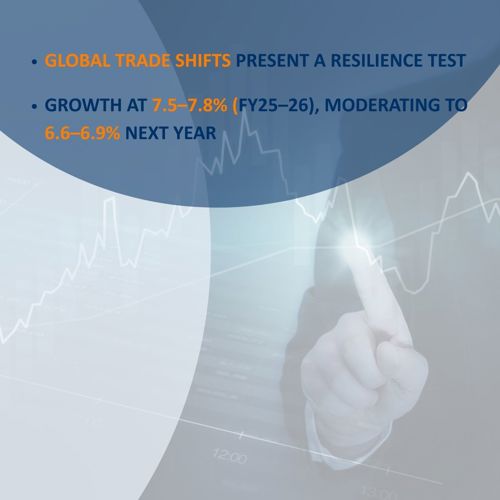
This growing exposure comes at a moment when the global trade environment is undergoing major changes. The shifts expected in fiscal 2026, especially the direct and indirect effects of new tariff measures, will provide a critical test of India’s economic resilience and its ability to navigate a more uncertain international landscape.
As India moves into 2026, a combination of structural reforms, steady domestic demand, and evolving global partnerships is expected to shape its next phase of economic expansion. Growth for fiscal year 2025–2026 is likely to surpass earlier projections, supported by a strong third quarter lifted by festive-season consumption. Overall growth is anticipated to fall between 7.5% and 7.8%, before moderating to 6.6%–6.9% in FY2026–2027 as inflation continues to cool and revised GST rules come into force.
Domestic Demand: India’s Primary Growth Lever
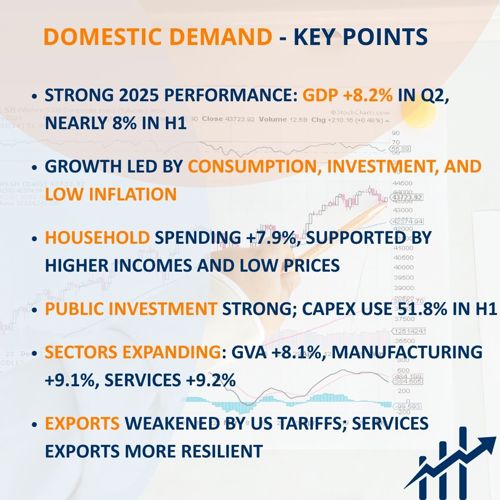
India’s economic performance remained solid through 2025. GDP grew 8.2% year over year in Q2, reinforcing expectations of a stronger full-year outcome. Despite turbulence from heightened US tariffs and unpredictable foreign portfolio flows, India recorded nearly 8% growth in H1, sustained by vigorous consumer spending and increased investment, supported by declining inflation and better rural conditions.
The key contributors are:
- Household consumption: Spending rose 7.9% in Q2, fueled by decade-low inflation of 1.7%, improved disposable incomes following tax adjustments, and beneficial rainfall patterns. Consumption expanded 7.5% in H1.
- Investment activity: Public investment remained a strong catalyst. Government capex utilization climbed to 51.8% in H1, compared to 37.3% a year earlier, helping push fixed investment growth to 7.6%.
- Sector performance: GVA increased 8.1% in Q2, with manufacturing advancing 9.1% and services rising 9.2%, driven especially by financial and professional services. Services now represent 60% of GVA and nearly half of total exports.
- Exports: After a strong start in Q1, exports softened in Q2 due to higher US duties, including tariffs of up to 50% on select goods. Export momentum is expected to improve as India progresses with trade discussions with the US and EU and expands into high-value sectors like electronics, services, and pharmaceuticals. However, Services exports, which account for 47% of the country’s exports, according to the Indian government, are less vulnerable to global trade fluctuations than goods exports.
Policy Reforms Supporting the Growth Cycle
Fiscal measures
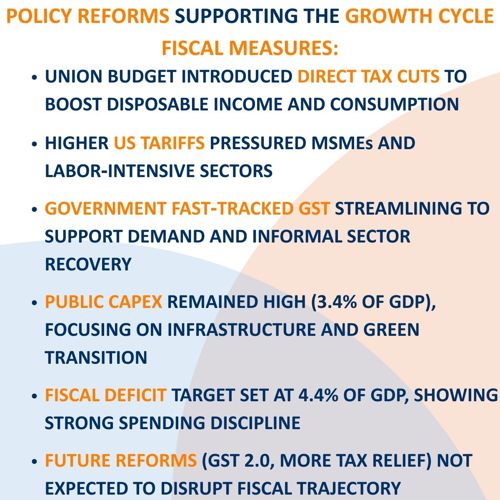
The year began on a hopeful note, with the Union Budget 2025–2026 signaling strong policy direction rather than major spending expansion. The government introduced long-anticipated direct tax cuts aimed at middle‑income households, a group strained by ongoing inflation, a gradual post–COVID‑19 labor market rebound, and high borrowing costs. By easing personal tax liabilities, officials sought to bolster disposable income, stimulate discretionary consumption, and support small enterprises that depend heavily on domestic demand.
By April 2025, global challenges had grown, and the United States’ move to impose higher tariffs on select Indian products created additional strain for micro, small, and medium enterprises (MSMEs) as well as labor‑intensive industries such as seafood, textiles, apparel, and auto components.
To counter these pressures, the government fast‑tracked a major reform (the streamlining of GST rate slabs) just ahead of the festive period. The aim was to strengthen local demand (to compensate for weak export markets), assist the informal sector’s recovery, enhance tax compliance, and encourage higher consumer outlays.
Alongside these efforts, the government sustained elevated levels of public capital investment (3.4% of GDP during the first half of fiscal 2025–2026) directing spending particularly toward infrastructure and green‑transition initiatives, including renewable‑energy investments. This ensured that domestic demand remained the primary driver of economic growth.
India has also tightened expenditure, targeting a fiscal deficit of 4.4% of GDP for the current year, a notable improvement from the pandemic peak of 9.2% in fiscal 2020–2021. Effective spending discipline and strong revenue performance have so far enabled the government to pursue measures that support growth.
Looking ahead, upcoming reforms, such as the implementation of GST 2.0 and additional tax‑relief initiatives, are unlikely to disrupt this progress. Increased non‑tax revenues, supported by a faster disinvestment program and strategic asset monetization, are expected to compensate for any potential revenue gaps, helping maintain fiscal responsibility while sustaining economic momentum.
Monetary policy
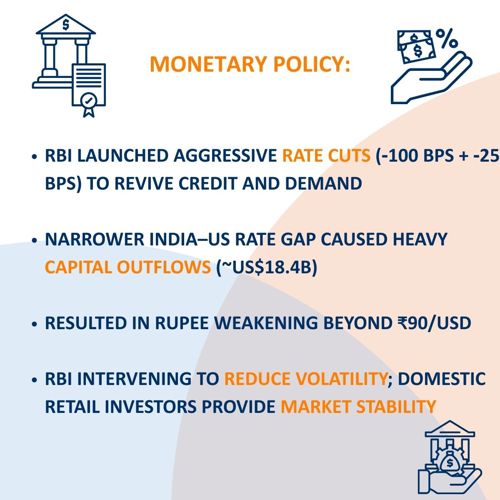
Fiscal and monetary authorities acted in tandem to reinforce domestic demand. The Reserve Bank of India (RBI) confronted a slowdown in credit growth by launching one of its most aggressive rate‑cutting cycles in recent years, reducing policy rates by 100 basis points starting February, and an additional 25‑basis‑point cut later in the year to revive lending and consumption.
However, this accommodative stance narrowed the India–US interest‑rate gap, contributing to sizeable capital outflows. In 2025, foreign portfolio investors withdrew roughly US$18.4 billion, the highest outflow in 15 years, which contributed to the rupee weakening beyond ₹90 per US dollar. RBI interventions are expected to reduce volatility, although persistent outflows may continue to weigh on the currency. Notably, domestic retail investors have played an important stabilizing role in equity markets.
Labor market reforms
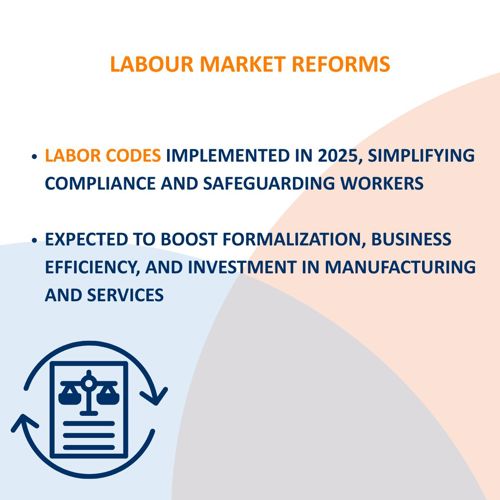
A major milestone was achieved in 2025 when the long‑delayed Labor Codes finally took effect. By simplifying compliance requirements and preserving worker protections, the reform is poised to improve the operating environment for businesses, support job formalization, and attract new investment in both manufacturing and services.
India’s Shifting Trade Strategy
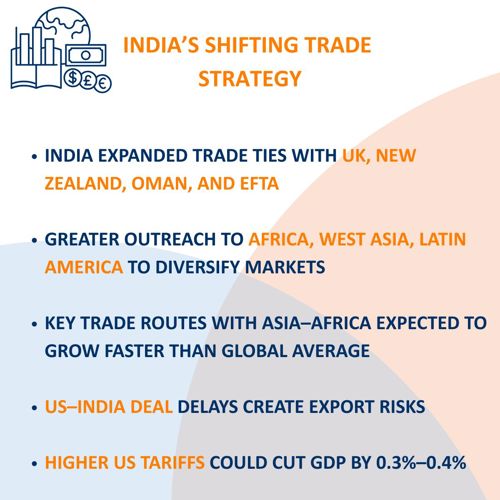
India’s external engagement in 2025 underwent a significant transformation. The country deepened ties with longstanding partners while expanding into new regions to diversify markets and reduce concentration risks. Agreements were concluded with the UK, New Zealand, and Oman, negotiations began with Israel, and the EFTA pact became operational.
Beyond traditional partners, India intensified outreach across emerging markets in Africa, West Asia, and Latin America, regions that account for 85% of the world’s population and about 40% of global GDP. Trade routes linking South Asia, Southeast Asia, and Africa are projected to grow at rates significantly higher than the global average.
However, the unresolved US–India trade deal continues to create uncertainty. The agreement is expected to enhance bilateral trade and investment, but prolonged delays pose risks: goods exports could remain subdued, and services exports may face longer-term vulnerabilities. Depending on the scenario, higher US tariffs could affect India’s GDP by 0.3%–0.4%.
India’s Economic Outlook for FY2025–2026: Key Risks to Monitor
Much of 2025 focused on absorbing external shocks and strengthening domestic fundamentals. As India transitions into 2026, both global and domestic risks will require careful policy management.
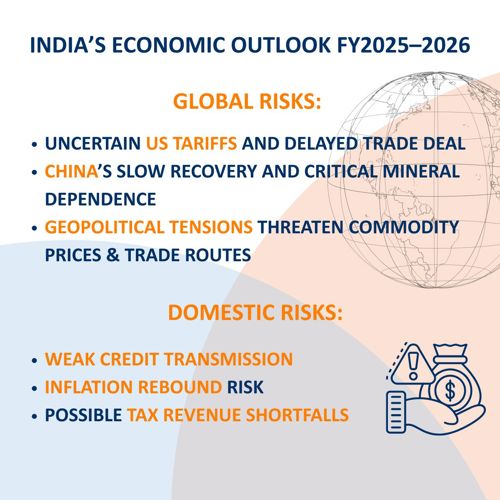
Major global risks in 2026 include:
- Uncertain US tariff policies and the unpredictable timeline for the India–US trade deal.
- China’s sluggish recovery, coupled with its dominance in critical minerals, which could pressure India’s supply‑chain resilience as bilateral relations evolve.
- Geopolitical tensions in Central Asia, which could disrupt global commodity prices and essential logistics corridors such as the Red Sea route.
Key domestic risks to watch:
- Weak transmission of policy rate cuts into meaningful credit growth.
- A potential resurgence in inflation, especially as demand accelerates and core inflation remains above 4%.
- Possible shortfalls in tax revenues, which could complicate fiscal consolidation efforts.
Growth in Q3 is expected to be strong thanks to festive-season demand, followed by a more tempered expansion in Q4, unless the US–India trade deal is finalized, which could unlock additional trade and investment flows.
In Deloitte’s optimistic scenario, overall growth for FY2025–2026 is expected to fall between 7.5% and 7.8%, while the following year’s expansion will likely be more moderate due to a higher base and persistent global challenges.
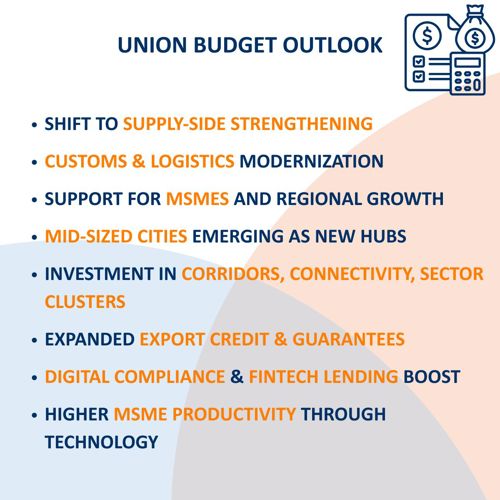
Union Budget Outlook: From Demand Support to Supply-Side Expansion
India is at a pivotal juncture. For the first time in a decade, the Union budget will be presented against a backdrop of strong GDP growth, controlled inflation, and stable external conditions. Recent efforts to stimulate domestic demand amid global uncertainty have been effective, but further progress will depend on strengthening supply‑side capabilities.
The government has indicated a potential full restructuring of customs processes, aimed at reducing compliance burdens and improving logistics efficiency. The budget may also prioritize productivity enhancements, greater support for MSMEs, and strategies to foster balanced growth outside major metropolitan areas.
Mid‑sized cities, including Indore, Coimbatore, Lucknow, and Bhubaneswar, are emerging as new centers of economic activity, attracting manufacturing hubs, global capability centers, and startups. These cities offer promising opportunities due to improved infrastructure and a growing skilled workforce.
The budget may prioritize industrial corridors and logistics hubs to reduce supply‑chain costs, stronger connectivity, including regional airports, high‑speed rail, and digital infrastructure, sector-focused clusters in textiles, electronics, and auto components, public–private partnerships to co-develop infrastructure and workforce training.
On the other side, to enhance competitiveness, the government may focus on expanding export credit and concessional financing, along with stronger credit‑guarantee mechanisms, modernizing compliance through digital platforms, improving transparency and ease of doing business, promoting fintech‑enabled lending, with faster credit assessment and broader integration into platforms like TReDS, boosting MSME productivity, including digital accounting, AI‑based quality control, pricing tools, and demand forecasting.