OVERVIEW
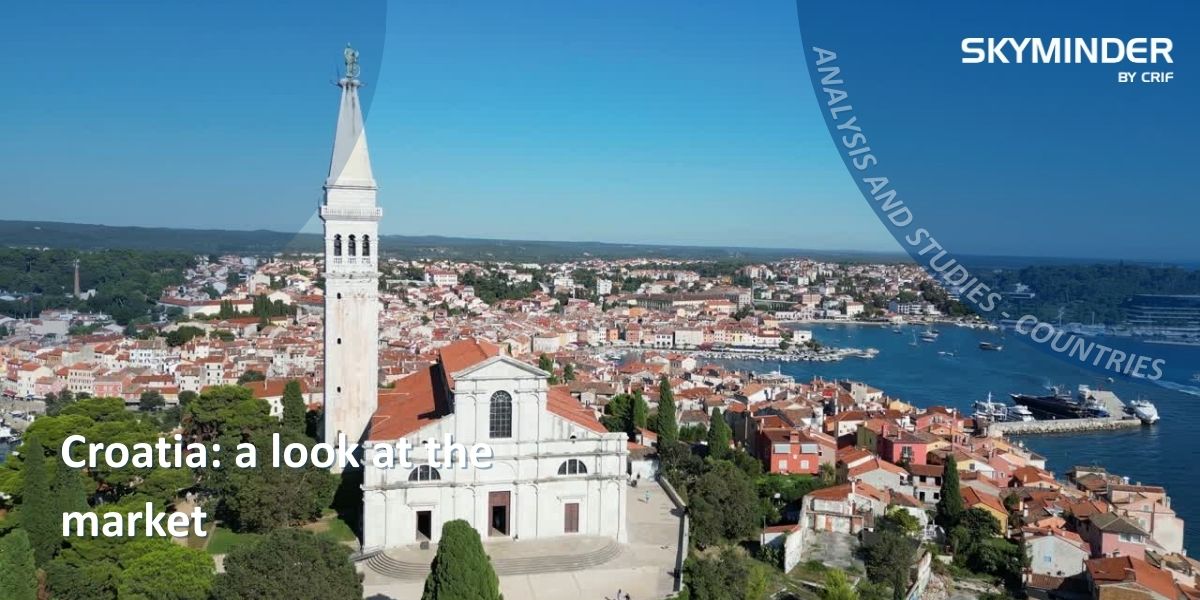
Croatia, positioned along the Adriatic Sea at the crossroads of Central and Southeast Europe, combines Mediterranean charm with a dynamic and evolving economy. Known for its thousand islands, crystal‑clear waters, and historic cities such as Dubrovnik and Split, the country blends natural beauty with centuries of cultural heritage shaped by Illyrian, Roman, Venetian, and Austro‑Hungarian influences.
Beyond tourism, one of its most visible strengths, Croatia has developed a diversified economic structure with solid performances in pharmaceuticals, electrical equipment, energy, and maritime industries. Since joining the European Union in 2013 and the Eurozone in 2023, the country has benefited from deeper integration, increased investment flows, and strengthened trade links with its European partners.
Zagreb, the capital, is the main political and economic center, hosting a growing technology and services sector. Other key urban areas contribute significantly: Split thrives as a tourism and maritime hub; Rijeka stands as an important port city; and Osijek anchors the agrifood industry in the east.
In 2024, Croatia ranked:
- 75th in GDP, at $93B current US$
- 75th in total exports out of 226 economies
- 60th in total imports
- 55th in GDP per capita (current US$)
· This combination of moderate size, strong integration, and high complexity highlights Croatia’s capability to compete in technologically sophisticated sectors.
ECONOMIC COMPLEXITY RANKING
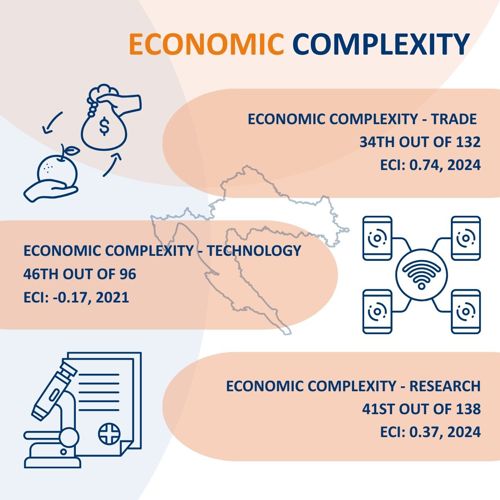
Croatia shows an impressive degree of diversification and technological capability relative to its size. In 2024, it ranked:
- 34th in Economic Complexity Index (Trade, 2024)
- 46th in ECI (Technology, 2021)
- 41st in ECI (Research, 2024)
These rankings reflect competitive industries such as pharmaceuticals, electrical machinery, and advanced manufacturing, key pillars of the country’s export profile.
EXPORT
In 2024, Croatia exported $23.7B, positioning it as the 75th largest exporter in the world.
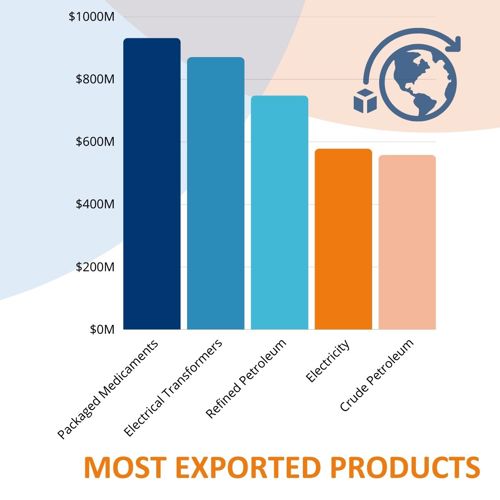
The country’s main export products were:
- Packaged Medicaments – $932M
- Electrical Transformers – $871M
- Refined Petroleum – $748M
- Electricity – $578M
- Crude Petroleum – $558M
These sectors illustrate Croatia’s strength in both energy and high‑value manufacturing.
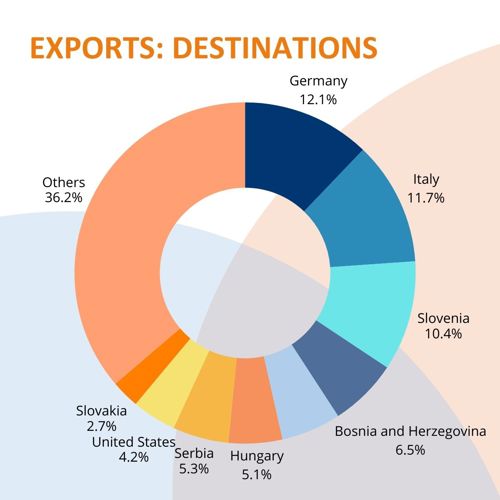
The top destinations for Croatian goods were:
- Germany – $2.88B
- Italy – $2.76B
- Slovenia – $2.48B
- Bosnia and Herzegovina – $1.53B
- Austria – $1.34B
Germany and Italy remain Croatia’s primary commercial partners, reflecting strong EU integration and established supply‑chain relationships.
IMPORT
In 2024, Croatia imported $46.4B, making it the 60th largest importer globally.
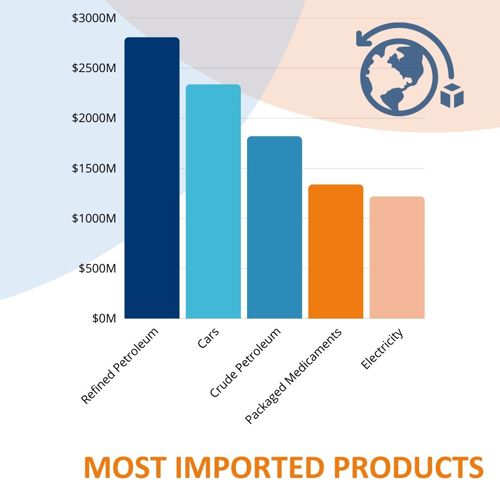
The main imported products were:
- Refined Petroleum – $2.81B
- Cars – $2.34B
- Crude Petroleum – $1.82B
- Packaged Medicaments – $1.34B
- Electricity – $1.22B
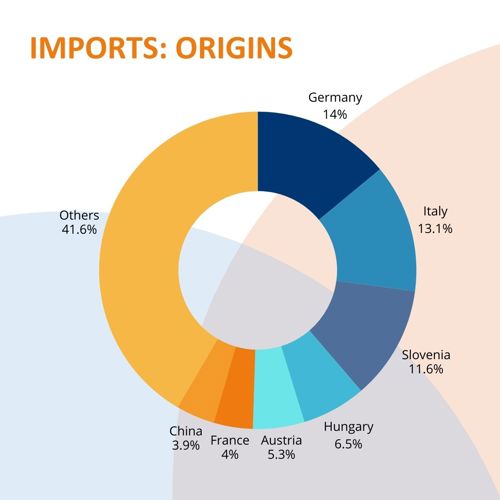
Its leading suppliers were:
- Germany – $6.5B
- Italy – $6.09B
- Slovenia – $5.4B
- Hungary – $3.03B
- Austria – $2.44B
These patterns reveal Croatia’s dependency on neighboring EU economies for both industrial inputs and consumer goods.
YEARLY TRADE
Croatia’s trade flows have expanded significantly in recent years.
Exports
Between 2019 and 2024, exports grew by $6.68B, rising from $17B to $23.7B.
The most recent export structure continues to be led by:
- Packaged Medicaments – $932M
- Electrical Transformers – $871M
- Refined Petroleum – $748M
- Electricity – $578M
- Crude Petroleum – $558M
Main destinations remain stable, dominated by Germany, Italy, and Slovenia.
Imports
Imports increased even more sharply, rising by $17.4B, from $29B in 2019 to $46.4B in 2024.
The top import categories (petroleum products, cars, and pharmaceuticals) highlight the country’s strong domestic consumption and industrial needs.
Trade Balance
In 2024, Croatia recorded positive trade balances with:
- Montenegro – $302M
- Senegal – $241M
- United Kingdom – $213M
- Bosnia and Herzegovina – $205M
- Serbia – $180M
Conversely, the largest trade deficits were with:
- Germany – -$3.62B
- Italy – -$3.33B
- Slovenia – -$2.92B
- Hungary – -$1.83B
- China – -$1.65B
These imbalances reflect Croatia’s reliance on advanced machinery, energy inputs, and consumer goods from major European economies.
CURIOSITY CORNER
Beyond its well-known tourism sector, Croatia nurtures several unique strengths. One particularly interesting niche is its high‑quality pharmaceutical production. Croatian pharmaceutical companies, rooted in a long scientific tradition, have become globally competitive, making packaged medicaments the country’s top export.
Another remarkable aspect is Croatia’s expertise in electrical transformers and power equipment, a legacy of its industrial engineering base. These products are exported worldwide, underlining the country’s capacity to produce technologically advanced goods despite its small size.
Whether through innovative manufacturing or its centuries‑old maritime heritage, Croatia continues to demonstrate a blend of tradition and modern competitiveness.
CONCLUSION
Croatia’s economic landscape reveals a country that, despite its relatively small size, has carved out a distinctive and competitive position within the European market. Its strong integration into the EU, rapidly advancing economic complexity, and growing presence in high‑value sectors such as pharmaceuticals, electrical equipment, and energy demonstrate its ability to innovate and adapt. With exports steadily expanding and strategic ties with Germany, Italy, and neighboring countries strengthening year after year, Croatia is well‑positioned to consolidate its role in regional value chains. While challenges remain, particularly the persistent trade deficit, the country’s combination of stability, technological advancement, and strategic geography offers promising opportunities for businesses and investors looking toward Southeast Europe. Croatia stands as a market worth watching, and even more, a market worth engaging with.