PRODUCT CLASSIFICATION
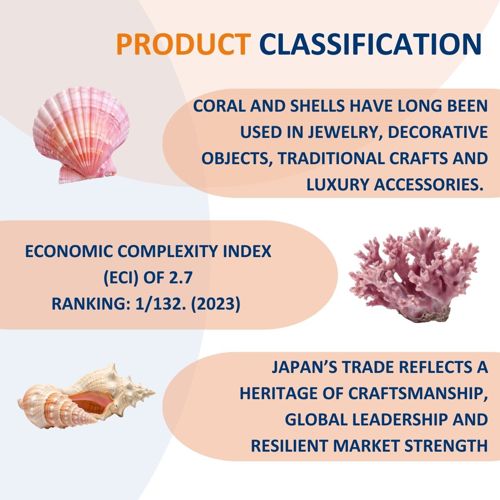
Valued for their aesthetic, cultural, and artisanal significance, corals and shells have long been used in jewelry, decorative objects, traditional crafts and luxury accessories. Beyond their ornamental appeal, these materials play a role in niche biomedical applications, natural pigments, and high-end design, making them a distinctive segment of global trade.
From a trade classification perspective, coral and shells fall under HS Code 0508, which includes unworked or simply prepared coral, shells of molluscs, crustaceans, and echinoderms, as well as cuttle-bone. This category highlights their status as natural raw materials with both commercial and ecological relevance.
Japan stands out as one of the world’s leading players in this market. In 2023, the country accounted for 22.8% of global exports, ranking 1st out of 122 exporters. Between May 2024 and April 2025, Japan exported approximately ¥4.94 billion in coral and shells, making it the nation’s 565th most exported product. Hong Kong is the top destination, absorbing ¥3.29 billion of Japan’s shipments, while Chinese Taipei has emerged as the fastest-growing market.
On the import side, Japan purchased around ¥999 million worth of coral and shells in the same period, ranking 1,007th among its imports, with South Korea as the main supplier and China as the fastest-growing origin.
However, the sector faces significant challenges. Environmental regulations, sustainability concerns, and international restrictions (particularly those linked to CITES) affect harvesting, processing, and trade flows. Japan’s industry must navigate these constraints while supporting traditional craftsmanship, especially in regions known for coral carving and jewelry production.
In terms of economic complexity, Japan maintains a high ECI score of 2.07, ranking 1st globally in 2023. Yet coral and shells themselves remain a low-complexity product within the country’s export basket, reflecting their nature as raw or minimally processed materials rather than technologically intensive goods.
EXPORTS
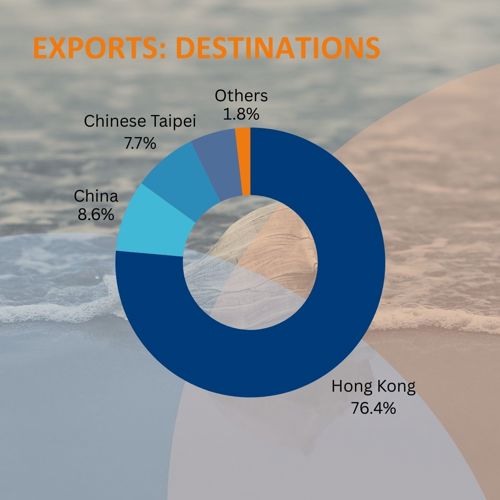
In 2024, Japan exported ¥4.94 billion in Coral and Shells, making it the 1,270th most exported product out of 4,864 categories in the national export basket. Despite being a niche commodity, coral and shells represent a traditional and culturally significant segment of Japan’s artisanal and luxury goods industry.
The main destinations for Japanese exports in 2024 were:
- Hong Kong – ¥3.64B
- Chinese Taipei – ¥769M
- Vietnam – ¥357M
- China – ¥251M
- South Korea – ¥38M
These figures confirm Hong Kong’s dominant role as Japan’s primary market, absorbing the vast majority of coral and shell shipments.
The fastest‑growing export markets between 2023 and 2024 were:
- Chinese Taipei – +¥90M
- Vietnam – +¥26M
- South Korea – +¥9.43M
This growth reflects expanding demand in East and Southeast Asia, particularly in sectors such as jewelry, decorative crafts, and luxury accessories.
IMPORTS
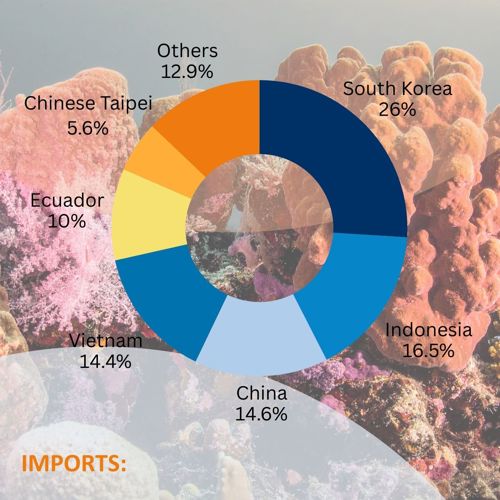
In 2024, Japan imported ¥1.04 billion of coral and shells, ranking as the 2,955th most imported product out of 5,226 categories. Although Japan is a major exporter, it still relies on foreign suppliers for specific raw materials.
The main origins of Japan’s imports were:
- South Korea – ¥253M
- China – ¥209M
- Vietnam – ¥182M
- Indonesia – ¥144M
- Ecuador – ¥131M
The fastest‑growing import origins between 2023 and 2024 were:
- China – +¥41.4M
- Vietnam – +¥30.9M
- Ecuador – +¥26.3M
These trends highlight increasing regional trade integration and Japan’s reliance on Asian and Latin American suppliers.
OVERVIEW (October 2025)
In October 2025, Japan exported ¥332M and imported ¥98.4M of coral and shells, generating a positive trade balance of ¥233M.
Between September and October 2025:
- Exports increased by ¥257M (+344%), from ¥74.8M to ¥332M
- Imports increased by ¥20.7M (+26.6%), from ¥77.7M to ¥98.4M
This sharp monthly rise indicates a strong seasonal or market‑driven spike in demand.
CONCLUSIONS
Japan’s corals and shells trade highlights a blend of cultural tradition and strong regional market integration. As the world’s leading exporter, the country continues to supply high‑value markets, especially Hong Kong and Chinese Taipei, while maintaining a solid trade surplus in this niche sector.
At the same time, the industry operates within a sensitive regulatory landscape shaped by sustainability requirements and CITES restrictions, which influence both sourcing and export dynamics. Import trends show Japan’s reliance on neighboring Asian suppliers, reinforcing the interconnected nature of the regional supply chain.
Overall, Japan’s position in the coral and shells market remains robust, but future growth will depend on balancing commercial opportunities with responsible resource management and evolving environmental standards.