PRODUCT CLASSIFICATION
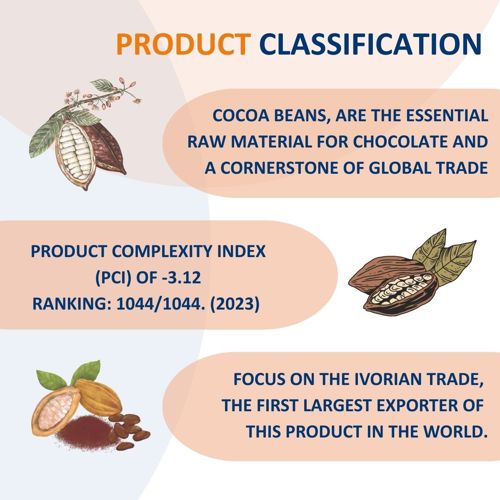
Cocoa beans are the dried and fully fermented seeds of Theobroma cacao, valued worldwide for their role as the primary ingredient in chocolate and a wide range of confectionery products. Known for their rich flavor profile, versatility, and nutritional components such as flavonoids and theobromine, cocoa beans are consumed indirectly through processed goods like cocoa liquor, cocoa butter, and cocoa powder, which are essential in food, beverage, and cosmetic industries.
They are fundamental to global food cultures, from artisanal chocolate makers to large-scale confectionery corporations, and their cultivation supports millions of smallholder farmers across tropical regions. Cocoa farming contributes significantly to rural development and international trade, particularly in West Africa, where it is a cornerstone of national economies.
Cocoa beans belong to the category Cocoa and cocoa preparations, within the broader Vegetable Product section, which includes related by-products such as Cocoa Beans (Whole/Broken, Raw/Roasted), Cocoa Powder (Sweetened/Unsweetened), Cocoa Paste, and Cocoa Butter. This classification reflects the diverse forms in which cocoa enters global markets.
They also have a Product Complexity Index of -2.01, ranking 961 out of 1044 products in 2023, highlighting their relatively low complexity compared to other traded goods but immense importance in terms of volume and value.
This post will not consider the cocoa trade in general, but it will be focused on the Ivorian market, the world’s largest exporter of this product.
COCOA TRADE IN CÔTE D’IVOIRE
Côte d’Ivoire is the leading global exporter of cocoa beans, with exports valued at $5.33 billion in 2023, representing 66.8% of the country’s total cocoa bean exports. Cocoa beans are the nation’s top export product, underscoring their central role in the Ivorian economy.
The main destinations for Ivorian cocoa beans are:
- the Netherlands ($1.44B),
- the United States ($1.05B),
- Malaysia ($1.01B),
- France ($426M),
- Germany ($362M).
These figures highlight the dominance of European and Asian markets in absorbing Côte d’Ivoire’s cocoa supply.
On the import side, Côte d’Ivoire sources cocoa beans primarily from:
- Ghana ($2.01M),
- Togo ($1.62M),
- Nigeria ($1.25M)
Though imports are minimal compared to exports.
Cocoa beans are not only the country’s largest export but also a driver of bilateral trade relationships. For example, cocoa beans account for 17.9% of Côte d’Ivoire’s exports to the United States and 38.7% of exports to the Netherlands, reflecting their strategic importance in trade balances.
EXPORT
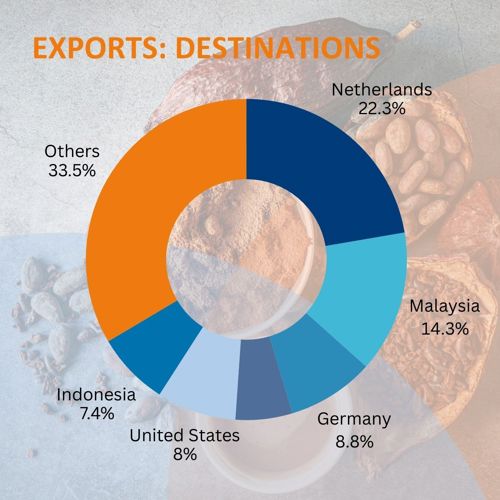
In 2023, Côte d’Ivoire shipped out $3.68 billion worth of cocoa beans, securing its position as the world’s leading supplier among 134 exporting nations. Within the country’s export portfolio, cocoa beans ranked as the second most significant product out of 989, underscoring their central role in the national economy.
The largest buyers of Ivorian cocoa beans during that year were:
- The Netherlands ($757M),
- Malaysia ($409M),
- Belgium ($388M),
- The United States ($368M),
- Germany ($246M).
These destinations highlight the strong demand from both European and Asian markets.
Between 2022 and 2023, the most dynamic growth in demand came from:
- The Netherlands (up $146M),
- Indonesia (up $45M),
- Turkey (up $43.6M),
Reflecting shifting trade flows and expanding consumption in new regions.
IMPORT
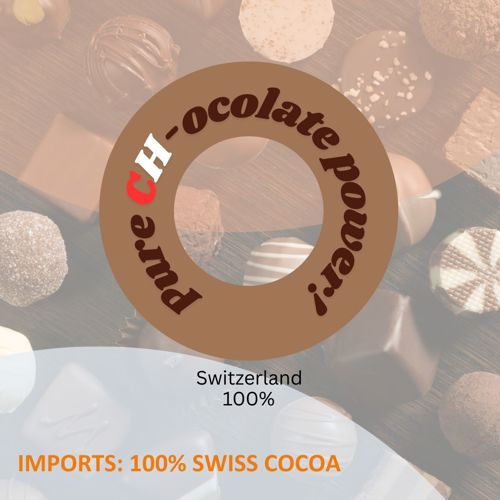
In 2023, Côte d’Ivoire brought in a very small volume of cocoa beans, valued at just $2.15 thousand. This placed the country as the 122nd largest importer out of 159 nations worldwide. Within Côte d’Ivoire’s overall import basket, cocoa beans ranked extremely low, coming in as the 1,082nd most imported product out of 1,138.
The limited imports were sourced almost entirely from Switzerland ($2.15k), highlighting that while Côte d’Ivoire dominates global exports, its role as an importer of cocoa beans is negligible.
CONCLUSIONS
In 2023, Côte d’Ivoire’s cocoa bean trade reinforced the country’s position as the world’s leading supplier. With favorable growing conditions and a long-standing tradition of cultivation, cocoa has become the backbone of the nation’s agricultural exports and a defining feature of its international trade profile.
This achievement reflects Côte d’Ivoire’s ability to connect global demand with local resources, strengthening its role in the global cocoa market. Such dominance not only highlights the country’s current success but also provides a foundation for future growth, particularly if more value is captured through local processing and diversification.