PRODUCT CLASSIFICATION
Chewing gum occupies a distinct niche within the global confectionery industry. Despite its simplicity, it represents a long‑standing consumer good shaped by evolving tastes, health trends, and branding strategies. Traditional sugar‑based gum remains a staple in many markets, valued for its flavor variety, affordability and impulse‑purchase appeal. The category competes not through technological sophistication but through marketing, distribution, and continuous innovation in taste and texture.
In 2023, global trade in this category reached $1.13B, marking a 13.7% increase from 2022, when trade totaled $992M. Over the past five years, the segment has grown at an annualized rate of 3.05%, reflecting stable global demand despite rising competition from sugar‑free alternatives.
Among the 5,380 products traded worldwide in 2023, chewing gum containing sugar ranked 2,137th in global trade value, accounting for less than 0.005% of world trade. According to the Product Complexity Index (PCI), it placed 2,653rd out of 3,127 products, with a PCI score of –1.14, indicating a low‑complexity manufactured good. This aligns with the standardized nature of gum production, even though brand equity, flavor innovation, and retail positioning remain crucial competitive drivers.
EXPORT
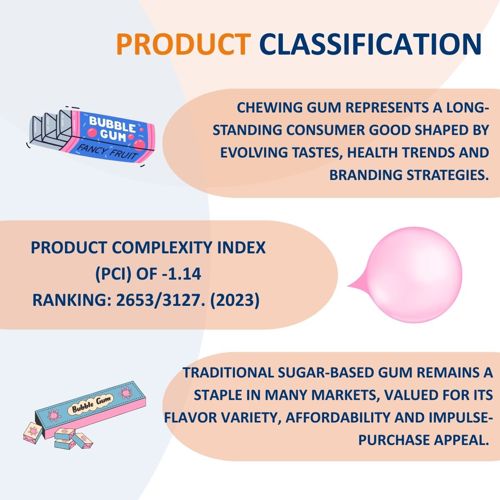
In 2023, the leading exporters of chewing gum were:
- China – $120M
- Mexico – $89.2M
- Canada – $74.8M
China dominates global exports thanks to its large‑scale, cost‑efficient confectionery manufacturing, enabling competitive pricing and wide market reach. Mexico benefits from strong integration with the North American market, while Canada leverages a well‑established confectionery industry with consistent export capacity.
The top importers in 2023 were:
- United States – $135M
- United Arab Emirates – $75.4M
- Kuwait – $49M
The United States stands as the largest destination market, driven by high consumer demand and extensive retail distribution. The United Arab Emirates and Kuwait act as both high‑consumption markets and regional re‑export hubs within the Gulf.
Chewing gum containing sugar falls under the Foodstuffs section, specifically within HS2 Sugars & Confectioneries, under the HS4 Confectionery Sugar heading, reflecting its classification as a low‑complexity processed food product with steady global trade flows.
IMPORT
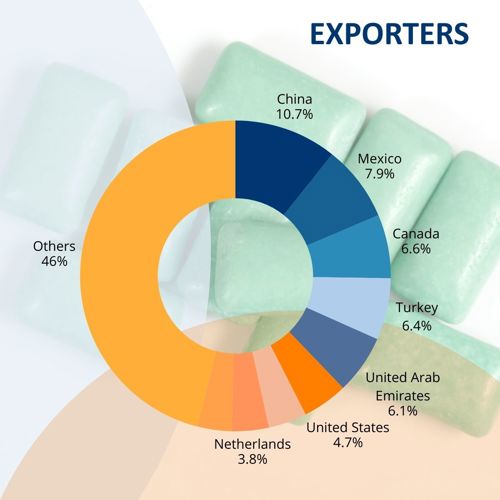
In 2023, the main importers of chewing gum were:
- United States – $135M
- United Arab Emirates – $75.4M
- Kuwait – $49M
The United States stands as the world’s largest importer, reflecting strong domestic demand for confectionery products and a highly diversified retail market. The United Arab Emirates serves both as a high‑consumption market and a strategic re‑export hub for the Gulf region, while Kuwait shows consistently high per‑capita demand for packaged sweets, making it a significant importer relative to its population size.
Countries where chewing gum containing sugar represents a notable share of imports tend to be concentrated in regions with limited domestic confectionery production and strong reliance on imported consumer goods. Although the product accounts for a small fraction of overall trade, its steady inflows highlight its role as a fast‑moving consumer good with stable demand patterns.
CURIOSITY CORNER: Chewing Gum
Chewing gum has a surprisingly ancient and multicultural history. Long before modern confectionery existed, civilizations around the world were already chewing natural resins: the ancient Greeks enjoyed mastiche from the mastic tree, while the Maya and Aztecs chewed chicle, a sap from the sapodilla tree. These early gums were used not only for enjoyment, but also for cleaning teeth and freshening breath.
The modern chewing‑gum industry took shape in the late 19th century, when chicle was imported into the United States and transformed into flavored, sweetened gum. Interestingly, the shift from natural chicle to synthetic gum bases in the mid‑20th century was driven by supply shortages and the need for more consistent textures, making today’s gum a product of both chemistry and consumer preference.
Branding has always played a central role: iconic shapes like sticks, pellets, and coated dragees were introduced to differentiate products and improve shelf stability. Sugar‑free gum later reshaped the market, but sugar‑based gum remains a global staple thanks to its affordability and nostalgic appeal.
A lesser‑known curiosity is that chewing gum has been used in space. NASA included gum in astronaut rations during early missions because it helped relieve pressure in the ears during launch and landing. Even today, gum continues to evolve, with innovations ranging from biodegradable gum bases to functional gums enriched with vitamins or caffeine, showing that even a simple chew can have a surprisingly dynamic story.
CONCLUSIONS
Chewing gum remains a small but steady segment of global trade. Production is concentrated in competitive manufacturing hubs like China and Mexico, while demand is strongest in large consumer markets such as the United States and in high‑consumption Gulf countries.
Despite its low complexity, the product continues to perform well thanks to strong branding, impulse‑driven purchasing, and cultural familiarity. Looking ahead, shifts toward natural ingredients and more sustainable gum bases may gradually reshape this traditional confectionery category.