
OVERVIEW
Australia stands as one of the most resource‑rich, internationally connected, and export‑driven economies in the Asia–Pacific region. With a GDP of $1.76T in 2024, the country ranks as the 14th largest economy globally, the 20th in total exports, and an impressive 15th in GDP per capita.
In December 2025, Australia recorded:
- Exports: $47.4B
- Imports: $40B
- Trade balance: +$7.4B
Compared to December 2024, exports grew by 2.99%, while imports increased more sharply by 8.42%, reflecting rising domestic demand for consumer goods, machinery, and vehicles.
Australia’s economic profile is defined by its abundance of natural resources, strategic Indo‑Pacific location, and deep trade relationships with East Asian economies, especially China, Japan, and South Korea.
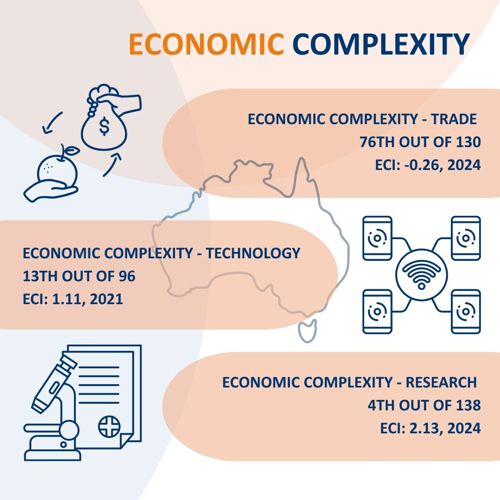
ECONOMIC PROFILE AND COMPLEXITY
Australia’s economy is highly specialized in:
- mining and energy commodities,
- agricultural products,
- metals and minerals,
- and increasingly, high‑value services such as education and financial services.
The mining sector, particularly iron ore, coal, gold, and natural gas, continues to anchor Australian exports. At the same time, growing technology imports highlight the country’s reliance on global supply chains for electronics, vehicles, and digital equipment.
State‑level dynamics remain central: Western Australia dominates mining exports, while New South Wales and Victoria drive consumer imports and service‑sector activity.
EXPORTS
In 2024, Australia exported $360B, ranking as the 20th largest exporter in the world. Over the past five years, exports increased by $63.8B, from $296B in 2019.
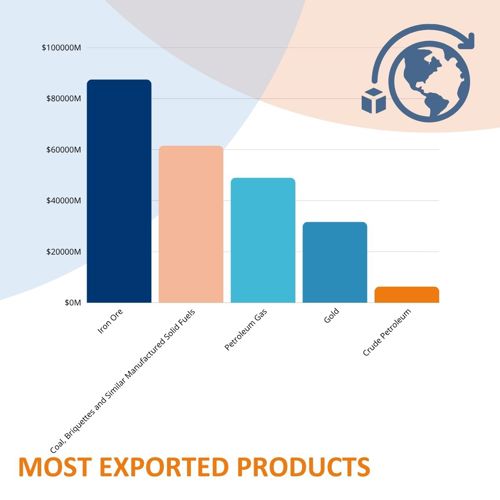
Top Export Products (2024)
- Iron Ore – $87.5B
- Coal, Briquettes & Similar Fuels – $61.6B
- Petroleum Gas – $49B
- Gold – $31.7B
- Crude Petroleum – $6.33B
These products highlight Australia’s role as a global resource powerhouse, with commodities feeding industrial supply chains across Asia.
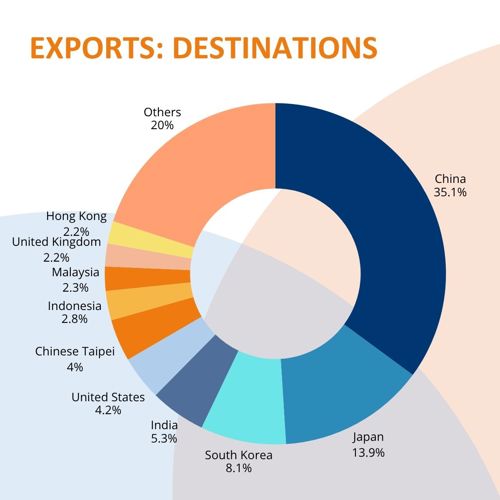
Top Export Destinations (2024)
- China – $126B
- Japan – $49.9B
- South Korea – $29.2B
- India – $18.9B
- United States – $15.2B
Monthly Export Highlights (Dec 2025)
Exports were mainly driven by:
- Western Australia – $20.7B
- Queensland – $10.1B
- New South Wales – $9.51B
Top markets in December 2025:
- China – $17.3B
- Japan – $5.2B
- South Korea – $3.95B
- Channel Islands – $2.64B
- United States – $2.19B
Export Growth Drivers (Dec 2025)
Significant increases came from:
- Channel Islands (+364%)
- Hong Kong (+130%)
- China (+5.3%)
These growth dynamics highlight Australia’s expanding role in both traditional commodity trade and financial‑linked gold flows.
IMPORTS
In 2024, Australia imported $287B, ranking as the 25th largest importer globally. Over the last five years, imports increased by $65.7B, rising from $221B in 2019.
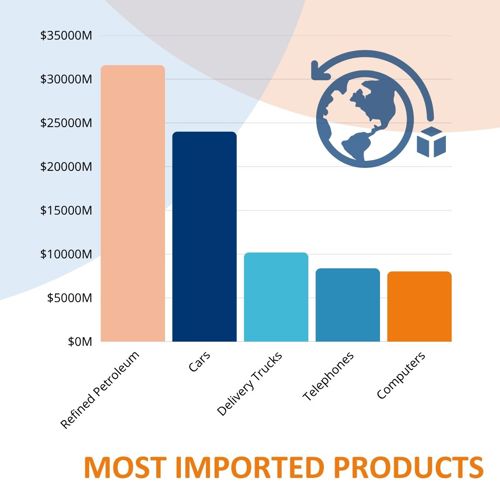
Top Import Products (2024)
- Refined Petroleum – $31.6B
- Cars – $24B
- Delivery Trucks – $10.2B
- Telephones – $8.38B
- Computers – $8.04B
These reflect Australia’s dependency on foreign‑produced vehicles, technology, and refined fuels.
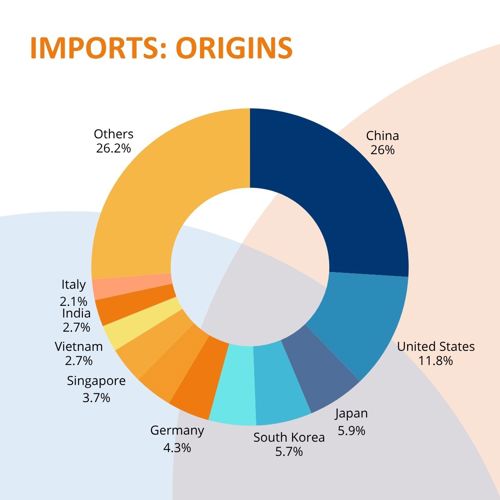
Top Import Origins (2024)
- China – $74.5B
- United States – $33.9B
- Japan – $16.8B
- South Korea – $16.4B
- Thailand – $13.9B
Monthly Import Highlights (Dec 2025)
Imports were concentrated in:
- New South Wales – $15.7B
- Victoria – $10.7B
- Queensland – $6.19B
Main suppliers in December 2025:
- China – $11.3B
- United States – $3.79B
- Thailand – $2.17B
Import Growth (Dec 2025)
Sharp increases came from:
- China (+25.7%)
- Thailand (+28.9%)
- Vietnam (+36.3%)
These trends reinforce Australia’s growing integration into Asia’s consumer electronics, automotive, and machinery supply chains.
TRADE BALANCE
In 2024, the countries generating the highest Australian trade surpluses were:
- China – +$51.7B
- Japan – +$33B
- South Korea – +$12.8B
- India – +$11.1B
- Chinese Taipei – +$8.33B
Countries with the largest trade deficits were:
- United States – –$18.7B
- Germany – –$8.75B
- Thailand – –$8.58B
- Italy – –$5.45B
- France – –$3.32B
The strong surpluses with East Asian markets reaffirm Australia’s dependence on resource‑driven trade, while deficits reflect its reliance on high‑value manufactured imports.
CURIOSITY CORNER
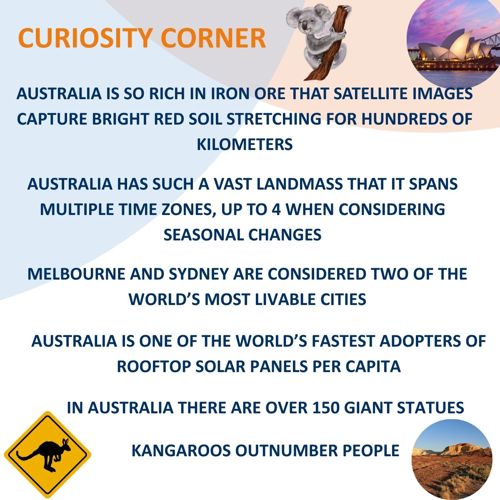
1. A Country That Rides on Iron Ore
Australia’s Pilbara region is so rich in iron ore that satellite images capture bright red soil stretching for hundreds of kilometers. The mines there are so large that many transport trucks are completely autonomous, self‑driving vehicles controlled remotely from operations centers in Perth.
2. A Time Zone Giant
Australia has such a vast landmass that it spans multiple time zones, up to four when considering seasonal changes. This makes Australia a strategic connector between global markets operating in Asia, Europe, and the U.S. on the same business day.
3. The World’s Most Livable Cities
Melbourne and Sydney frequently top rankings of the world’s most livable cities, attracting talent from across the globe and supporting Australia’s high-skilled workforce and service‑export strength (education, finance, creative industries).
4. A Renewable Energy Pioneer
Australia is one of the world’s fastest adopters of rooftop solar panels per capita. In some suburbs, more than 1 in 3 households produces their own electricity, boosting energy resilience and lowering costs for small businesses.
5. Home to “The Big Things”
Australia is famous for its quirky roadside monuments, over 150 giant statues like the Big Banana or the Big Merino. Surprisingly, these oversized landmarks boost local tourism economies, attracting travelers on long interstate routes.
6. Kangaroos Outnumber People
Australia has roughly twice as many kangaroos as humans, an iconic part of the country's identity and tourism economy.
CONCLUSION
Australia’s economic strength lies in its combination of natural resources, stable governance, and strong connectivity to Asia’s industrial and consumer markets. Its role as a global supplier of iron ore, coal, gold, and natural gas continues to shape its trade performance, while rising technology and vehicle imports highlight evolving consumer and industrial needs.
With persistent trade surpluses, expanding export markets, and growing investment in renewable energy and advanced services, Australia remains a key player in global supply chains and a strategic market in the Indo‑Pacific region.