AI in Global Business Risk Assessment: how automation transforms decision-making
What is AI in risk management?
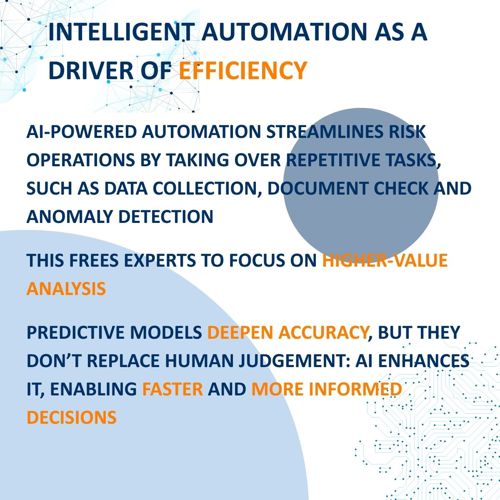
AI in risk management involves applying artificial intelligence technologies, such as machine learning models, generative AI (including LLMs), and robotic process automation to streamline, customize and improve how risks are detected and addressed. By incorporating AI into risk-related activities, teams can better anticipate potential problems, respond more efficiently, make quicker decisions, allocate resources more effectively and strengthen overall confidence in their risk management approach.
Risk assessment in global business is undergoing a structural transformation driven by advances in artificial intelligence. Increasing operational complexity, regulatory pressure, and the accelerating pace at which new risks emerge require tools capable of surpassing the limitations of manual processes. AI‑based technologies are replacing fragmented models and retrospective analyses with integrated, dynamic systems capable of learning in real time.
A New Operating Model for Risk Management
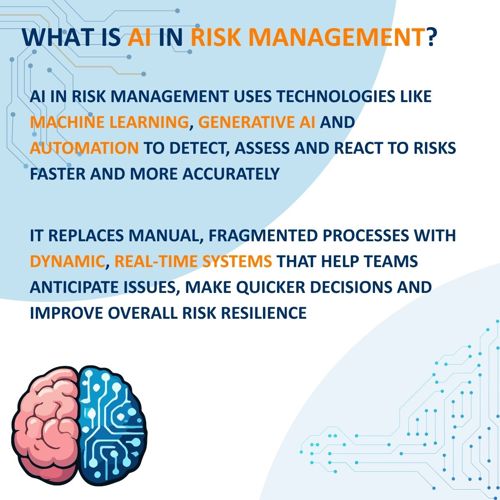
Risk management functions are shifting away from approaches based on repetitive activities and heavily manual data production, moving instead toward a more targeted decision‑making model. AI enables the consolidation of information flows from heterogeneous sources, the detection of weak signals before they escalate into critical issues and the generation of immediate insights in contexts marked by volatility and rapid change.
This transformation affects not only the speed of analysis but also its nature. Intelligent systems support continuous monitoring of risks, the anticipation of future scenarios, and the optimization of resource allocation. This shift toward more proactive management enhances decision consistency and strengthens the organization’s ability to respond swiftly to both internal and external pressures.
Intelligent Automation as a Driver of Efficiency
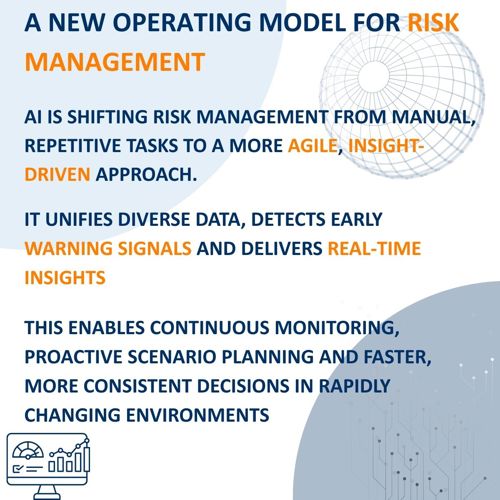
AI‑driven automation is reshaping operational processes within risk functions. Advanced automation solutions handle repetitive tasks such as data collection, document monitoring, information verification, and the automatic categorization of anomalies. This reduces processing time and frees analytical capacity for higher‑value strategic activities.
At the same time, predictive models help identify recurring patterns, interpret unstructured signals, and evaluate the reliability of economic actors with a level of depth that traditional tools cannot achieve. The adoption of these technologies does not replace human expertise; instead, it enhances it by enabling experts to focus on interpreting results and defining strategic responses.
An Integrated Ecosystem of Technologies
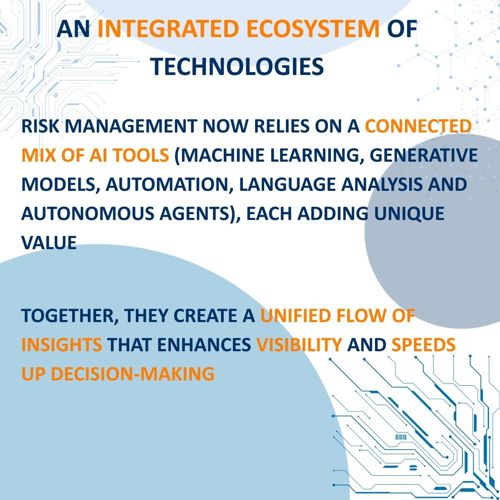
Modern risk management does not rely on a single technology but rather on a comprehensive ecosystem that includes machine learning, generative models, robotic process automation, linguistic analysis tools and autonomous agents. Each component contributes a specific capability, enabling a more complete, coherent, and multidimensional assessment.
Predictive models enhance the ability to anticipate developments, automated systems ensure operational continuity, and textual analysis tools extract value from documents, news flows, and unstructured information. Integrating these elements creates a unified information flow that improves overall risk visibility and accelerates the decision-making process.
An End-to-End Approach to Risk Assessment
Digital transformation is pushing organizations toward risk assessment models that span the entire lifecycle, from identification to management, from measurement to internal communication. AI connects the different stages, overcoming the fragmentation typical of traditional systems.
This integration supports a systemic vision of risk: no longer a series of isolated events, but a continuous flow of interdependencies that can be observed, analyzed and anticipated in a coherent manner. Automation accelerates the transition from data to decisions, while algorithms increase the robustness, reliability, and reproducibility of assessments.
Implications for Global Business Risk Assessment
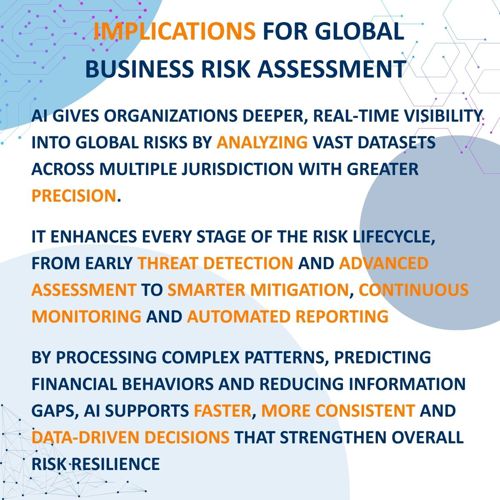
The use of AI in global business risk assessment enables organizations to gain a deeper and more granular understanding of their exposure. Access to real‑time information from multiple jurisdictions makes it possible to analyze business risk with greater precision than traditional models allow.
Specifically, AI supports the entire risk management lifecycle by enhancing each stage with specific capabilities tailored to the nature of the task. In the earliest phase, risk identification benefits from predictive analytics models that analyze historical patterns to uncover potential threats before they surface. Machine learning systems build on this by learning from past incidents, allowing them to recognize early signals of emerging risks that might otherwise go unnoticed.
As organizations move into risk assessment, AI expands the depth and precision of analysis. Natural Language Processing enables automated review of documents, regulatory texts and reports, extracting relevant insights to determine the level and nature of exposure. Generative AI builds on these inputs by creating simulated scenarios, helping teams explore how different conditions might influence potential outcomes. Autonomous AI agents continuously monitor relevant internal and external factors, ensuring that assessment remains up‑to‑date as conditions evolve.
During the mitigation phase, automation becomes a key ally. Robotic Process Automation handles repetitive, operational tasks that would otherwise consume considerable time, giving risk teams more bandwidth for strategic planning. AI‑driven workflows further strengthen coordination by connecting departments and orchestrating activities required to implement mitigation strategies promptly and consistently.
In the monitoring phase, AI provides real‑time visibility into how risks develop through dynamic dashboards that track critical metrics and indicators. Conversational AI tools support ongoing engagement with stakeholders, gathering input that helps refine risk profiles and ensure that monitoring reflects the most current information available.
Finally, in the reporting phase, AI-powered SaaS platforms generate automated summaries highlighting the most significant areas of exposure. Advanced data visualization tools transform complex datasets into clear, interpretable visuals that make risk reports easier to understand and communicate across the organization.
Through this integrated progression, AI enhances every moment of the risk management lifecycle, supporting faster reactions, sharper insights, and more informed strategic decisions.
AI technologies support:
- the immediate processing of large volumes of global data,
- the detection of complex patterns,
- predictive evaluation of financial soundness and payment behavior,
- continuous monitoring of emerging risks across geographies,
- a reduction in information asymmetries during decision‑making.
These capabilities contribute to faster, more informed, and analytically grounded decisions.
Benefits, risks and challenges of applying AI to risk management
The adoption of AI in risk management introduces a powerful combination of advantages, concerns and organizational challenges that must be addressed in a balanced and thoughtful way.
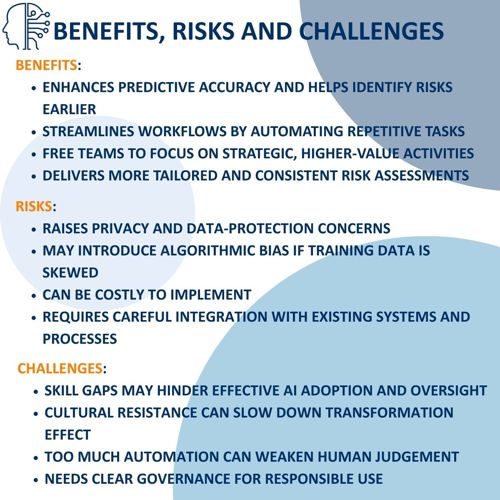
On the benefits side, AI enhances decision-making by rapidly processing vast quantities of data and transforming them into actionable insights. It strengthens predictive capabilities, allowing organizations to detect potential threats before they escalate, optimize resource allocation and operate with greater strategic foresight. Automation also plays a significant role in improving efficiency: by delegating repetitive or manual tasks to intelligent systems, risk teams can focus on higher‑value activities, increasing overall productivity and ensuring more accurate and consistent assessments. Furthermore, AI enables more personalized approaches by adapting risk evaluation models to the specific characteristics, context and needs of each organization.
However, these benefits coexist with a series of risks that require careful governance. The use of large datasets raises legitimate concerns about privacy and data protection, making it essential to ensure robust security controls and responsible handling of sensitive information. Another challenge lies in the potential for algorithmic bias, where models trained on historical data may inadvertently reproduce distortions or unfair patterns. Maintaining a human presence in the decision-making loop is also crucial, as excessive reliance on automated systems can diminish the nuance, empathy, and contextual judgment that experts bring to risk evaluation. Financial considerations play a role as well: advanced AI solutions can be costly to implement, particularly for smaller organizations, and require clear prioritization and scalable approaches. Integration complexity represents an additional hurdle, as AI systems may not align seamlessly with existing infrastructures, requiring thoughtful planning and phased deployment to avoid operational disruptions.
Beyond technical and structural risks, organizations also face cultural and capability-related challenges. Skill gaps can emerge when teams lack the expertise needed to design, operate, and supervise AI systems. Resistance to change may slow adoption, as employees may perceive AI as a threat rather than an enabler. Overcoming these barriers demands continuous training, transparent communication, and an organizational culture that encourages innovation while reinforcing the role of human expertise. When these aspects are managed effectively, AI becomes not only a technological enhancement but a strategic catalyst supporting agile, anticipatory, and well-informed risk management practices across the entire enterprise.
Conclusion
The adoption of AI in global business risk assessment represents a fundamental evolution in organizations’ ability to understand and anticipate complex dynamics. Intelligent automation, predictive modeling, and end‑to‑end process integration enable smoother and more effective risk management. In an increasingly interconnected economic environment, these technologies become indispensable strategic levers for making rapid, reliable, and data‑driven decisions on a global scale.
Source: AI in Risk Management: The Executive Guide to Opportunities, Challenges & Use Cases , Risk Modernization | AI is revolutionizing risk management